115195
论文已发表
注册即可获取德孚的最新动态
IF 收录期刊
- 3.6 Breast Cancer (Dove Med Press)
- 4.3 Clin Epidemiol
- 2.6 Cancer Manag Res
- 3.2 Infect Drug Resist
- 4.1 Clin Interv Aging
- 6.1 Drug Des Dev Ther
- 4.1 Int J Chronic Obstr
- 8.7 Int J Nanomed
- 2.5 Int J Women's Health
- 3.2 Neuropsych Dis Treat
- 2.4 OncoTargets Ther
- 2.6 Patient Prefer Adher
- 2.6 Ther Clin Risk Manag
- 3.1 J Pain Res
- 3.5 Diabet Metab Synd Ob
- 4.5 Psychol Res Behav Ma
- 3.4 Nat Sci Sleep
- 2.4 Pharmgenomics Pers Med
- 2.6 Risk Manag Healthc Policy
- 4.6 J Inflamm Res
- 2.3 Int J Gen Med
- 3.9 J Hepatocell Carcinoma
- 3.3 J Asthma Allergy
- 2.5 Clin Cosmet Investig Dermatol
- 3.0 J Multidiscip Healthc

局部晚期鼻咽癌的阶段特异性同步放化疗联合或不联合诱导化疗:一项基于人群的回顾性研究
Authors Xia WX, Liang H, Lv X, Wang L, Ye YF, Ke LR, Xu LH, Guo X, Xiang YQ
Received 4 July 2018
Accepted for publication 1 February 2019
Published 20 November 2019 Volume 2019:11 Pages 9813—9827
DOI https://doi.org/10.2147/CMAR.S179139
Checked for plagiarism Yes
Review by Single-blind
Peer reviewers approved by Dr Andrew Yee
Peer reviewer comments 2
Editor who approved publication: Dr Beicheng Sun
Purpose: This large population-based analysis aims to investigate whether the additional induction chemotherapy to concurrent chemoradiotherapy improved overall survival (OS) and disease-free survival (DFS) for locoregionally advanced nasopharyngeal carcinoma (LRANPC).
Patients and Methods: The study group comprised 3,980 patients who were treated either with IC+CCRT (1,888 patients) or CCRT alone (2,092 patients) between January 1998 and June 2013. Survival outcomes were compared using Cox proportional hazards regression models with adjustments for confounding provided by propensity score methods. Primary outcome variables included OS and DFS.
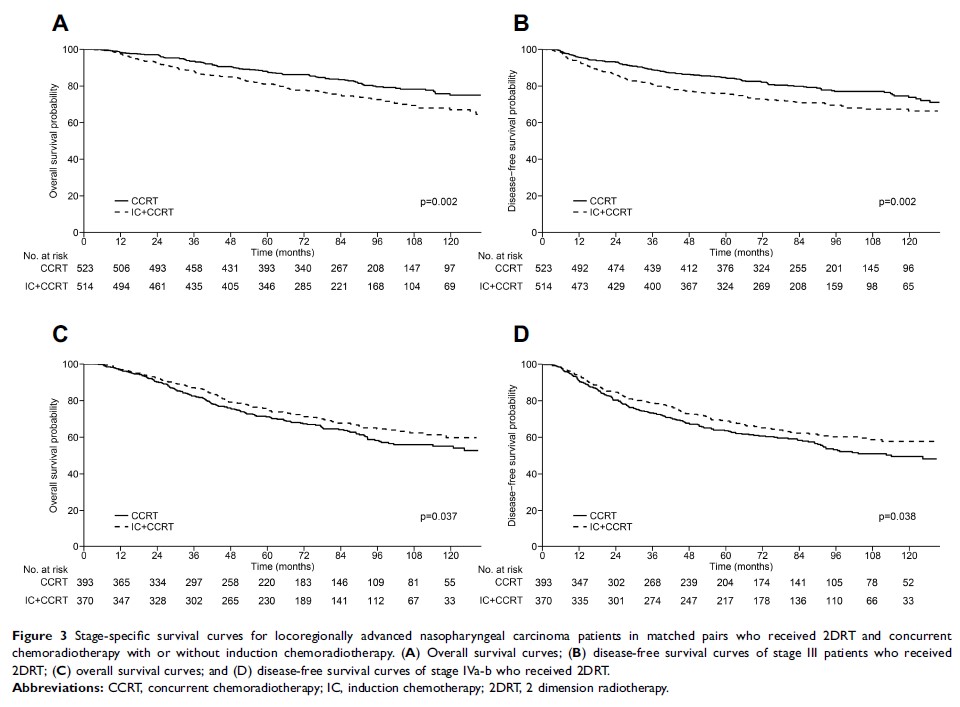
Results: Kaplan–Meier analysis showed that CCRT and IC+CCRT were of similar benefit to OS (P =0.099), whereas there was a marginal benefit of CCRT to DFS (P =0.063) in the overall cohort, which showed no differences between the two treatment regimens using multivariate Cox analysis and propensity score. Interestingly, for patients with 2D radiationtherapy (2DRT), CCRT had OS and DFS benefits for stage III, with 5-year and 10-year OS for CCRT vs IC+CCRT being 88% and 75% vs 81% and 67%, respectively (P =0.002); 5-year and 10-year DFS for CCRT vs IC+CCRT being 84% and 74% vs 76% and 66%, respectively (P =0.002). In contrast, IC + CCRT had OS and DFS benefits for stage IVa-b, with 5-year and 10-year OS for CCRT vs IC+CCRT being 71% and 55% vs 76% and 60%, respectively (P =0.037, HR=0.786); 5-year and 10-year DFS for CCRT vs IC+CCRT were 64% and 50% vs 69% and 58%, respectively (P =0.038, HR=0.801). No difference was found in intensity-modulated radiotherapy (IMRT) subgroup.
Conclusion: Our study indicates that CCRT and IC+CCRT may have similar OS and DFS benefits for overall LRANPC. Stage-specific chemoradiotherapy may be administered based on the greatest benefit of IC+CCRT for stage IVa-b patients and CCRT alone for stage III patients received 2DRT. The optimal chemotherapy pattern in combination with IMRT needs further investigation.
Trial registration: ClinicalTrials.gov ID: NCT02604472
Keywords: nasopharyngeal carcinoma, concurrent chemotherapy, radiation therapy, induction chemotherapy, prognosis, stage specific