115195
论文已发表
注册即可获取德孚的最新动态
IF 收录期刊
- 3.6 Breast Cancer (Dove Med Press)
- 4.3 Clin Epidemiol
- 2.6 Cancer Manag Res
- 3.2 Infect Drug Resist
- 4.1 Clin Interv Aging
- 6.1 Drug Des Dev Ther
- 4.1 Int J Chronic Obstr
- 8.7 Int J Nanomed
- 2.5 Int J Women's Health
- 3.2 Neuropsych Dis Treat
- 2.4 OncoTargets Ther
- 2.6 Patient Prefer Adher
- 2.6 Ther Clin Risk Manag
- 3.1 J Pain Res
- 3.5 Diabet Metab Synd Ob
- 4.5 Psychol Res Behav Ma
- 3.4 Nat Sci Sleep
- 2.4 Pharmgenomics Pers Med
- 2.6 Risk Manag Healthc Policy
- 4.6 J Inflamm Res
- 2.3 Int J Gen Med
- 3.9 J Hepatocell Carcinoma
- 3.3 J Asthma Allergy
- 2.5 Clin Cosmet Investig Dermatol
- 3.0 J Multidiscip Healthc

AOM/DSS 诱导的结直肠癌小鼠的黑根霉胞外多糖代谢组学变异
Authors Lu Y, Wang J, Ji Y, Chen K
Received 8 August 2019
Accepted for publication 4 November 2019
Published 20 November 2019 Volume 2019:12 Pages 10023—10033
DOI https://doi.org/10.2147/OTT.S226451
Checked for plagiarism Yes
Review by Single-blind
Peer reviewers approved by Ms Shreya Arora
Peer reviewer comments 2
Editor who approved publication: Dr Leo Jen-Liang Su
Background: Colorectal cancer (CRC), which occurs at the junction of the rectum and sigmoid colon, is a common malignancy associated with poor prognosis and high mortality worldwide. The exopolysaccharide (EPS1-1), isolated from the fermentation broth of Rhizopus nigricans (R. nigricans ), has been reported to possess anti-CRC properties. However, the metabolic alterations caused by azoxymethane (AOM) and dextran sulfate sodium (DSS) are still unknown.
Methods: In the present study, a mice colon cancer model was established by treatment with AOM/DSS. LC-MS/MS-based metabolomics studies were performed to analyze metabolic alterations at the tissue level. Partial least squares discriminant analysis (PLS-DA) was used to identify differentially expressed metabolites.
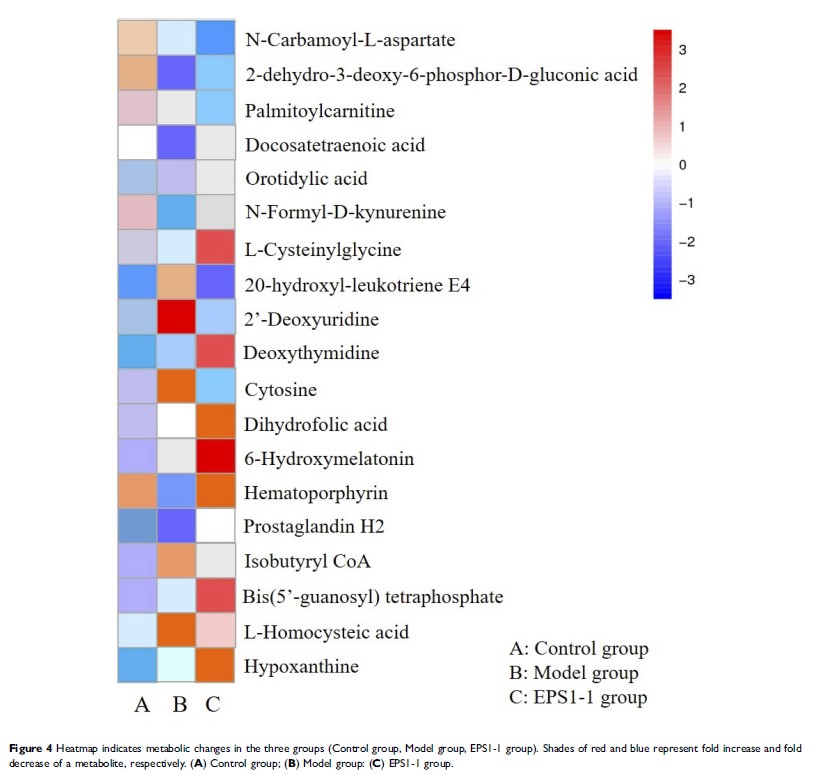
Results: Nineteen distinct metabolites were identified that were associated with disruptions in the following pathways: biosynthesis of unsaturated fatty acids, pyrimidine metabolism, phenylalanine metabolism, fatty acid metabolism, folate biosynthesis, and inositol phosphate metabolism. Furthermore, six significantly altered metabolites were involved in these six pathways. Compared with the Model group, the expression of cytosine, deoxyuridine, 20-hydroxy-leukotriene E4, and L-homocysteic acid was lower, whereas that of 2-dehydro-3-deoxy-6-phospho-D-gluconic acid and hematoporphyrin was higher in the EPS1-1 group.
Conclusion: The results of multivariate statistical analysis demonstrate a promising application of the above metabolites by EPS1-1 in CRC therapy. Deeper understanding of the related mechanism warrants further investigation.
Keywords: exopolysaccharide, Rhizopus nigricans , metabolomics, colorectal cancer, azoxymethane/dextran sulfate sodium, LC-MS/MS