117333
论文已发表
注册即可获取德孚的最新动态
IF 收录期刊
- 3.6 Breast Cancer (Dove Med Press)
- 4.3 Clin Epidemiol
- 2.6 Cancer Manag Res
- 3.2 Infect Drug Resist
- 4.1 Clin Interv Aging
- 6.1 Drug Des Dev Ther
- 4.1 Int J Chronic Obstr
- 8.7 Int J Nanomed
- 2.5 Int J Women's Health
- 3.2 Neuropsych Dis Treat
- 2.4 OncoTargets Ther
- 2.6 Patient Prefer Adher
- 2.6 Ther Clin Risk Manag
- 3.1 J Pain Res
- 3.5 Diabet Metab Synd Ob
- 4.5 Psychol Res Behav Ma
- 3.4 Nat Sci Sleep
- 2.4 Pharmgenomics Pers Med
- 2.6 Risk Manag Healthc Policy
- 4.6 J Inflamm Res
- 2.3 Int J Gen Med
- 3.9 J Hepatocell Carcinoma
- 3.3 J Asthma Allergy
- 2.5 Clin Cosmet Investig Dermatol
- 3.0 J Multidiscip Healthc

雷公藤甲素对大鼠牙齿运动和牙根吸收的影响
Authors Yang F, Wang XX, Ma D, Cui Q, Zheng DH, Liu XC, Zhang J
Received 31 May 2019
Accepted for publication 11 November 2019
Published 25 November 2019 Volume 2019:13 Pages 3963—3975
DOI https://doi.org/10.2147/DDDT.S217936
Checked for plagiarism Yes
Review by Single-blind
Peer reviewers approved by Dr Melinda Thomas
Peer reviewer comments 2
Editor who approved publication: Dr Georgios D. Panos
Purpose: The aim of this study was to investigate the effects of triptolide on the tooth movement and root resorption in rats during orthodontic treatment.
Material and methods: A total of 48 male Wistar rats were divided into three groups of 16 each. The right maxillary first molars of rats were drawn mesially by closed coil nickel–titanium spring with a force of 50 g. The two experimental groups received intraperitoneal injections of triptolide for 14 days at a dose of 15 μg/kg/day and 30 μg/kg/day, respectively. The control group received vehicle injections. After 14 days, the rats were humanely killed. The amount of tooth movement was measured. Eight rats from each group were randomly chosen for analysis of the percentage of root resorption area by scanning electron microscopy. For the remaining eight rats in each group, the H&E staining, tartrate-resistant acid phosphatase (TRAP) staining and immunohistochemistry analysis were performed.
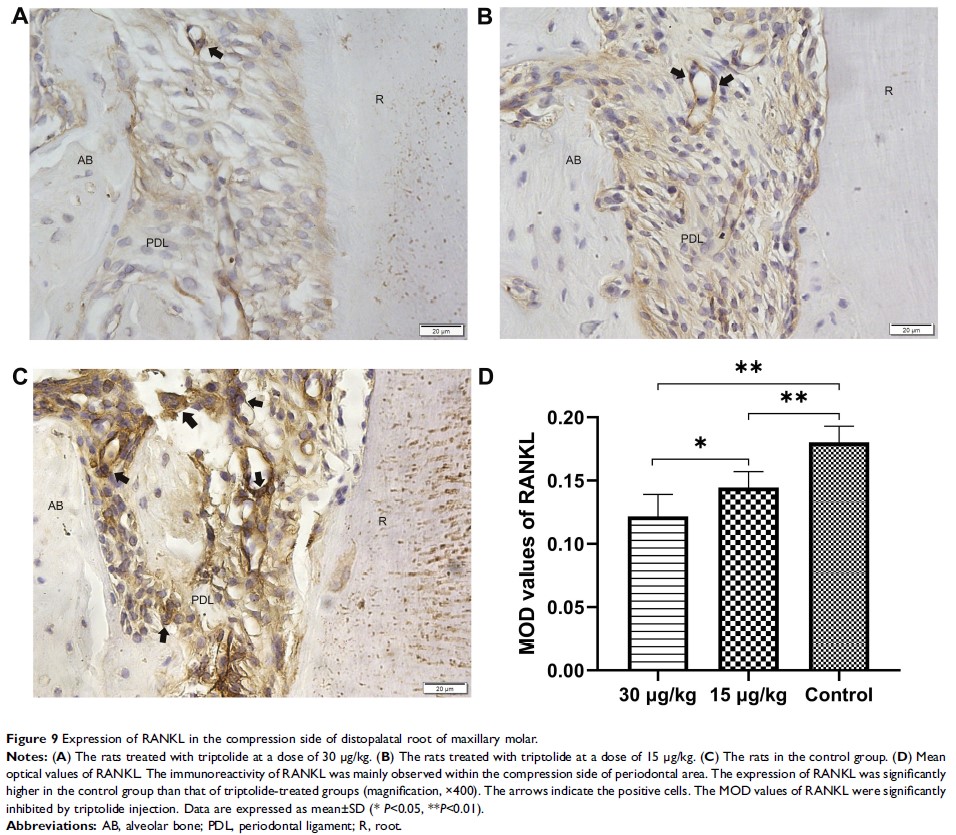
Results: The amount of tooth movement and the ratio of root resorption area were significantly decreased in the triptolide-treated rats. The number of TRAP-positive cells was significantly lower in triptolide-treated groups. Moreover, the expression of nuclear factor kappa B ligand (RANKL) was reduced. In contrast, the expression of osteoprotegerin was significantly up-regulated. In the tension side, the expressions of runt-related transcription factor 2 and osteocalcin were significantly enhanced by triptolide injection.
Conclusion: Triptolide injection could arrest orthodontic tooth movement and reduce root resorption in rats via inhibition of osteoclastogenesis. In addition, triptolide may exert a positive effect on osteoblastogenesis.
Keywords: triptolide, osteoclast, scanning electron microscope, tooth movement, bone formation