115195
论文已发表
注册即可获取德孚的最新动态
IF 收录期刊
- 3.6 Breast Cancer (Dove Med Press)
- 4.3 Clin Epidemiol
- 2.6 Cancer Manag Res
- 3.2 Infect Drug Resist
- 4.1 Clin Interv Aging
- 6.1 Drug Des Dev Ther
- 4.1 Int J Chronic Obstr
- 8.7 Int J Nanomed
- 2.5 Int J Women's Health
- 3.2 Neuropsych Dis Treat
- 2.4 OncoTargets Ther
- 2.6 Patient Prefer Adher
- 2.6 Ther Clin Risk Manag
- 3.1 J Pain Res
- 3.5 Diabet Metab Synd Ob
- 4.5 Psychol Res Behav Ma
- 3.4 Nat Sci Sleep
- 2.4 Pharmgenomics Pers Med
- 2.6 Risk Manag Healthc Policy
- 4.6 J Inflamm Res
- 2.3 Int J Gen Med
- 3.9 J Hepatocell Carcinoma
- 3.3 J Asthma Allergy
- 2.5 Clin Cosmet Investig Dermatol
- 3.0 J Multidiscip Healthc

在抗结核治疗中,新肺部肿块形成时出现的反常反应:一个病例系列和文献综述
Authors Guo T, Guo W, Song M, Ni S, Luo M, Chen P, Peng H
Received 8 April 2019
Accepted for publication 30 October 2019
Published 26 November 2019 Volume 2019:12 Pages 3677—3685
DOI https://doi.org/10.2147/IDR.S211556
Checked for plagiarism Yes
Review by Single-blind
Peer reviewers approved by Dr Colin Mak
Peer reviewer comments 2
Editor who approved publication: Dr Eric Nulens
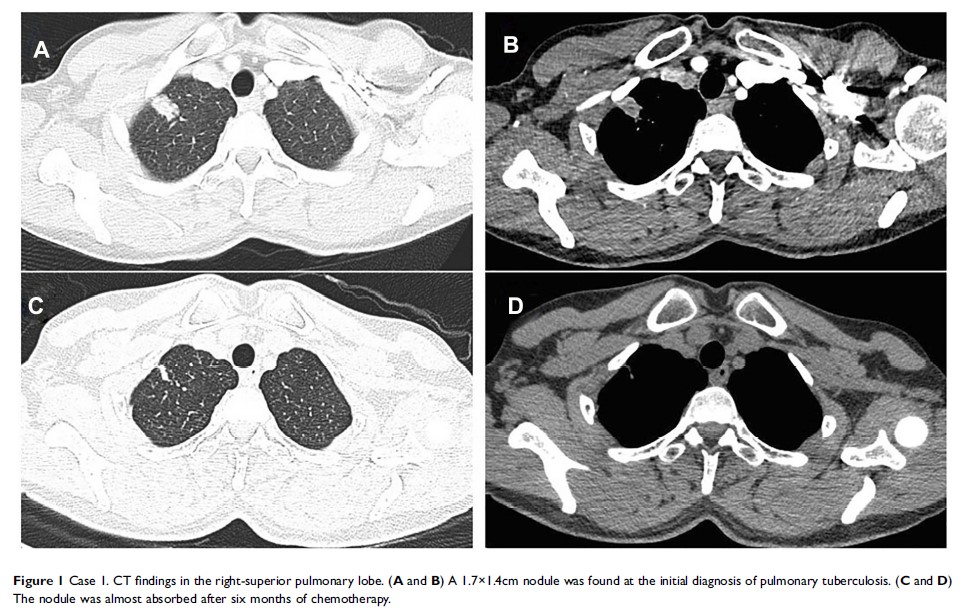
Introduction: Paradoxical reaction refers to deterioration of the original tuberculosis lesions or emergence of new infiltrative lesions during anti-tuberculosis treatment. The common manifestations of paradoxical reaction include new pleural effusion, cerebral tuberculosis and lymphadenitis. Paradoxical reaction manifested by new pulmonary mass is rare.
Patients and methods: This article summarizes and analyzes the clinical manifestations, chest CT, laboratory findings, treatments, pathological biopsy results of five patients diagnosed as paradoxical reaction in the form of new pulmonary mass. A literature review related to paradoxical reaction was conducted.
Results: Five patients diagnosed as pulmonary tuberculosis or tuberculous pleuritis received systematic anti-tuberculosis treatmensssts. New pulmonary masses were found by CT scans during the follow-ups. The patients were negative for tumor markers, examination of rheumatoid connective tissue disease and G/GM test. The original anti-tuberculosis treatments were continued. All of the masses were diminished gradually.
Conclusion: Paradoxical reaction needs to be taken into consideration when a new pulmonary mass occurs during anti-tuberculosis treatments. The diagnosis should be based on the patients’ clinical manifestations, laboratory results, imaging examinsssations and lung biopsy examinations. The original anti-tuberculosis therapy can be continued in patients without severe clinical symptoms. A close follow-up is needed.
Keywords: tuberculosis, paradoxical reaction, mass