117333
论文已发表
注册即可获取德孚的最新动态
IF 收录期刊
- 3.6 Breast Cancer (Dove Med Press)
- 4.3 Clin Epidemiol
- 2.6 Cancer Manag Res
- 3.2 Infect Drug Resist
- 4.1 Clin Interv Aging
- 6.1 Drug Des Dev Ther
- 4.1 Int J Chronic Obstr
- 8.7 Int J Nanomed
- 2.5 Int J Women's Health
- 3.2 Neuropsych Dis Treat
- 2.4 OncoTargets Ther
- 2.6 Patient Prefer Adher
- 2.6 Ther Clin Risk Manag
- 3.1 J Pain Res
- 3.5 Diabet Metab Synd Ob
- 4.5 Psychol Res Behav Ma
- 3.4 Nat Sci Sleep
- 2.4 Pharmgenomics Pers Med
- 2.6 Risk Manag Healthc Policy
- 4.6 J Inflamm Res
- 2.3 Int J Gen Med
- 3.9 J Hepatocell Carcinoma
- 3.3 J Asthma Allergy
- 2.5 Clin Cosmet Investig Dermatol
- 3.0 J Multidiscip Healthc

褪黑素通过诱导由内质网应激引发的细胞凋亡和自噬对胃癌的治疗作用
Authors Zheng Y, Tu J, Wang X, Yu Y, Li J, Jin Y, Wu J
Received 6 August 2019
Accepted for publication 4 November 2019
Published 26 November 2019 Volume 2019:12 Pages 10187—10198
DOI https://doi.org/10.2147/OTT.S226140
Checked for plagiarism Yes
Review by Single-blind
Peer reviewers approved by Ms Isha Chandra
Peer reviewer comments 2
Editor who approved publication: Dr Leo Jen-Liang Su
Background: Gastric cancer (GC) is the main malignancy affecting a large population worldwide. Lack of effective enough treatment is one of the leading factors contributing to the high mortality rate. Melatonin, a naturally occurring compound, has been proven to exert cytotoxic and antiproliferative effects on human gastric cancers. Nevertheless, the mechanisms of anti-gastric cancer of melatonin remain elucidated. It is believed that endoplasmic reticulum (ER) stress and its resultant unfolded protein response (UPR) are connected to the survival, progression, and chemoresistance of various tumor cells via multiple cellular procedures, such as autophagy. In this study, the effects of melatonin on human gastric cancer cell lines AGS and SGC-7901 was assessed to reveal the interaction between melatonin, endoplasmic reticulum stress, and autophagy in gastric cancer.
Methods: CCK-8, the wound healing analysis, colony formation assay, immunofluorescence analysis, Western blotting, flow cytometry, and animal models were used in the current study.
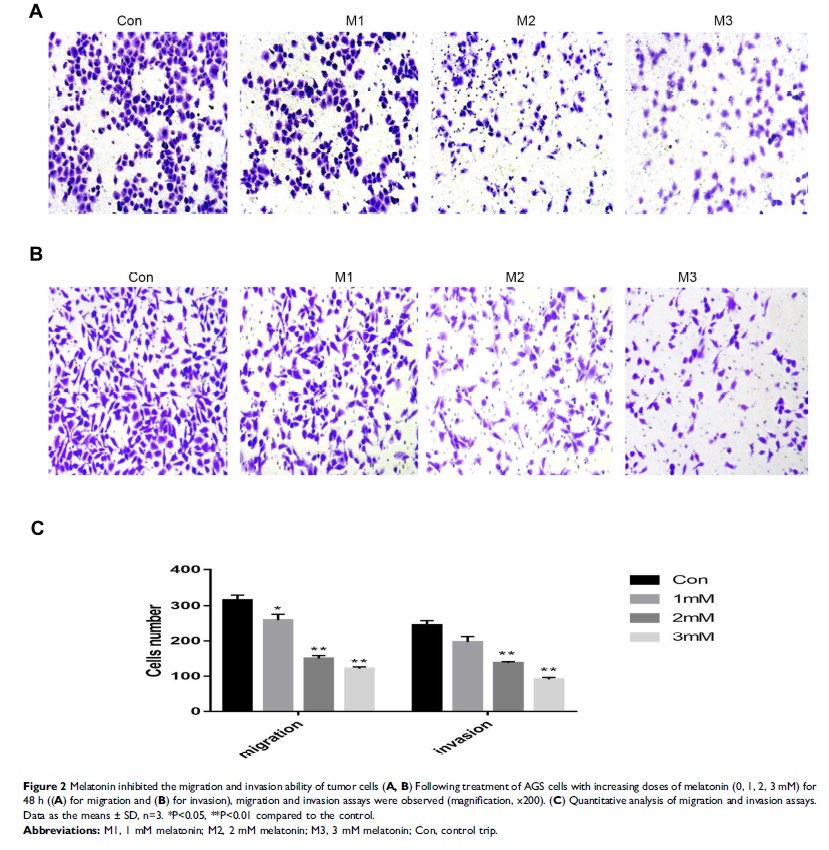
Results: The data demonstrated that melatonin could inhibit GC growth, proliferation, and invasion both in vivo and in vitro. Apoptosis and autophagy induced in a concentration-dependent manner is response to melatonin-induced ER stress. Melatonin induced the expression of apoptotic and autophagy-related proteins, which was markedly attenuated by the ER stress inhibitor 4-PBA and autophagy inhibitor 3-MA. In addition, we used the specific IRE1 inhibitor STF 083010, finding that inhibiting IRE1 could considerably relieve ER stress-induced autophagy activity, as revealed by the reduction of LC3-II and Beclin-1.
Conclusion: This study confirmed that melatonin-induced inhibition of GC cell proliferation is mediated by the activation of the IRE/JNK/Beclin1 signaling.
Keywords: melatonin, autophagy, endoplasmic reticulum stress, apoptosis, inositol-requiring 1α, Jun N-terminal kinase