119942
论文已发表
注册即可获取德孚的最新动态
IF 收录期刊
- 3.6 Breast Cancer (Dove Med Press)
- 4.3 Clin Epidemiol
- 2.6 Cancer Manag Res
- 3.2 Infect Drug Resist
- 4.1 Clin Interv Aging
- 6.1 Drug Des Dev Ther
- 4.1 Int J Chronic Obstr
- 8.7 Int J Nanomed
- 2.5 Int J Women's Health
- 3.2 Neuropsych Dis Treat
- 2.4 OncoTargets Ther
- 2.6 Patient Prefer Adher
- 2.6 Ther Clin Risk Manag
- 3.1 J Pain Res
- 3.5 Diabet Metab Synd Ob
- 4.5 Psychol Res Behav Ma
- 3.4 Nat Sci Sleep
- 2.4 Pharmgenomics Pers Med
- 2.6 Risk Manag Healthc Policy
- 4.6 J Inflamm Res
- 2.3 Int J Gen Med
- 3.9 J Hepatocell Carcinoma
- 3.3 J Asthma Allergy
- 2.5 Clin Cosmet Investig Dermatol
- 3.0 J Multidiscip Healthc

非小细胞肺癌的罕见致癌驱动因素和靶向治疗的最新进展
Authors Guo Y, Cao R, Zhang X, Huang L, Sun L, Zhao J, Ma J, Han C
Received 10 September 2019
Accepted for publication 9 November 2019
Published 28 November 2019 Volume 2019:12 Pages 10343—10360
DOI https://doi.org/10.2147/OTT.S230309
Checked for plagiarism Yes
Review by Single-blind
Peer reviewers approved by Ms Shreya Arora
Peer reviewer comments 3
Editor who approved publication: Dr Gaetano Romano
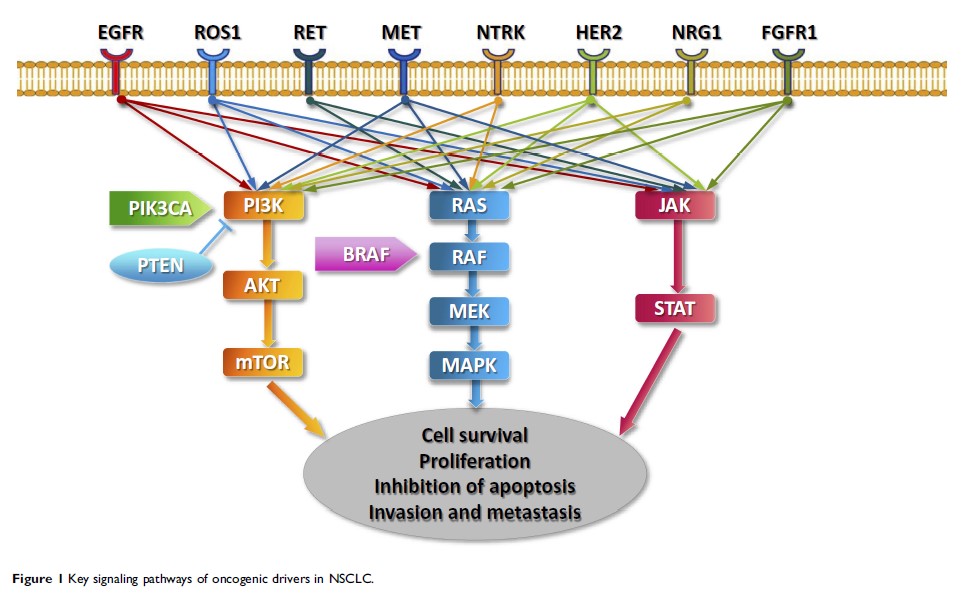
Abstract: Non-small cell lung cancer (NSCLC) is frequently associated with oncogenic driver mutations, which play an important role in carcinogenesis and cancer progression. Targeting epidermal growth factor receptor (EGFR) mutations and anaplastic lymphoma kinase rearrangements has become standard therapy for patients with these aberrations because of the greater improvement of survival, tolerance, and quality-of-life compared to chemotherapy. Clinical trials for emerging therapies that target other less common driver genes are generating mixed results. Here, we review the literature on rare drivers in NSCLC with frequencies lower than 5% (e.g., ROS1, RET, MET, BRAF, NTRK, HER2, NRG1, FGFR1, PIK3CA, DDR2, and EGFR exon 20 insertions). In summary, targeting rare oncogenic drivers in NSCLC has achieved some success. With the development of new inhibitors that target these rare drivers, the spectrum of targeted therapy has been expanded, although acquired resistance is still an unavoidable problem.
Keywords: non-small cell lung cancer, oncogenic driver, targeted therapy