119942
论文已发表
注册即可获取德孚的最新动态
IF 收录期刊
- 3.6 Breast Cancer (Dove Med Press)
- 4.3 Clin Epidemiol
- 2.6 Cancer Manag Res
- 3.2 Infect Drug Resist
- 4.1 Clin Interv Aging
- 6.1 Drug Des Dev Ther
- 4.1 Int J Chronic Obstr
- 8.7 Int J Nanomed
- 2.5 Int J Women's Health
- 3.2 Neuropsych Dis Treat
- 2.4 OncoTargets Ther
- 2.6 Patient Prefer Adher
- 2.6 Ther Clin Risk Manag
- 3.1 J Pain Res
- 3.5 Diabet Metab Synd Ob
- 4.5 Psychol Res Behav Ma
- 3.4 Nat Sci Sleep
- 2.4 Pharmgenomics Pers Med
- 2.6 Risk Manag Healthc Policy
- 4.6 J Inflamm Res
- 2.3 Int J Gen Med
- 3.9 J Hepatocell Carcinoma
- 3.3 J Asthma Allergy
- 2.5 Clin Cosmet Investig Dermatol
- 3.0 J Multidiscip Healthc

ATM-c-IAP1 信号通路的激活可介导雌二醇对间歇性缺氧暴露下的人血管内皮细胞的保护作用
Authors Lin YN, Lan XF, Liu ZR, Yan YR, Zhou JP, Li N, Sun XW, Li QY
Received 18 September 2019
Accepted for publication 5 November 2019
Published 28 November 2019 Volume 2019:11 Pages 357—366
DOI https://doi.org/10.2147/NSS.S231456
Checked for plagiarism Yes
Review by Single-blind
Peer reviewer comments 2
Editor who approved publication: Professor Steven A Shea
Purpose: Chronic intermittent hypoxia (CIH) contributes to the increased risk of cardiovascular diseases in obstructive sleep apnea (OSA). We previously reported the anti-apoptotic effects of estradiol (E2) on IH-exposed human umbilical vein endothelial cells (HUVECs). Herein, we employed a proteomic analysis to elucidate the mechanisms of the protective effects of E2 under IH exposure.
Methods: HUVECs were divided into three groups: control, IH, and IH+E2 group. Isobaric tags for relative and absolute quantification (iTRAQ) were performed to compare protein profiles among the groups. Some of the identified proteins were validated by Western blotting.
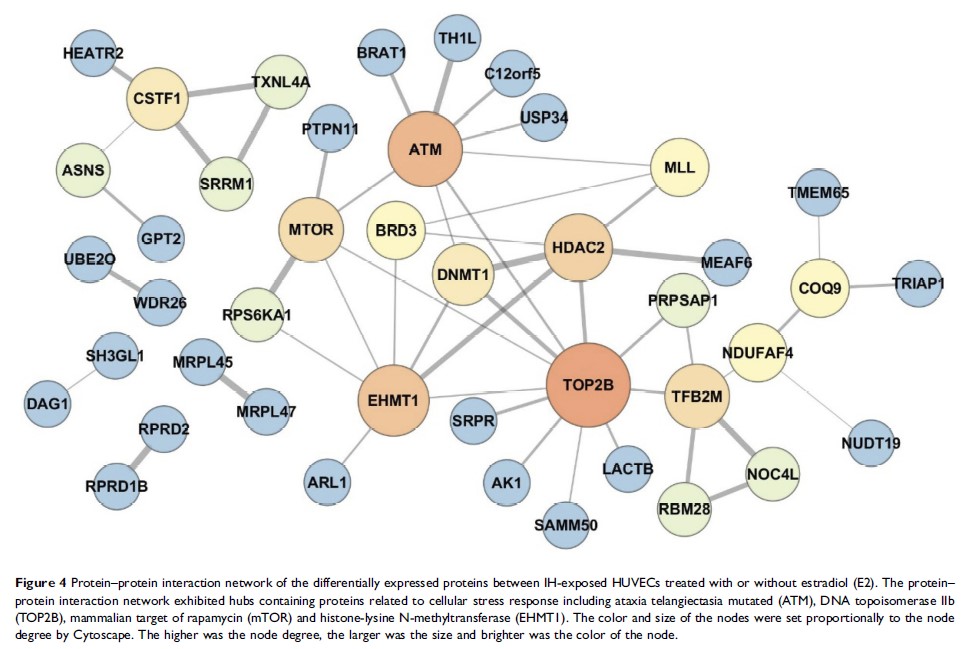
Results: A total of 185 proteins were differentially expressed in the IH+E2 group compared to the IH group. Bioinformatics analysis indicated that the effects of E2 may be linked to the regulation of cellular stress response. Among the differentially expressed proteins, we identified that serine-protein kinase ataxia telangiectasia mutated (ATM) and its downstream target, cellular inhibitor of apoptosis protein 1 (c-IAP1), were up-regulated by E2. We also observed that E2 decreased the level of cleaved caspase-3 and inhibited cell apoptosis in IH-exposed HUVECs. The inhibition of ATM abolished the anti-apoptotic effect of E2.
Conclusion: The ATM-c-IAP1 pathway is involved in the cardioprotective effects of E2 in HUVECs exposed to IH.
Keywords: estradiol, obstructive sleep apnea, OSA, intermittent hypoxia, IH, endothelial dysfunction, proteomics