119942
论文已发表
注册即可获取德孚的最新动态
IF 收录期刊
- 3.6 Breast Cancer (Dove Med Press)
- 4.3 Clin Epidemiol
- 2.6 Cancer Manag Res
- 3.2 Infect Drug Resist
- 4.1 Clin Interv Aging
- 6.1 Drug Des Dev Ther
- 4.1 Int J Chronic Obstr
- 8.7 Int J Nanomed
- 2.5 Int J Women's Health
- 3.2 Neuropsych Dis Treat
- 2.4 OncoTargets Ther
- 2.6 Patient Prefer Adher
- 2.6 Ther Clin Risk Manag
- 3.1 J Pain Res
- 3.5 Diabet Metab Synd Ob
- 4.5 Psychol Res Behav Ma
- 3.4 Nat Sci Sleep
- 2.4 Pharmgenomics Pers Med
- 2.6 Risk Manag Healthc Policy
- 4.6 J Inflamm Res
- 2.3 Int J Gen Med
- 3.9 J Hepatocell Carcinoma
- 3.3 J Asthma Allergy
- 2.5 Clin Cosmet Investig Dermatol
- 3.0 J Multidiscip Healthc

多壁碳纳米管(MWCNT)通过内质网应激来激活细胞凋亡途径:表面化学是否重要?
Authors Sun Y, Gong J, Cao Y
Received 1 June 2019
Accepted for publication 14 November 2019
Published 28 November 2019 Volume 2019:14 Pages 9285—9294
DOI https://doi.org/10.2147/IJN.S217977
Checked for plagiarism Yes
Review by Single-blind
Peer reviewers approved by Dr Colin Mak
Peer reviewer comments 2
Editor who approved publication: Professor Thomas J Webster
Purpose: Physicochemical properties play a crucial role in determining the toxicity of multi-walled carbon nanotubes (MWCNTs). Recently we found that MWCNTs with longer length and smaller diameters could induce toxicity to human umbilical vein endothelial cells (HUVECs) through the activation of endoplasmic reticulum (ER) stress. In this study, we further investigated the possible contribution of hydroxylation and carboxylation to the cytotoxicity of MWCNTs.
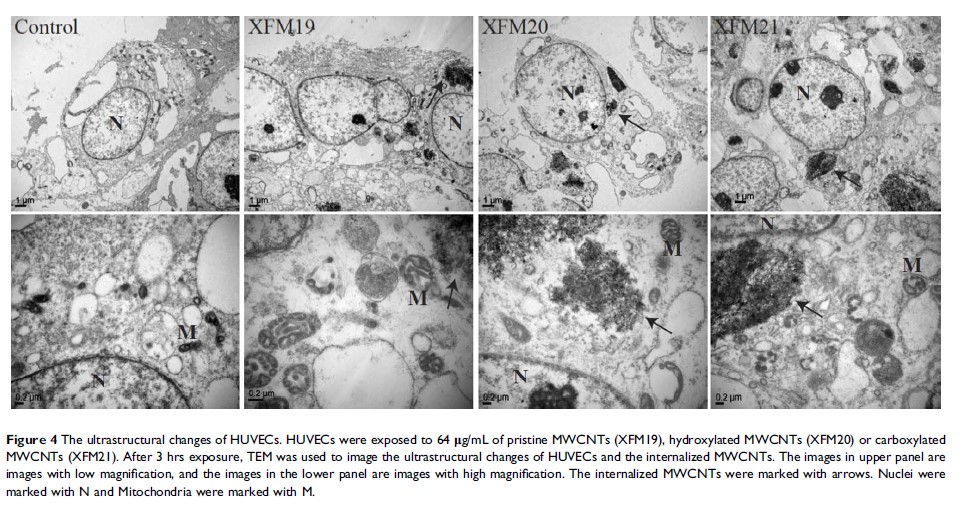
Methods: The HUVECs were exposed to pristine (code XFM19), hydroxylated (code XFM20; content of hydroxyl groups 1.76 wt%) and carboxylated (code XFM21; content of carboxyl groups 1.23 wt%) MWCNTs, respectively. Then, the internalization, cytotoxicity, oxidative stress and activation of apoptosis-ER stress pathway were measured.
Results: In consequence, all types of MWCNTs could be internalized into the HUVECs, and the cellular viability was significantly reduced to a similar level. Moreover, the MWCNTs increased intracellular reactive oxygen species (ROS) and decreased glutathione (GSH) to similar levels, indicating their capacity of inducing oxidative stress. The Western blot results showed that all types of MWCNTs reduced BCL-2 and increased caspase-3, caspase-8, cleaved caspase-3 and cleaved caspase-8. The expression of ER stress gene DNA damage-inducible transcript 3 (DDIT3 ) and protein level of chop were only significantly induced by XFM20 and XFM21, whereas protein level of p-chop was promoted by XFM19 and XFM21. In addition, the pro-survival gene XBP-1s was significantly down-regulated by all types of MWCNTs.
Conclusion: These results suggested that MWCNTs could induce cytotoxicity to HUVECs via the induction of oxidative stress and apoptosis-ER stress, whereas a low degree of hydroxylation or carboxylation did not affect the toxicity of MWCNTs to HUVECs.
Keywords: multi-walled carbon nanotubes, MWCNTs, human umbilical vein endothelial cells, HUVECs, endoplasmic reticulum (ER) stress, hydroxylation, carboxylation, ER stress