119942
论文已发表
注册即可获取德孚的最新动态
IF 收录期刊
- 3.6 Breast Cancer (Dove Med Press)
- 4.3 Clin Epidemiol
- 2.6 Cancer Manag Res
- 3.2 Infect Drug Resist
- 4.1 Clin Interv Aging
- 6.1 Drug Des Dev Ther
- 4.1 Int J Chronic Obstr
- 8.7 Int J Nanomed
- 2.5 Int J Women's Health
- 3.2 Neuropsych Dis Treat
- 2.4 OncoTargets Ther
- 2.6 Patient Prefer Adher
- 2.6 Ther Clin Risk Manag
- 3.1 J Pain Res
- 3.5 Diabet Metab Synd Ob
- 4.5 Psychol Res Behav Ma
- 3.4 Nat Sci Sleep
- 2.4 Pharmgenomics Pers Med
- 2.6 Risk Manag Healthc Policy
- 4.6 J Inflamm Res
- 2.3 Int J Gen Med
- 3.9 J Hepatocell Carcinoma
- 3.3 J Asthma Allergy
- 2.5 Clin Cosmet Investig Dermatol
- 3.0 J Multidiscip Healthc

对结核性结肠炎患者实施超深层测序显示出肺外结核诊断的局限性:一例病例报告
Authors Zhang C, Hu T, Xiu L, Li Y, Peng J
Received 8 August 2019
Accepted for publication 22 November 2019
Published 29 November 2019 Volume 2019:12 Pages 3739—3743
DOI https://doi.org/10.2147/IDR.S226518
Checked for plagiarism Yes
Review by Single-blind
Peer reviewers approved by Dr Colin Mak
Peer reviewer comments 2
Editor who approved publication: Professor Suresh Antony
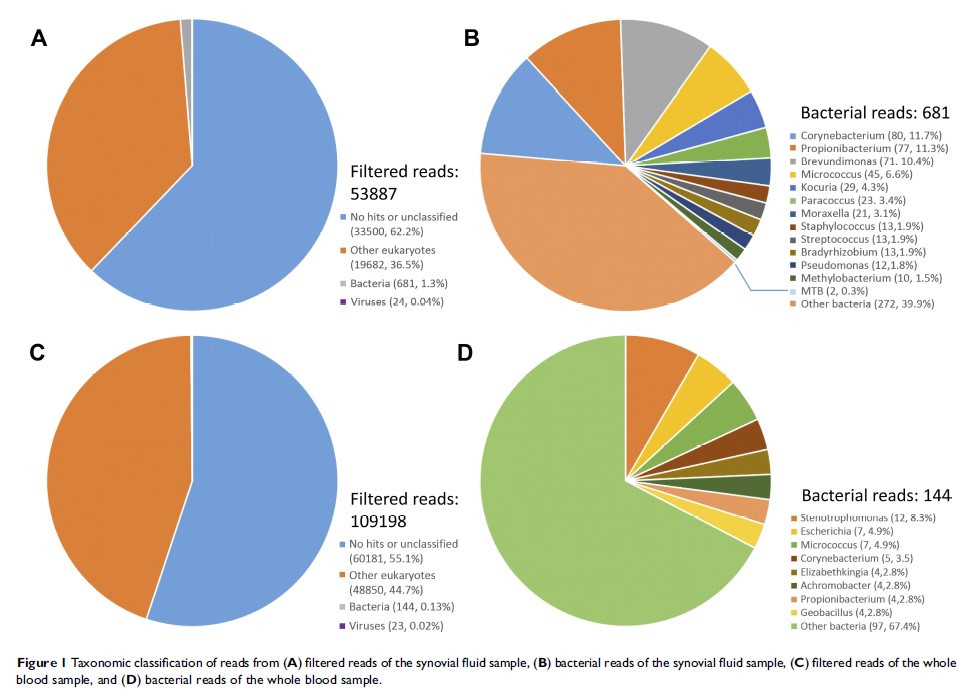
Abstract: Unbiased metagenomic next-generation sequencing (mNGS) has been widely applied in clinical microbiology for infectious disease diagnostics. Some successful applications in central nervous system infections and respiratory tract infections have proved it to be a promising tool for pathogen detection. Here, mNGS was used to confirm the infectious etiology in a case of tuberculous coxitis, which is a common type of extrapulmonary tuberculosis (TB). A 77-year-old Asian male presented with hip pain and fever was diagnosed with smear- and culture-negative tuberculous coxitis based on the evidence of imaging and interferon-γ release assay. At the same time as the anti-TB therapy started, the patient underwent joint clearance surgery. Whole blood and synovial fluid sampled from surgery were kept for bacteriological confirmation using mNGS with high sequencing depth. However, only two paired-end reads from synovial fluid samples were identified as Mycobacterium tuberculosis . Before leaving hospital, the patient was still receiving anti-TB treatment and began to recover. Considering the obvious escalation of the cost and analysis time as the depth of sequencing increases, although we got a positive result here, the scarce number of reads obtained through ultra-deep sequencing indicates its limitations in extrapulmonary tuberculosis.
Keywords: extrapulmonary tuberculosis, metagenomics, molecular diagnostic techniques, Mycobacterium tuberculosis