119942
论文已发表
注册即可获取德孚的最新动态
IF 收录期刊
- 3.6 Breast Cancer (Dove Med Press)
- 4.3 Clin Epidemiol
- 2.6 Cancer Manag Res
- 3.2 Infect Drug Resist
- 4.1 Clin Interv Aging
- 6.1 Drug Des Dev Ther
- 4.1 Int J Chronic Obstr
- 8.7 Int J Nanomed
- 2.5 Int J Women's Health
- 3.2 Neuropsych Dis Treat
- 2.4 OncoTargets Ther
- 2.6 Patient Prefer Adher
- 2.6 Ther Clin Risk Manag
- 3.1 J Pain Res
- 3.5 Diabet Metab Synd Ob
- 4.5 Psychol Res Behav Ma
- 3.4 Nat Sci Sleep
- 2.4 Pharmgenomics Pers Med
- 2.6 Risk Manag Healthc Policy
- 4.6 J Inflamm Res
- 2.3 Int J Gen Med
- 3.9 J Hepatocell Carcinoma
- 3.3 J Asthma Allergy
- 2.5 Clin Cosmet Investig Dermatol
- 3.0 J Multidiscip Healthc

在线购物时的想象力是非常重要的:唯物主义和在线冲动性购买两者的心理模拟的调节作用
Authors Li J, Yang R, Cui J, Guo Y
Received 15 August 2019
Accepted for publication 20 November 2019
Published 29 November 2019 Volume 2019:12 Pages 1071—1079
DOI https://doi.org/10.2147/PRBM.S227403
Checked for plagiarism Yes
Review by Single-blind
Peer reviewers approved by Dr Melinda Thomas
Peer reviewer comments 2
Editor who approved publication: Professor Igor Elman
Background: Several studies have demonstrated that materialistic people tend to engage in impulsive buying. However, how to help them reduce such irrational behavior, especially in online shopping context, is not known. This study aimed to explore whether mental simulation moderates the relationship between materialism and online impulsive buying.
Methods: A total of 200 Chinese college students participated in the experiment. We adopted an imaginary priming paradigm to manipulate three types of mental simulation: process simulation (i.e., imagining the detailed process of purchasing goods), upward outcome simulation (i.e., imagining possible positive outcomes after purchasing), and downward outcome simulation (i.e., imagining possible negative outcomes after purchasing). Then we asked participants to make purchase decisions in a simulated online store.
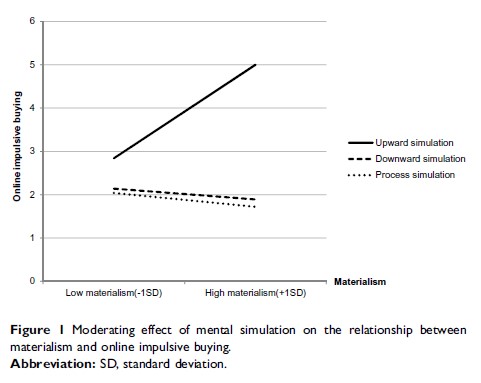
Results: Results showed that mental simulation exerted a significant moderating effect. In the upward outcome simulation group, a higher level of materialism predicted more online impulsive buying. However, this association was not significant in the downward outcome simulation and process simulation groups.
Conclusion: Our findings have implications for interventions in that mental simulation (process simulation or downward outcome simulation) can act as an effective way to help materialists reduce online impulsive buying.
Keywords: materialism, online impulsive buying, mental simulation, moderation