119942
论文已发表
注册即可获取德孚的最新动态
IF 收录期刊
- 3.6 Breast Cancer (Dove Med Press)
- 4.3 Clin Epidemiol
- 2.6 Cancer Manag Res
- 3.2 Infect Drug Resist
- 4.1 Clin Interv Aging
- 6.1 Drug Des Dev Ther
- 4.1 Int J Chronic Obstr
- 8.7 Int J Nanomed
- 2.5 Int J Women's Health
- 3.2 Neuropsych Dis Treat
- 2.4 OncoTargets Ther
- 2.6 Patient Prefer Adher
- 2.6 Ther Clin Risk Manag
- 3.1 J Pain Res
- 3.5 Diabet Metab Synd Ob
- 4.5 Psychol Res Behav Ma
- 3.4 Nat Sci Sleep
- 2.4 Pharmgenomics Pers Med
- 2.6 Risk Manag Healthc Policy
- 4.6 J Inflamm Res
- 2.3 Int J Gen Med
- 3.9 J Hepatocell Carcinoma
- 3.3 J Asthma Allergy
- 2.5 Clin Cosmet Investig Dermatol
- 3.0 J Multidiscip Healthc

S-反式,反式-法尼基硫代水杨酸通过抑制 RAS/ERK 信号通路对阿尔茨海默氏病的神经保护作用
Authors Wang X, Wang Y, Zhu Y, Yan L, Zhao L
Received 3 October 2019
Accepted for publication 21 November 2019
Published 29 November 2019 Volume 2019:13 Pages 4053—4063
DOI https://doi.org/10.2147/DDDT.S233283
Checked for plagiarism Yes
Review by Single-blind
Peer reviewers approved by Ms Soumya Khanapur
Peer reviewer comments 3
Editor who approved publication: Dr Tin Wui Wong
Background: Alzheimer’s disease (AD), a leading cause of dementia, becomes a serious health issue for individuals and society around the world. AD is a neurodegenerative disease characterized by the deposition of amyloid-β (Aβ) peptides and neurofibrillary tangles (NFT) and the loss of large numbers of neurons. To date, there is no effective treatment for AD, and thus, to enhance neurogenesis in the AD brain may be a therapeutic strategy. RAS signaling pathway involves in synaptic plasticity and memory formation, which is overexpressed in brains with AD. This study used Aβ1-42-injected mice (Aβ1-42-mice) as the AD model to investigate the effects of S-trans, trans-farnesylthiosalicylic acid (FTS), a synthetic Ras inhibitor, on the impairment of neurogenesis and the spatial cognitive deficits.
Materials and methods: AD model mice were manufactured through intracerebroventricular injection of Aβ1-42. Morris water maze (MWM) was performed to evaluate the capacity of spatial memory, and Nissl staining was applied to assess neuronal damage in the hippocampus CA1. Immunohistochemistry of 5-bromo-2-deoxyuridine (BrdU), BrdU/neuronal nuclei (NeuN), and doublecortin (DCX) were used to detect progenitor cell proliferation, maturation, and neurite growth, respectively. And the expression levels of RAS, ERK/ERK phosphorylation (p-ERK) and CREB/CREB phosphorylation (p-CREB) were detected by Western blot.
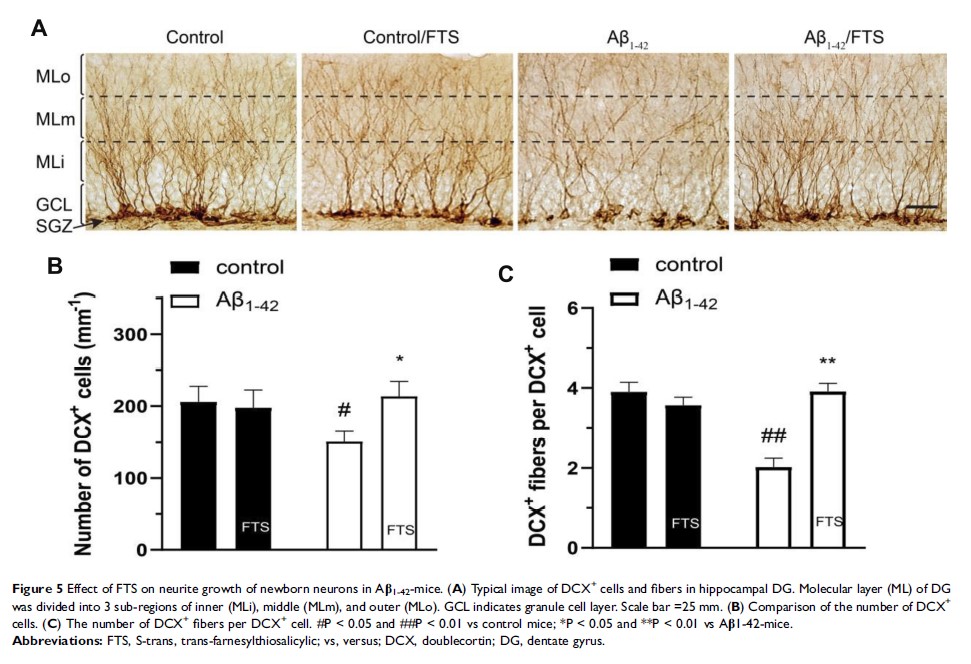
Results: The results demonstrated that FTS could prevent Aβ1-42 to impair survival and neurite growth of newborn neurons in the hippocampal dentate gyrus (DG) in Aβ1-42-mice. Furthermore, behavioral indexes and morphological findings showed that FTS improved the learning and spatial memory abilities of Aβ1-42-mice. In addition, FTS could inhibit the levels of hippocampal p-ERK and p-CREB activated by Aβ, which is the underlying molecular mechanism.
Conclusion: In conclusion, these findings suggest that FTS as a RAS inhibitor could be a potential therapeutic agent for the treatment of AD.
Keywords: Alzheimer’s disease, S-trans, trans-farnesylthiosalicylic acid, spatial cognition, amyloid-β, neurogenesis, signaling pathway