119942
论文已发表
注册即可获取德孚的最新动态
IF 收录期刊
- 3.6 Breast Cancer (Dove Med Press)
- 4.3 Clin Epidemiol
- 2.6 Cancer Manag Res
- 3.2 Infect Drug Resist
- 4.1 Clin Interv Aging
- 6.1 Drug Des Dev Ther
- 4.1 Int J Chronic Obstr
- 8.7 Int J Nanomed
- 2.5 Int J Women's Health
- 3.2 Neuropsych Dis Treat
- 2.4 OncoTargets Ther
- 2.6 Patient Prefer Adher
- 2.6 Ther Clin Risk Manag
- 3.1 J Pain Res
- 3.5 Diabet Metab Synd Ob
- 4.5 Psychol Res Behav Ma
- 3.4 Nat Sci Sleep
- 2.4 Pharmgenomics Pers Med
- 2.6 Risk Manag Healthc Policy
- 4.6 J Inflamm Res
- 2.3 Int J Gen Med
- 3.9 J Hepatocell Carcinoma
- 3.3 J Asthma Allergy
- 2.5 Clin Cosmet Investig Dermatol
- 3.0 J Multidiscip Healthc

miR-424-5p 促进喉鳞状细胞癌的增殖、迁移和侵袭
Authors Li Y, Liu J, Hu W, Zhang Y, Sang J, Li H, Ma T, Bo Y, Bai T, Guo H, Lu Y, Xue X, Niu M, Ge S, Wen S, Wang B, Gao W, Wu Y
Received 23 July 2019
Accepted for publication 18 November 2019
Published 29 November 2019 Volume 2019:12 Pages 10441—10453
DOI https://doi.org/10.2147/OTT.S224325
Checked for plagiarism Yes
Review by Single-blind
Peer reviewers approved by Ms Aruna Narula
Peer reviewer comments 4
Editor who approved publication: Dr Takuya Aoki
Background: Recent studies revealed that miR-424-5p regulates the malignant behavior of multiple cancer types. However, the expression and function of miR-424-5p in laryngeal squamous cell carcinoma (LSCC) is unclear.
Purpose: This study aimed to evaluate the association of miR-424-5p level with clinical features of LSCC and investigate the effect and potential mechanism of miR-424-5p on LSCC progression.
Methods: The expression of miR-424-5p in LSCC and paired adjacent normal margin (ANM) tissues from 106 patients with LSCC were analyzed by quantitative PCR (qPCR), and clinical significance was analyzed. Target genes of miR-424-5p were predicted, followed by functional annotation. The functional role of miR-424-5p in LSCC was investigated by molecular and cellular experiments with LSCC cell lines, with flow cytometry used for cell cycle analysis. In addition, miR-424-5p regulation of the predicted target gene cell adhesion molecule 1 (CADM1) was validated by qPCR, Western blot analysis and luciferase reporter assay.
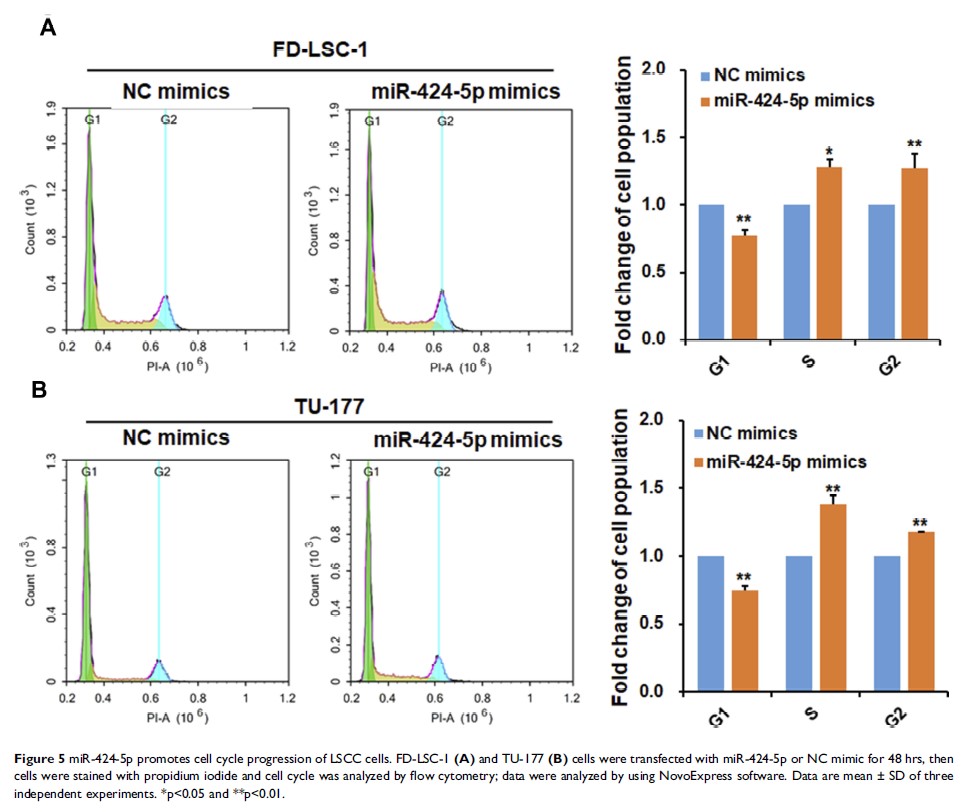
Results: miR-424-5p was upregulated in LSCC versus ANM tissues. High miR-424-5p level was significantly associated with poor differentiation, advanced tumor stage and cervical lymph node metastasis. Bioinformatics analysis showed that miR-424-5p target genes are mainly enriched in biological processes of the cell cycle, cell division, and negative regulation of cell migration, and were involved in multiple cancer-related pathways. Overexpression of miR-424-5p promoted proliferation, migration, invasion, and adhesion of LSCC cells and affected the cell cycle progression. Additionally, CADM1 was a direct target of miR-424-5p in LSCC cells.
Conclusion: miR-424-5p functions as an oncogene to promote the aggressive progression of LSCC, and CADM1 is a direct downstream target of miR-424-5p in LSCC cells. miR-424-5p may be a potential therapeutic target in LSCC.
Keywords: laryngeal squamous cell carcinoma, miR-424-5p, proliferation, migration and invasion, oncogenic miRNA