119942
论文已发表
注册即可获取德孚的最新动态
IF 收录期刊
- 3.6 Breast Cancer (Dove Med Press)
- 4.3 Clin Epidemiol
- 2.6 Cancer Manag Res
- 3.2 Infect Drug Resist
- 4.1 Clin Interv Aging
- 6.1 Drug Des Dev Ther
- 4.1 Int J Chronic Obstr
- 8.7 Int J Nanomed
- 2.5 Int J Women's Health
- 3.2 Neuropsych Dis Treat
- 2.4 OncoTargets Ther
- 2.6 Patient Prefer Adher
- 2.6 Ther Clin Risk Manag
- 3.1 J Pain Res
- 3.5 Diabet Metab Synd Ob
- 4.5 Psychol Res Behav Ma
- 3.4 Nat Sci Sleep
- 2.4 Pharmgenomics Pers Med
- 2.6 Risk Manag Healthc Policy
- 4.6 J Inflamm Res
- 2.3 Int J Gen Med
- 3.9 J Hepatocell Carcinoma
- 3.3 J Asthma Allergy
- 2.5 Clin Cosmet Investig Dermatol
- 3.0 J Multidiscip Healthc

红霉素可预防弹性蛋白肽引起的肺气肿并调节小鼠的 CD4+T 细胞反应
Authors Tang S, Ma T, Zhang H, Zhang J, Zhong X, Tan C, Qiu Y, Zeng W, Feng X
Received 8 July 2019
Accepted for publication 13 November 2019
Published 29 November 2019 Volume 2019:14 Pages 2697—2709
DOI https://doi.org/10.2147/COPD.S222195
Checked for plagiarism Yes
Review by Single-blind
Peer reviewers approved by Dr Melinda Thomas
Peer reviewer comments 3
Editor who approved publication: Prof. Dr. Chunxue Bai
Purpose: Elastin peptides (EP) can induce lung inflammation and emphysema. Erythromycin has been shown to decrease acute exacerbation frequency and delay lung function decline in chronic obstructive pulmonary disease patients and ameliorate emphysema in murine models; however, the mechanism remains unclear. We aimed to observe the preventive and immunomodulatory effects of erythromycin in a mouse model of EP-induced emphysema.
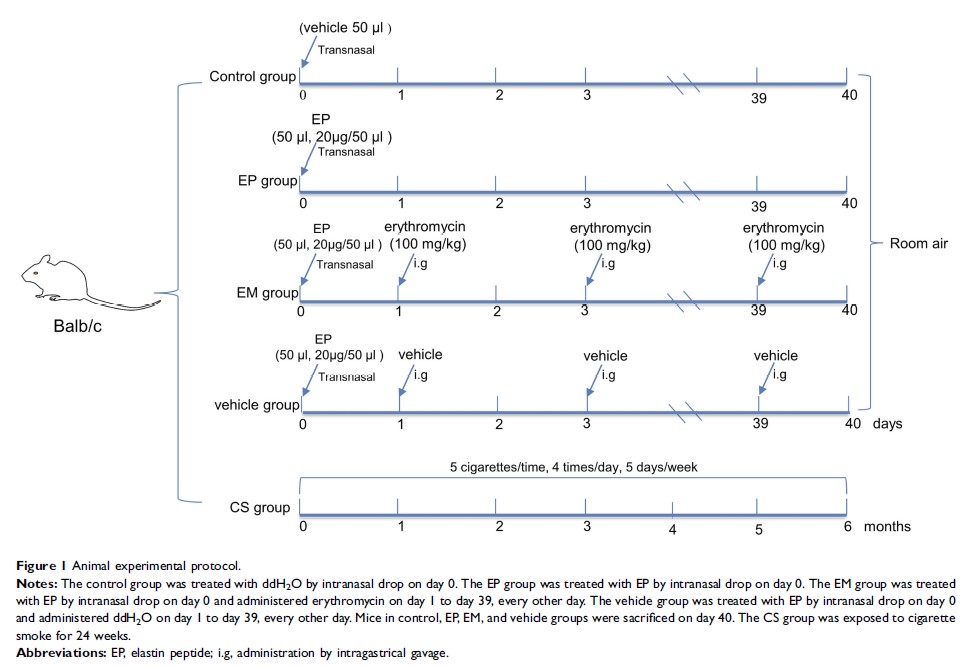
Methods: In the in vivo study, Balb/c mice were treated with EP intranasally on day 0, and then administered erythromycin (100 mg/kg) or vehicle orally on day 1, which was continued every other day. Mice exposed to cigarette smoke were used as an emphysema positive control. The severity of emphysema and inflammation in the lungs of EP-exposed mice with or without erythromycin treatment were observed on day 40 after EP administration. In the in vitro study, naïve CD4+T cells were isolated from healthy mice spleens and stimulated by EP with or without erythromycin incubation. Flow cytometry was used to measure the proportions of Th1, Th17, and Treg cells. ELISA was used to detect cytokine levels of IFN-γ, IL-17, IL-6, and TGF-β. Transcript levels of Ifnγ, IL17a , and Foxp3 were evaluated by qRT-PCR.
Results: After exposure to EP, Th1 and Th17 cell percentages and the levels of inflammatory cytokines increased in vivo and in vitro, while Treg cells decreased in vivo. Erythromycin reduced IFN-γ, IL-17, IL-6 inflammatory cytokines, MLI, and the inflammation score in the lungs of EP-exposed mice. In vitro, erythromycin also limited Th17 and Th1 cell differentiation and downregulated transcript levels of Ifnγ and IL17a in the EP-stimulated CD4+T cells.
Conclusion: The Th1 and Th17 cell responses were increased in EP-induced emphysema. Prophylactic use of erythromycin effectively ameliorated emphysema and modulated CD4+T cells responses in EP-induced lung inflammation in mice.
Keywords: Th1, Th17, Treg cells, inflammation, lungs