119942
论文已发表
注册即可获取德孚的最新动态
IF 收录期刊
- 3.6 Breast Cancer (Dove Med Press)
- 4.3 Clin Epidemiol
- 2.6 Cancer Manag Res
- 3.2 Infect Drug Resist
- 4.1 Clin Interv Aging
- 6.1 Drug Des Dev Ther
- 4.1 Int J Chronic Obstr
- 8.7 Int J Nanomed
- 2.5 Int J Women's Health
- 3.2 Neuropsych Dis Treat
- 2.4 OncoTargets Ther
- 2.6 Patient Prefer Adher
- 2.6 Ther Clin Risk Manag
- 3.1 J Pain Res
- 3.5 Diabet Metab Synd Ob
- 4.5 Psychol Res Behav Ma
- 3.4 Nat Sci Sleep
- 2.4 Pharmgenomics Pers Med
- 2.6 Risk Manag Healthc Policy
- 4.6 J Inflamm Res
- 2.3 Int J Gen Med
- 3.9 J Hepatocell Carcinoma
- 3.3 J Asthma Allergy
- 2.5 Clin Cosmet Investig Dermatol
- 3.0 J Multidiscip Healthc

含熟地黄多糖(RGP)的自组装聚乙二醇化纳米佐剂的最佳制备方法及其对巨噬细胞的免疫作用
Authors Huang Y, Nan L, Xiao C, Ji Q, Li K, Wei Q, Liu Y, Bao G
Received 10 July 2019
Accepted for publication 13 November 2019
Published 29 November 2019 Volume 2019:14 Pages 9361—9375
DOI https://doi.org/10.2147/IJN.S221398
Checked for plagiarism Yes
Review by Single-blind
Peer reviewers approved by Dr Melinda Thomas
Peer reviewer comments 2
Editor who approved publication: Dr Linlin Sun
Background: Rehmannia glutinosa polysaccharide is the main reason that contributes to the immunological function of R. glutinosa . Due to its disadvantages in clinical use, here we designed the PEGylation nano-RGP (pRL) to improve the drug-targeting effect and the immunological function. Our present work aims to establish the optimum condition of preparing the pRL and to investigate its immunological function on macrophages.
Methods: pRL was prepared by thin film hydration method combined with ultra-sonication technique. And its preparation conditions were optimized with response surface methodology. Also, the lyophilization method was optimized. The characteristics of the pRL were evaluated, including particle size, drug loading, encapsulation efficiency and morphology. The immunological function of pRL on macrophage was investigated through CCK-8 test, ELISA and flow cytometry.
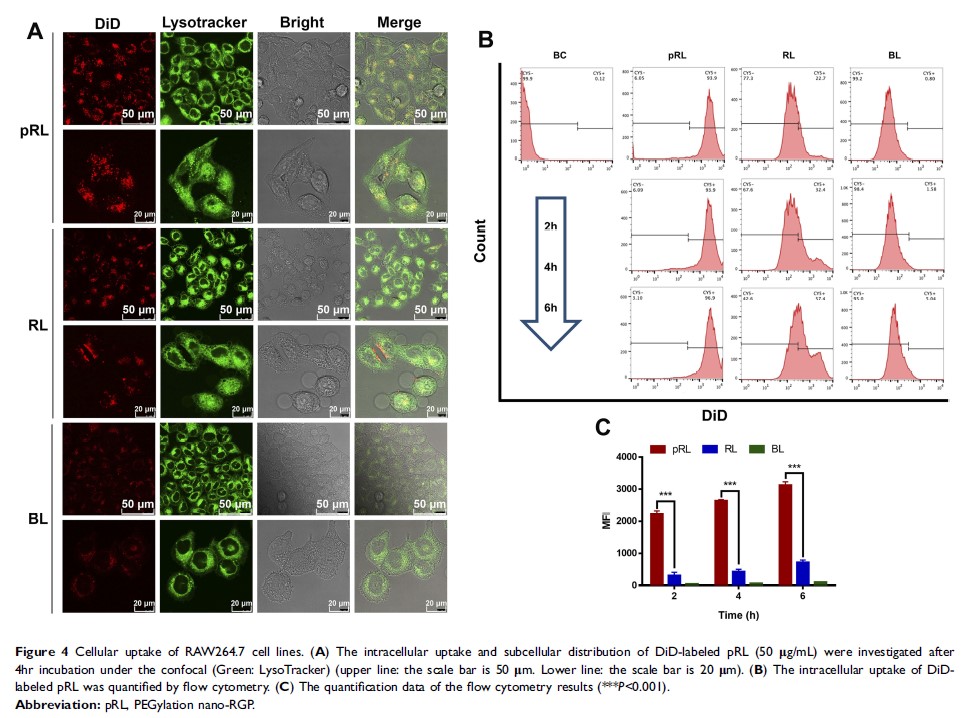
Results: The lipid-to-cholesterol molar ratio of 8:1, the addition of DSPE-PEG2000 of 9% and the lipid-to-drug ratio of 5.4:1 were the optimum preparation technology for pRL. The encapsulation efficiency (EE) of pRL under this preparation technology was 95.81±1.58%, with a particle size of 31.98 ± 2.6 nm. The lactose-to-lipid ratio (2:1) was the optimal lyophilization method. pRL promoted macrophage proliferation, which is significantly better than that of nano-RGP without PEGylation (RL). pRL-stimulated RAW264.7 cells showed a high secretion of pro-inflammatory cytokines, which is the characteristic indicator of M1 polarization. Enhanced cellular uptake through macropinocytosis-dependent and caveolae-mediated endocytosis was observed in pRL-treated RAW264.7 cells.
Conclusion: Our study concluded that PEGylation effectively overcame the poor targeting effect of Rehmannia glutinosa polysaccharide (RGP) and significantly improved the immunological profile of its nano-formulation, which suggested that pRL could serve as an immune adjuvant in clinical application.
Keywords: Rehmannia glutinosa polysaccharide, PEGylation, preparation technology, lyophilization method, macrophages