117333
论文已发表
注册即可获取德孚的最新动态
IF 收录期刊
- 3.6 Breast Cancer (Dove Med Press)
- 4.3 Clin Epidemiol
- 2.6 Cancer Manag Res
- 3.2 Infect Drug Resist
- 4.1 Clin Interv Aging
- 6.1 Drug Des Dev Ther
- 4.1 Int J Chronic Obstr
- 8.7 Int J Nanomed
- 2.5 Int J Women's Health
- 3.2 Neuropsych Dis Treat
- 2.4 OncoTargets Ther
- 2.6 Patient Prefer Adher
- 2.6 Ther Clin Risk Manag
- 3.1 J Pain Res
- 3.5 Diabet Metab Synd Ob
- 4.5 Psychol Res Behav Ma
- 3.4 Nat Sci Sleep
- 2.4 Pharmgenomics Pers Med
- 2.6 Risk Manag Healthc Policy
- 4.6 J Inflamm Res
- 2.3 Int J Gen Med
- 3.9 J Hepatocell Carcinoma
- 3.3 J Asthma Allergy
- 2.5 Clin Cosmet Investig Dermatol
- 3.0 J Multidiscip Healthc

纳米囊泡和人间质液在胃肠道恶性病变检测、诊断、预后和治疗中的应用综述
Authors Huang Y, Deng X, Liang J
Received 13 March 2019
Accepted for publication 8 November 2019
Published 2 December 2019 Volume 2019:14 Pages 9469—9482
DOI https://doi.org/10.2147/IJN.S208559
Checked for plagiarism Yes
Review by Single-blind
Peer reviewers approved by Dr Thiruganesh Ramasamy
Peer reviewer comments 2
Editor who approved publication: Dr Mian Wang
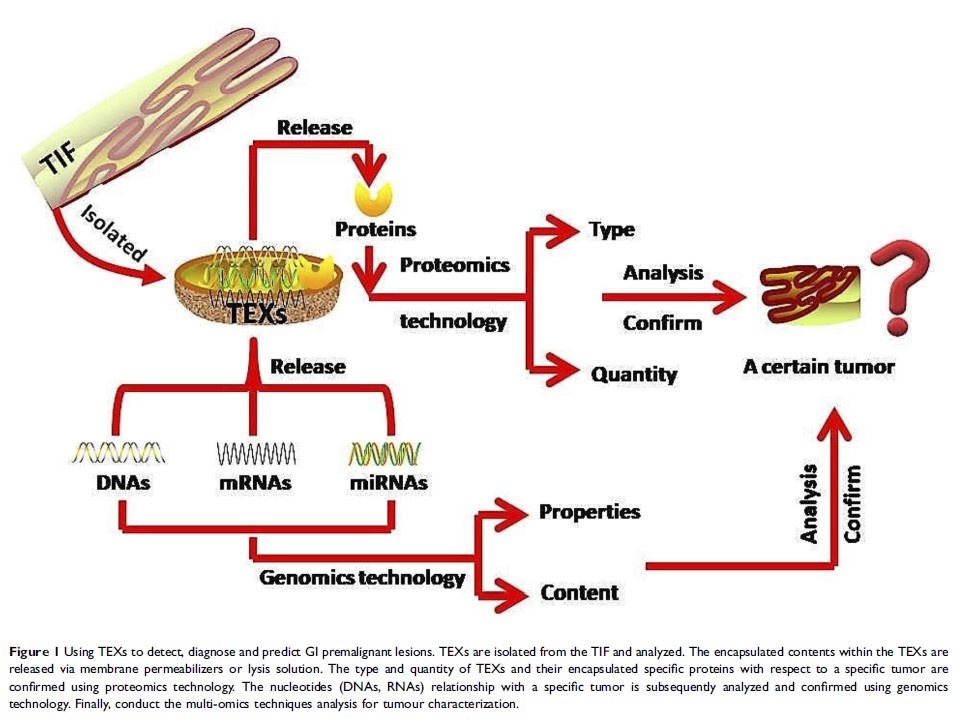
Abstract: Premalignant lesions arise from cells that abnormally proliferate and have a tendency to become cancerous. Developing methods to specifically target and remove these premalignant lesions is imperative to the prevention of malignant progression into gastrointestinal (GI) tumors. However, accurate detection and diagnosis of GI precancerous lesions is challenging, as these lesions show little or no structural change. Thus, this prevents early intervention and reduces the success rate of therapy. In this review, we performed a systematic analysis of the technological advancements in the combined application of nanovesicles (NVs) and the human interstitial fluid (HIF) to specifically target GI premalignant lesions. NVs, which include quantum dots (QDs), are small membranous vehicles of a nanometer diameter that are widely used as drug delivery vectors, therapeutic effectors and diagnostic sensors. HIF is the fluid that is present in human interstitial tissues (HITs) in which signaling molecules and agents travel and can be found throughout the body. HIF is exploited by tumor cells for their invasion, migration and spread. Because the HITs span the entire submucosa of the gastrointestinal tract, they have been increasingly targeted in GI tumor therapy. The challenges involved in the combined application of NVs and HIF in the detection, diagnosis, prognosis and therapy of GI premalignant lesions are also discussed.
Keywords: gastrointestinal premalignant lesions, nanovesicles, human interstitium