119942
论文已发表
注册即可获取德孚的最新动态
IF 收录期刊
- 3.6 Breast Cancer (Dove Med Press)
- 4.3 Clin Epidemiol
- 2.6 Cancer Manag Res
- 3.2 Infect Drug Resist
- 4.1 Clin Interv Aging
- 6.1 Drug Des Dev Ther
- 4.1 Int J Chronic Obstr
- 8.7 Int J Nanomed
- 2.5 Int J Women's Health
- 3.2 Neuropsych Dis Treat
- 2.4 OncoTargets Ther
- 2.6 Patient Prefer Adher
- 2.6 Ther Clin Risk Manag
- 3.1 J Pain Res
- 3.5 Diabet Metab Synd Ob
- 4.5 Psychol Res Behav Ma
- 3.4 Nat Sci Sleep
- 2.4 Pharmgenomics Pers Med
- 2.6 Risk Manag Healthc Policy
- 4.6 J Inflamm Res
- 2.3 Int J Gen Med
- 3.9 J Hepatocell Carcinoma
- 3.3 J Asthma Allergy
- 2.5 Clin Cosmet Investig Dermatol
- 3.0 J Multidiscip Healthc

中国南方经培养验证的新生儿败血症的发生率、细菌谱和耐药性
Authors Gao K, Fu J, Guan X, Zhu S, Zeng L, Xu X, Chang CY, Liu H
Received 17 July 2019
Accepted for publication 31 October 2019
Published 3 December 2019 Volume 2019:12 Pages 3797—3805
DOI https://doi.org/10.2147/IDR.S223597
Checked for plagiarism Yes
Review by Single-blind
Peer reviewers approved by Dr Cristina Weinberg
Peer reviewer comments 2
Editor who approved publication: Dr Sahil Khanna
Background: Neonatal sepsis (NS) is one of the leading causes of infant morbidity and mortality, but little is known about pathogen incidence and distribution in China.
Methods: In this retrospective study (January 2012 to December 2016), culture-proven cases aged less than 28 days with diagnosed NS in the Guangzhou Women and Children’s Medical Center, South China, were analyzed for pathogen incidence and antimicrobial resistance.
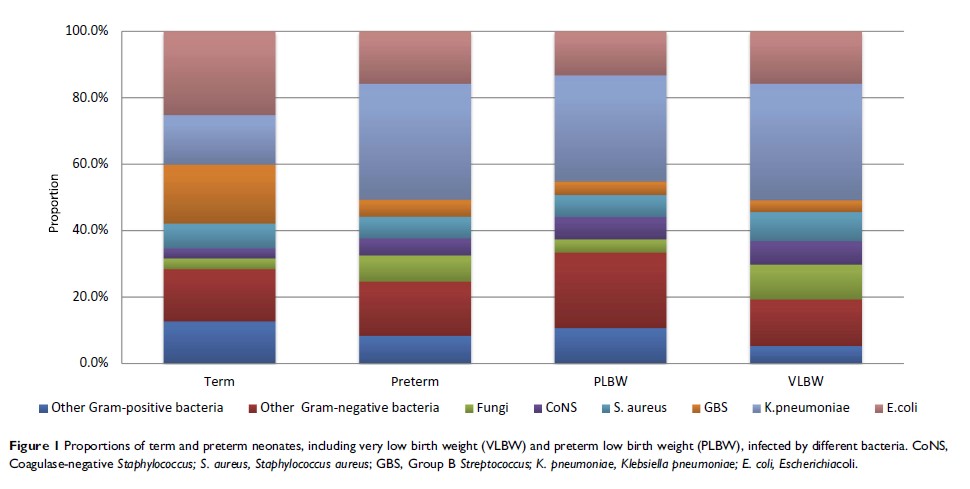
Results: A total of 620 isolates were identified from 597 NS cases. Gram-negative bacteria (n=371, 59.8%) dominated over Gram-positive bacteria (n=218, 35.2%) and fungi (n=30, 4.8%). Klebsiella pneumoniae (21.9%), Escherichia coli (21.9%), group B Streptococcus (GBS, 13.2%), and Staphylococcus aureus (6.8%) were the four most predominant pathogens. In early-onset sepsis (EOS), GBS (30.0%) and E. coli (20.0%) were dominant, whereas in late-onset sepsis (LOS), K. pneumoniae (25.6%) and E. coli (22.4%) were dominant. E. coli (25.2%) and GBS (17.7%) were the most frequently isolated from term patients, whereas K. pneumoniae was the most frequently isolated from preterm patients (34.9%). Of the infected infants, 9.5% died from sepsis, most commonly by E. coli infection (16.2%). Among 91,215 live births (LBs) delivered in the study hospital (2012–2016), 252 infants developed sepsis infection (2.76 per 1000 LBs, 95% CI 2.4–3.1), including EOS (0.78 per 1000 LBs) and LOS (2.13 per 1000 LBs). All GBS isolates were susceptible to β-lactam antibiotics, and S. aureus , including methicillin-resistant isolates, were susceptible to vancomycin. An extended-spectrum β-lactamase producer was identified in 37.3% of E. coli and 50.4% of K. pneumoniae .
Conclusion: K. pneumoniae was the most frequent pathogen in culture-proven NS in South China, primarily associated with LOS in preterm, whereas GBS was the dominant pathogen in EOS. E. coli was common in both episodes with the highest mortality.
Keywords: neonatal sepsis, incidence, antimicrobial resistance, Escherichia coli , group B Streptococcus , Klebsiella pneumoniae