119942
论文已发表
注册即可获取德孚的最新动态
IF 收录期刊
- 3.6 Breast Cancer (Dove Med Press)
- 4.3 Clin Epidemiol
- 2.6 Cancer Manag Res
- 3.2 Infect Drug Resist
- 4.1 Clin Interv Aging
- 6.1 Drug Des Dev Ther
- 4.1 Int J Chronic Obstr
- 8.7 Int J Nanomed
- 2.5 Int J Women's Health
- 3.2 Neuropsych Dis Treat
- 2.4 OncoTargets Ther
- 2.6 Patient Prefer Adher
- 2.6 Ther Clin Risk Manag
- 3.1 J Pain Res
- 3.5 Diabet Metab Synd Ob
- 4.5 Psychol Res Behav Ma
- 3.4 Nat Sci Sleep
- 2.4 Pharmgenomics Pers Med
- 2.6 Risk Manag Healthc Policy
- 4.6 J Inflamm Res
- 2.3 Int J Gen Med
- 3.9 J Hepatocell Carcinoma
- 3.3 J Asthma Allergy
- 2.5 Clin Cosmet Investig Dermatol
- 3.0 J Multidiscip Healthc

在中国西部的重症监护病房建立与医疗保健相关感染的登记系统:研究依据和患者特征
Authors Wang W, Zhu S, He Q, Zhang R, Kang Y, Wang M, Zou K, Zong Z, Sun X
Received 12 August 2019
Accepted for publication 23 November 2019
Published 4 December 2019 Volume 2019:11 Pages 1035—1045
DOI https://doi.org/10.2147/CLEP.S226935
Checked for plagiarism Yes
Review by Single-blind
Peer reviewers approved by Dr Nicola Ludin
Peer reviewer comments 4
Editor who approved publication: Professor Henrik Toft Sørensen
Purpose: Limited evidence is available to support the management of healthcare-associated infections (HAIs) in intensive care units (ICUs). Establishing a registry with complete and accurate information is urgently needed. The West China Hospital system has the most complete and largest data system for HAI in the ICU setting in China. By linking a multidimensional database, we developed a registry of HAI in ICU.
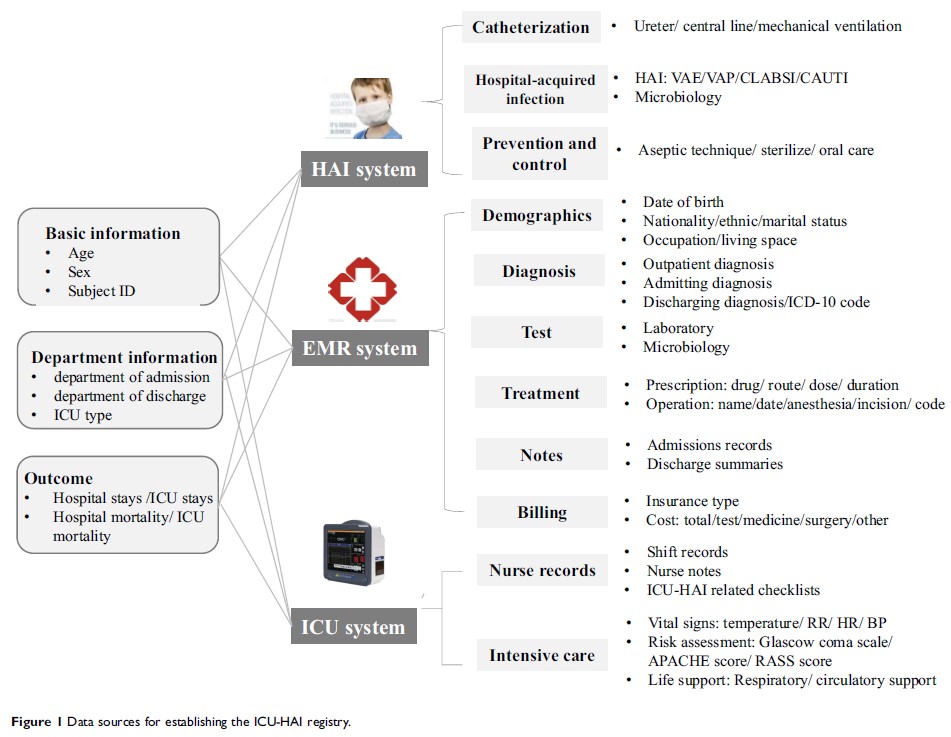
Methods: The ICU-HAI registry was established using a multi-source database that included electronic medical record (EMR), ICU system and ICU-HAI system in the West China Hospital healthcare system. Patients who were admitted to ICUs between 1 April 2015 and 30 March 2018 were included and data were extracted based on pre-designed, standardized data forms. We achieved the linkage of the three databases using a unique patient identification code, and cleaned the data based on standardized variable dictionaries and cleaning rules. We evaluated the quality of the registry through data verification and assessment of the quality of key variables.
Results: In total, 23, 062 patients were included. The ICU mortality and hospital mortality were 5.4% and 5.5% respectively. A total of 855 patients developed ICU-HAIs, 1540 patients developed ventilator-associated events (VAE), and 171 patients developed possible ventilator-associated pneumonia (PVAP). Quality assessment showed that the accuracy of data extraction and linkage was 100%. Furthermore, 98% of all patients had at least one important laboratory tests performed, and the median number of tests performed was 4 to 5 per admission.
Conclusion: A unique registry for HAIs in the ICU setting was successfully established, which contains complete and accurate information for all patients in the ICU. The registry, linked from multiple data sources, provides unique research insights into the management of HAIs in the ICU setting in China.
Keywords: healthcare-associated infection, intensive care units, registry