119942
论文已发表
注册即可获取德孚的最新动态
IF 收录期刊
- 3.6 Breast Cancer (Dove Med Press)
- 4.3 Clin Epidemiol
- 2.6 Cancer Manag Res
- 3.2 Infect Drug Resist
- 4.1 Clin Interv Aging
- 6.1 Drug Des Dev Ther
- 4.1 Int J Chronic Obstr
- 8.7 Int J Nanomed
- 2.5 Int J Women's Health
- 3.2 Neuropsych Dis Treat
- 2.4 OncoTargets Ther
- 2.6 Patient Prefer Adher
- 2.6 Ther Clin Risk Manag
- 3.1 J Pain Res
- 3.5 Diabet Metab Synd Ob
- 4.5 Psychol Res Behav Ma
- 3.4 Nat Sci Sleep
- 2.4 Pharmgenomics Pers Med
- 2.6 Risk Manag Healthc Policy
- 4.6 J Inflamm Res
- 2.3 Int J Gen Med
- 3.9 J Hepatocell Carcinoma
- 3.3 J Asthma Allergy
- 2.5 Clin Cosmet Investig Dermatol
- 3.0 J Multidiscip Healthc

一种新型的粪肠球菌检测方法,使用与金纳米颗粒侧向流动生物传感器相关联的多重交叉位移放大
Authors Chen X, Ma K, Yi X, Xiao Z, Xiong L, Wang Y, Li S
Received 19 October 2019
Accepted for publication 22 November 2019
Published 4 December 2019 Volume 2019:12 Pages 3771—3781
DOI https://doi.org/10.2147/IDR.S235325
Checked for plagiarism Yes
Review by Single-blind
Peer reviewers approved by Ms Georgia Watson
Peer reviewer comments 2
Editor who approved publication: Professor Suresh Antony
Background: Enterococcus faecalis , an opportunistic bacterial pathogen, is one of the most frequently isolated bacterial species and cause of serious nosocomial infections in recent decades. A reliable and rapid assay for E. faecalis detection is significant for the diagnosis and follow-up treatment.
Methods: A novel assay method, named multiple cross displacement amplification linked with nanoparticle-based lateral flow biosensor (MCDA-LFB), was applied for detecting E. faecalis strains. A set of special 10 primers was designed according to E. faecalis -specific gene Ef0027 . The MCDA amplification conditions, including the target DNA concentration, reaction temperature and time, were optimized. The sensitivity and specificity of MCDA method were tested in the current study, and then, the MCDA-LFB technology was applied to detect the E. faecalis strain from clinical samples.
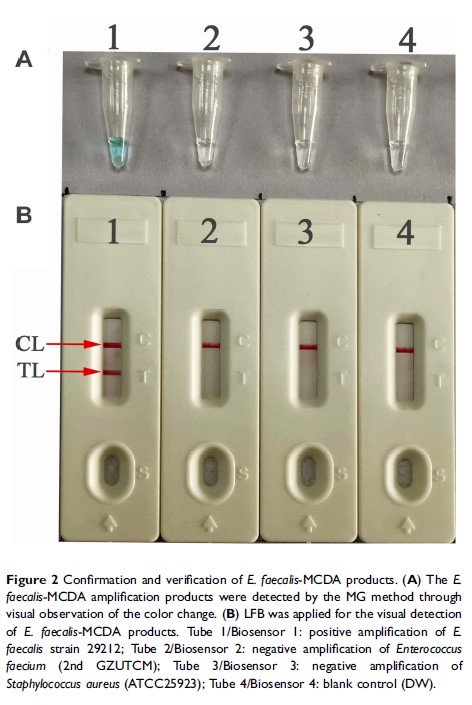
Results: The E. faecalis specific primers were valid for the establishment of MCDA-LFB technology forthe detection of E. faecalis based on the Ef0027 gene. The MCDA amplification condition was optimized at 62°C for 35 min. The MCDA products were directly sensed and displayed with a biosensor. The full process, comprising genomic DNA template preparation (approximately 30 mins), amplification of MCDA (35 mins), and the product identification (approximately 2 mins), could be achieved in 70 mins. The MCDA technique could detect as little as 10 fg per reaction system of pure E. faecalis genomic DNA. The specificity of E. faecalis -MCDA-LFB method is 100%, with no cross-reactions to non-E. faecalis strains.
Conclusion: The MCDA-LFB technique established in the present study is a reliable, simple, rapid, sensitive and specific method to assay E. faecalis and can be applied for the detection of clinical samples.
Keywords: Enterococcus faecalis , limit of detection, multiple cross displacement amplification, gold nanoparticle, lateral flow biosensor, MCDA-LFB