119942
论文已发表
注册即可获取德孚的最新动态
IF 收录期刊
- 3.6 Breast Cancer (Dove Med Press)
- 4.3 Clin Epidemiol
- 2.6 Cancer Manag Res
- 3.2 Infect Drug Resist
- 4.1 Clin Interv Aging
- 6.1 Drug Des Dev Ther
- 4.1 Int J Chronic Obstr
- 8.7 Int J Nanomed
- 2.5 Int J Women's Health
- 3.2 Neuropsych Dis Treat
- 2.4 OncoTargets Ther
- 2.6 Patient Prefer Adher
- 2.6 Ther Clin Risk Manag
- 3.1 J Pain Res
- 3.5 Diabet Metab Synd Ob
- 4.5 Psychol Res Behav Ma
- 3.4 Nat Sci Sleep
- 2.4 Pharmgenomics Pers Med
- 2.6 Risk Manag Healthc Policy
- 4.6 J Inflamm Res
- 2.3 Int J Gen Med
- 3.9 J Hepatocell Carcinoma
- 3.3 J Asthma Allergy
- 2.5 Clin Cosmet Investig Dermatol
- 3.0 J Multidiscip Healthc

来自西部某医院的耐多药大肠杆菌中毒力基因的多样性
Authors Li X, Luo Q, Yu X, Zhang Y, Cao X, Li D
Received 5 August 2019
Accepted for publication 16 November 2019
Published 5 December 2019 Volume 2019:12 Pages 3817—3826
DOI https://doi.org/10.2147/IDR.S226072
Checked for plagiarism Yes
Review by Single-blind
Peer reviewer comments 2
Editor who approved publication: Dr Eric Nulens
Background: Escherichia coli strains are the most commonly isolated bacteria in hospitals. The normally harmless commensal E. coli can become a highly adapted pathogen, capable of causing various diseases both in healthy and immunocompromised individuals, by acquiring a combination of mobile genetic elements. Our aim was to characterize E. coli strains from a hospital in western China to determine their virulence and antimicrobial resistance potential.
Methods: A total of 97 E. coli clinical isolates were collected from the First Affiliated Hospital of Chengdu Medical College from 2015 to 2016. Microbiological methods, PCR, and antimicrobial susceptibility tests were used in this study.
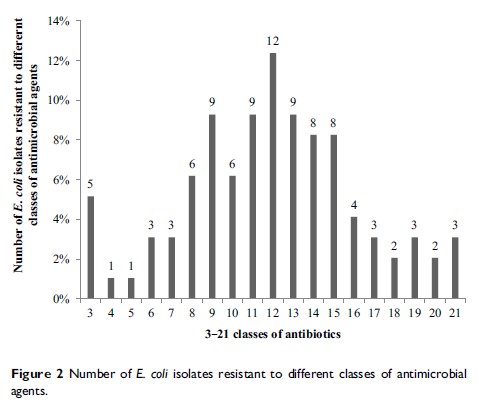
Results: The frequency of occurrence of the virulence genes fimC, irp2, fimH, fyuA, lpfA, hlyA, sat , and cnf1 in the E. coli isolates was 93.81, 92.78, 91.75, 84.54, 41.24, 32.99, 28.86, and 7.22%, respectively. Ninety-five (97.9%) isolates carried two or more different virulence genes. Of these, 44 (45.4%) isolates simultaneously harbored five virulence genes, 24 (24.7%) isolates harbored four virulence genes, and 17 (17.5%) isolates harbored six virulence genes. In addition, all E. coli isolates were multidrug resistant and had a high degree of antimicrobial resistance.
Conclusion: These results indicate a high frequency of occurrence and heterogeneity of virulence gene profiles among clinical multidrug resistant E. coli isolates. Therefore, appropriate surveillance and control measures are essential to prevent the further spread of these isolates in hospitals.
Keywords: Escherichia coli , clinical isolates, virulence genes, antimicrobial resistance, MDR