119942
论文已发表
注册即可获取德孚的最新动态
IF 收录期刊
- 3.6 Breast Cancer (Dove Med Press)
- 4.3 Clin Epidemiol
- 2.6 Cancer Manag Res
- 3.2 Infect Drug Resist
- 4.1 Clin Interv Aging
- 6.1 Drug Des Dev Ther
- 4.1 Int J Chronic Obstr
- 8.7 Int J Nanomed
- 2.5 Int J Women's Health
- 3.2 Neuropsych Dis Treat
- 2.4 OncoTargets Ther
- 2.6 Patient Prefer Adher
- 2.6 Ther Clin Risk Manag
- 3.1 J Pain Res
- 3.5 Diabet Metab Synd Ob
- 4.5 Psychol Res Behav Ma
- 3.4 Nat Sci Sleep
- 2.4 Pharmgenomics Pers Med
- 2.6 Risk Manag Healthc Policy
- 4.6 J Inflamm Res
- 2.3 Int J Gen Med
- 3.9 J Hepatocell Carcinoma
- 3.3 J Asthma Allergy
- 2.5 Clin Cosmet Investig Dermatol
- 3.0 J Multidiscip Healthc

在预定时间拔管后,并非所有 COPD 患者都能从无创通气预防性治疗中获益:一项探索性研究
Authors Gong Y, Han X, Duan J, Huang S
Received 24 September 2019
Accepted for publication 22 November 2019
Published 5 December 2019 Volume 2019:14 Pages 2809—2814
DOI https://doi.org/10.2147/COPD.S232339
Checked for plagiarism Yes
Review by Single-blind
Peer reviewer comments 3
Editor who approved publication: Prof. Dr. Chunxue Bai
Background: Prophylactic noninvasive ventilation (NIV) after scheduled extubation can benefit patients with chronic respiratory disorders, among which chronic obstructive pulmonary disease (COPD) is a significant example. However, it is not known whether all COPD patients benefit from prophylactic NIV.
Methods: We performed a post hoc analysis of prospectively collected data. COPD patients who successfully completed a spontaneous breathing trial were enrolled. In the prophylactic NIV group, NIV was applied immediately after extubation. In the usual care group, conventional oxygen therapy was used. Patients were followed up to 90 days post-extubation.
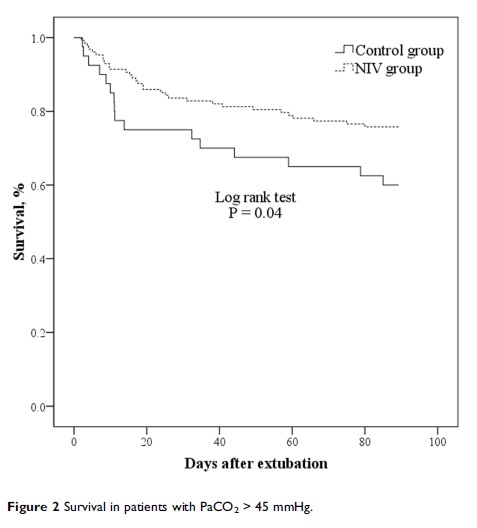
Results: Among patients with PaCO2 > 45 mmHg, 128 and 40 received prophylactic NIV and usual care, respectively. Prophylactic NIV led to lower rates of re-intubation (4% vs 30% at 72 h and 11% vs 35% at 7 days, both p < 0.01) and hospital mortality (18% vs 40%, p < 0.01) than usual care. The proportion of 90-day mortality was also lower in the prophylactic NIV group (log rank test, p = 0.04). Among patients with PaCO2 ≤ 45 mmHg, 32 and 21 received prophylactic NIV and usual care, respectively. In this cohort however, prophylactic NIV neither reduced re-intubation (6% vs 5% at 72 h, p > 0.99, and 9% vs 14% at 7 days, p = 0.67) nor hospital mortality (19% vs 24%, p = 0.74). The proportion of 90-day mortality did not differ between the two groups (log rank test, p = 0.79).
Conclusion: This exploratory study shows that prophylactic NIV benefits COPD patients with PaCO2 > 45 mmHg, but it may not benefit those with PaCO2 ≤ 45 mmHg. Further study with a larger sample size is required to confirm this.
Keywords: noninvasive ventilation, ventilator weaning, re-intubation