119942
论文已发表
注册即可获取德孚的最新动态
IF 收录期刊
- 3.6 Breast Cancer (Dove Med Press)
- 4.3 Clin Epidemiol
- 2.6 Cancer Manag Res
- 3.2 Infect Drug Resist
- 4.1 Clin Interv Aging
- 6.1 Drug Des Dev Ther
- 4.1 Int J Chronic Obstr
- 8.7 Int J Nanomed
- 2.5 Int J Women's Health
- 3.2 Neuropsych Dis Treat
- 2.4 OncoTargets Ther
- 2.6 Patient Prefer Adher
- 2.6 Ther Clin Risk Manag
- 3.1 J Pain Res
- 3.5 Diabet Metab Synd Ob
- 4.5 Psychol Res Behav Ma
- 3.4 Nat Sci Sleep
- 2.4 Pharmgenomics Pers Med
- 2.6 Risk Manag Healthc Policy
- 4.6 J Inflamm Res
- 2.3 Int J Gen Med
- 3.9 J Hepatocell Carcinoma
- 3.3 J Asthma Allergy
- 2.5 Clin Cosmet Investig Dermatol
- 3.0 J Multidiscip Healthc

对未破裂的脑中部动脉瘤治疗中修剪和缠绕的荟萃分析:手术相关并发症的直接比较
Authors Xin W, Xin Q, Yang X
Received 7 August 2019
Accepted for publication 13 November 2019
Published 5 December 2019 Volume 2019:15 Pages 3387—3395
DOI https://doi.org/10.2147/NDT.S226353
Checked for plagiarism Yes
Review by Single-blind
Peer reviewer comments 2
Editor who approved publication: Professor Jun Chen
Background: Endovascular coiling and surgical clipping are routinely used to treat unruptured middle cerebral artery aneurysms (MCAAs). However, the optimal treatment for unruptured MCAAs is controversial. We aimed to systematically and comprehensively compare the clinical outcomes between endovascular coiling and surgical clipping for the treatment of MCAAs.
Method: This meta-analysis retrieved academic articles comparing the clinical outcomes between endovascular coiling and surgical clipping for unruptured MCAAs from the Cochrane Library, Medline, PubMed, and EMBASE databases. The reference articles of the identified studies were carefully reviewed to ensure that all available articles were represented in the study. The meta-analysis was conducted in accordance with the acknowledged the prioritized reported items for systematic review and meta-analysis (PRISMA) guidelines.
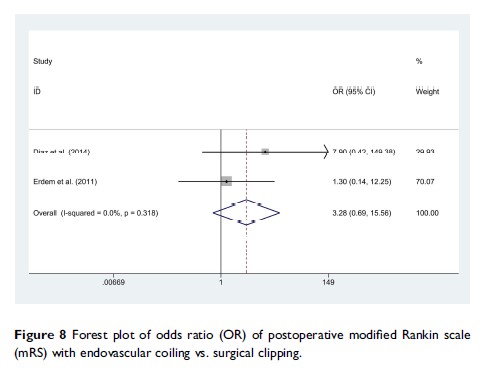
Results: A total of 6 studies, which enrolled a total of 789 participants, were included in our analysis. Of these 789 patients with MCAAs, 144 were assigned to an endovascular coiling group, and 645 were assigned to a surgical clipping group. Our results demonstrated that endovascular coiling was associated with a higher rate of retreatment (OR = 104.926; 95% CI: 12.931 to 851.379; P<0.001) and postoperative complications (OR = 3.157; 95% CI: 1.239 to 8.048; P= 0.016) than surgical clipping, especially for postoperative thrombus without infarction (OR = 4.905, 95% CI: 1.097 to 21.933; P = 0.037). Furthermore, surgical clipping was related to a higher rate of complete occlusion (OR = 0.349, 95% CI: 0.140 to 0.872; P = 0.024) and Glasgow Outcome Scale (GOS) ≥4 (OR = 0.250; 95% CI: 0.072 to 0.867; P= 0.029) than endovascular coiling after the operation. However, there was no significant difference in the rate of death, the proportion of patients with modified Rankin Scale (mRS)>2, infarction, or bleeding.
Conclusion: Although this study has inherent limitations, surgical clipping of unruptured MCAAs resulted in significantly higher complete aneurysm occlusion and GOS≥4 rates and was associated with a lower incidence of retreatment and complication, especially for postoperative thrombus without infarction. Therefore, the effect induced by surgical clipping of unruptured MCAAs remains superior to that induced by endovascular coiling; surgical clipping should be regarded as the first choice of treatment for unruptured MCAAs.
Keywords: endovascular coiling, surgical clipping, unruptured cerebral aneurysms