119942
论文已发表
注册即可获取德孚的最新动态
IF 收录期刊
- 3.6 Breast Cancer (Dove Med Press)
- 4.3 Clin Epidemiol
- 2.6 Cancer Manag Res
- 3.2 Infect Drug Resist
- 4.1 Clin Interv Aging
- 6.1 Drug Des Dev Ther
- 4.1 Int J Chronic Obstr
- 8.7 Int J Nanomed
- 2.5 Int J Women's Health
- 3.2 Neuropsych Dis Treat
- 2.4 OncoTargets Ther
- 2.6 Patient Prefer Adher
- 2.6 Ther Clin Risk Manag
- 3.1 J Pain Res
- 3.5 Diabet Metab Synd Ob
- 4.5 Psychol Res Behav Ma
- 3.4 Nat Sci Sleep
- 2.4 Pharmgenomics Pers Med
- 2.6 Risk Manag Healthc Policy
- 4.6 J Inflamm Res
- 2.3 Int J Gen Med
- 3.9 J Hepatocell Carcinoma
- 3.3 J Asthma Allergy
- 2.5 Clin Cosmet Investig Dermatol
- 3.0 J Multidiscip Healthc

对于接受无痛胃镜检查的中国患者,艾氯胺酮与氯胺酮的药代动力学和安全性比较:一项随机、开放标签的临床研究
Authors Wang J, Huang J, Yang S, Cui C, Ye L, Wang S, Yang G, Pei Q
Received 24 July 2019
Accepted for publication 30 October 2019
Published 6 December 2019 Volume 2019:13 Pages 4135—4144
DOI https://doi.org/10.2147/DDDT.S224553
Checked for plagiarism Yes
Review by Single-blind
Peer reviewer comments 2
Editor who approved publication: Dr Tuo Deng
Purpose: To assess the pharmacokinetics and safety of pure S-ketamine (esketamine) in Chinese patients undergoing painless gastroscopy and evaluate the potential advantage of esketamine in clinical treatment compared with racemate ketamine hydrochloride injection.
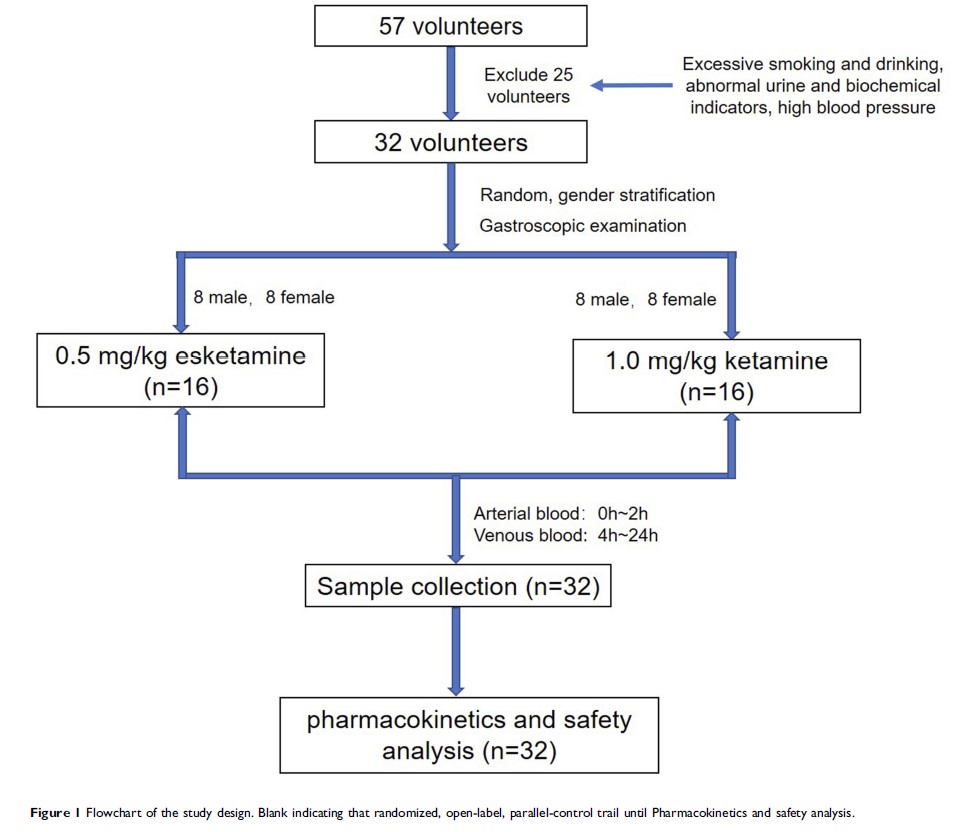
Patients and methods: A randomized, open-label, parallel-controlled, Phase I study was performed with 32 patients undergoing painless gastroscopy. Patients received a single dose of esketamine (0.5 mg/kg) or racemic ketamine (1 mg/kg, esketamine:R-ketamine=1:1), injected in 10 s. Blood samples were collected for pharmacokinetic analysis. The concentrations of esketamine, R-ketamine, S-norketamine, and R-norketamine were measured with a validated liquid chromatography with tandem mass spectrometry (LC-MS/MS) method.
Results: After administering a single dose of esketamine and racemate ketamine, the pharmacokinetics parameters of esketamine and S-norketamine are both similar in treatment groups. The clearance of esketamine in two groups was 18.1±3.2 and 18.4±3.4 mL/min•kg, respectively. However, in the ketamine group, esketamine has a larger clearance than R-ketamine (18.4±3.4 mL/min·kg vs 15.8±3.1 mL/min·kg, P <0.001). Further analysis showed that gender did not affect the pharmacokinetics of esketamine and racemate ketamine. Regarding the safety of esketamine and racemate ketamine, no serious adverse events were observed during treatment, and the incidences of adverse events were 75.0% (esketamine) and 87.5% (racemate ketamine). The main adverse reactions were dizziness, agitation, nausea, vomiting, headache, and fatigue. However, compared with racemic ketamine, esketamine offers a shorter recovery time (9 mins vs. 13 mins, P<0.05) and orientation recovery time (11.5 mins vs. 17 mins, P<0.05) after short anesthesia.
Conclusion: Esketamine administration as a single dose of 0.5 mg/kg was generally safe and tolerated in patients undergoing painless gastroscopy. In terms of anesthesia, a relatively small dose of esketamine can be used instead of racemate ketamine for routine treatment without consideration of gender differences.
Keywords: pharmacokinetics, esketamine, racemate ketamine, anesthesia, Chinese patients