119942
论文已发表
注册即可获取德孚的最新动态
IF 收录期刊
- 3.6 Breast Cancer (Dove Med Press)
- 4.3 Clin Epidemiol
- 2.6 Cancer Manag Res
- 3.2 Infect Drug Resist
- 4.1 Clin Interv Aging
- 6.1 Drug Des Dev Ther
- 4.1 Int J Chronic Obstr
- 8.7 Int J Nanomed
- 2.5 Int J Women's Health
- 3.2 Neuropsych Dis Treat
- 2.4 OncoTargets Ther
- 2.6 Patient Prefer Adher
- 2.6 Ther Clin Risk Manag
- 3.1 J Pain Res
- 3.5 Diabet Metab Synd Ob
- 4.5 Psychol Res Behav Ma
- 3.4 Nat Sci Sleep
- 2.4 Pharmgenomics Pers Med
- 2.6 Risk Manag Healthc Policy
- 4.6 J Inflamm Res
- 2.3 Int J Gen Med
- 3.9 J Hepatocell Carcinoma
- 3.3 J Asthma Allergy
- 2.5 Clin Cosmet Investig Dermatol
- 3.0 J Multidiscip Healthc

Catalpol 通过 BDNF,而不是通过 BDNF/Trkb 信号通路,增强神经再生并抑制新神经元的凋亡
Authors Zhu HF, Shao Y, Qin L, Wang JH, Feng S, Jiang YB, Wan D
Received 15 July 2019
Accepted for publication 8 October 2019
Published 10 December 2019 Volume 2019:13 Pages 4145—4157
DOI https://doi.org/10.2147/DDDT.S223322
Checked for plagiarism Yes
Review by Single-blind
Peer reviewer comments 2
Editor who approved publication: Dr Anastasios Lymperopoulos
Background: The role of catalpol in brain neurogenesis and newborn neuron survival has not been previously determined in permanent middle cerebral artery occlusion (pMCAO).
Methods: Fifty-four rats were divided into 6 groups: pMCAO (model, n=9); sham operation (NS, n=9); catalpol treatment (5 mg/kg and 10 mg/kg subgroups, n=9 each); K252a (n=9); and K252a+catalpol 5 mg/kg (n=9) with stroke. The effects of catalpol on behavior, neurogenesis surrounding the infarction ipsilateral to pMCAO, and the expression of brain-derived neurotrophic factor (BDNF) and its receptor (TrkB) were evaluated. Vehicle or, K252a (i.p.), an inhibitor of TrkB phosphorylase.
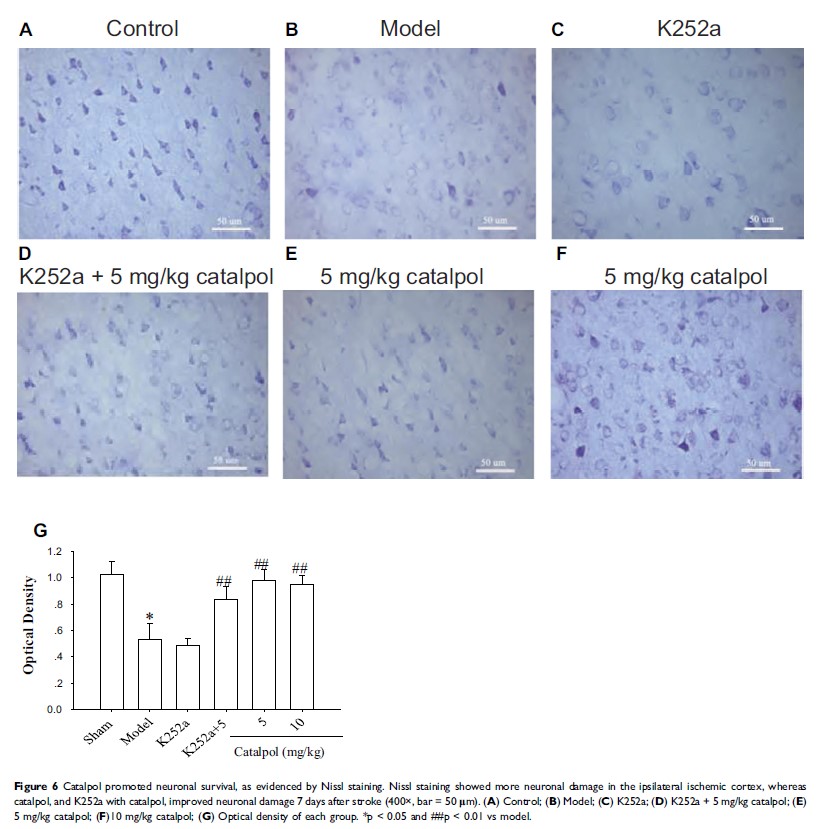
Results: Repeated administration of catalpol reduced neurological deficits and significantly improved neurogenesis. Catalpol increased the number of newborn immature neurons, as determined by BrdU+-Nestin+ and BrdU+-Tuj-1+ staining, and downregulated cleaved caspase 3 in Tuj-1+ cells at day 7 following stroke. Moreover, catalpol increased the protein expression of Tuj-1, MAP2, and the Bcl-2/Bax ratio, as determined using Western blot. Catalpol also significantly increased brain levels of BDNF, but not TrkB, resulting in enhanced survival of newborn neurons via inhibition of apoptosis.
Conclusion: Catalpol may contribute to neurogenesis in infarcted brain regions and help promote the survival of newborn neurons by activating BDNF, but not BDNF/TrkB signaling.
Keywords: catalpol, neurogenesis, permanent middle cerebral artery occlusion, pMCAO, brain derived neurotrophic factor, BDNF, neurological function