119942
论文已发表
注册即可获取德孚的最新动态
IF 收录期刊
- 3.6 Breast Cancer (Dove Med Press)
- 4.3 Clin Epidemiol
- 2.6 Cancer Manag Res
- 3.2 Infect Drug Resist
- 4.1 Clin Interv Aging
- 6.1 Drug Des Dev Ther
- 4.1 Int J Chronic Obstr
- 8.7 Int J Nanomed
- 2.5 Int J Women's Health
- 3.2 Neuropsych Dis Treat
- 2.4 OncoTargets Ther
- 2.6 Patient Prefer Adher
- 2.6 Ther Clin Risk Manag
- 3.1 J Pain Res
- 3.5 Diabet Metab Synd Ob
- 4.5 Psychol Res Behav Ma
- 3.4 Nat Sci Sleep
- 2.4 Pharmgenomics Pers Med
- 2.6 Risk Manag Healthc Policy
- 4.6 J Inflamm Res
- 2.3 Int J Gen Med
- 3.9 J Hepatocell Carcinoma
- 3.3 J Asthma Allergy
- 2.5 Clin Cosmet Investig Dermatol
- 3.0 J Multidiscip Healthc

具有抗肝细胞性肝癌活性的新型单臂抗 c-Met 抗体的制备
Authors Yin Y, Guo J, Teng F, Yu L, Jiang Y, Xie K, Jiang M, Fang J
Received 5 August 2019
Accepted for publication 7 November 2019
Published 10 December 2019 Volume 2019:13 Pages 4173—4184
DOI https://doi.org/10.2147/DDDT.S224491
Checked for plagiarism Yes
Review by Single-blind
Peer reviewer comments 2
Editor who approved publication: Professor Jianbo Sun
Introduction: Antibody-based c-mesenchymal–epithelial transition factor (c-Met) inhibition is a promising strategy for hepatocellular carcinoma (HCC) treatment, but the intrinsic agonistic activity of the anti-c-Met antibody limits its application in drug development. Constructing a monovalent one-armed antibody has been reported to be an effective way to create an inhibitory anti-c-Met antibody.
Materials and methods: In the present study, a novel monovalent one-armed anti-c-Met antibody was constructed using the knobs-into-holes technology, and its inhibitory effects against HCC and the underlying mechanisms were explored.
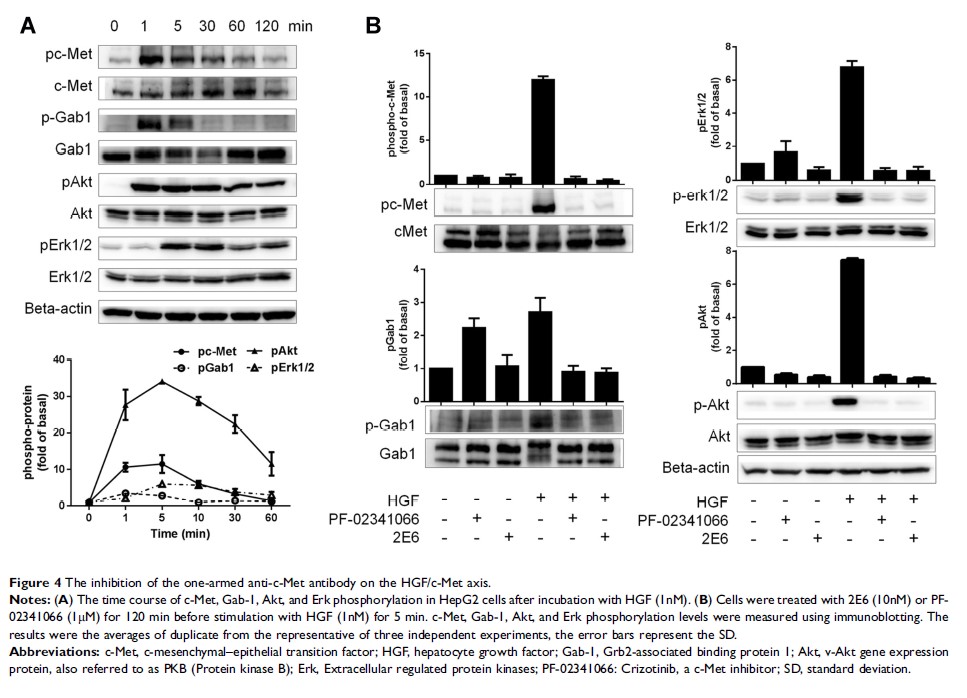
Results: The one-armed anti-c-Met antibody blocked the hepatocyte growth factor (HGF)/c-Met interaction and the subsequent signal transduction, including phosphorylation of c-Met, Grb2-associated binding protein 1(Gab-1), extracellular regulated protein kinases 1/2(Erk1/2), and Akt, also referred to as protein kinase B (PKB) in HCC cell line HepG2. Furthermore, the autocrine stimulation of HepG2 cell proliferation and HGF-induced HCC cell migration were strongly inhibited by the one-armed anti-c-Met antibody. In addition, the antibody also reduced the HGF-induced proliferation and tube formation of human umbilical vein endothelial cells (HUVECs). Treating HepG2-bearing mice with the one-armed anti-c-Met antibody significantly inhibited the tumor growth in the xenograft nude mouse model.
Conclusion: The one-armed anti-c-Met antibody derived from the full-length bivalent anti-c-Met antibody might serve as a potential antitumor agent against HCC.
Keywords: antitumor, c-Met, hepatocellular carcinoma, knobs into holes, monovalent antibody, targeted therapy