119942
论文已发表
注册即可获取德孚的最新动态
IF 收录期刊
- 3.6 Breast Cancer (Dove Med Press)
- 4.3 Clin Epidemiol
- 2.6 Cancer Manag Res
- 3.2 Infect Drug Resist
- 4.1 Clin Interv Aging
- 6.1 Drug Des Dev Ther
- 4.1 Int J Chronic Obstr
- 8.7 Int J Nanomed
- 2.5 Int J Women's Health
- 3.2 Neuropsych Dis Treat
- 2.4 OncoTargets Ther
- 2.6 Patient Prefer Adher
- 2.6 Ther Clin Risk Manag
- 3.1 J Pain Res
- 3.5 Diabet Metab Synd Ob
- 4.5 Psychol Res Behav Ma
- 3.4 Nat Sci Sleep
- 2.4 Pharmgenomics Pers Med
- 2.6 Risk Manag Healthc Policy
- 4.6 J Inflamm Res
- 2.3 Int J Gen Med
- 3.9 J Hepatocell Carcinoma
- 3.3 J Asthma Allergy
- 2.5 Clin Cosmet Investig Dermatol
- 3.0 J Multidiscip Healthc

隧穿纳米管介导的 microRNA-155 细胞间运输可促进膀胱癌细胞的侵袭和增殖能力
Authors Lu JJ, Yang WM, Li F, Zhu W, Chen Z
Received 27 May 2019
Accepted for publication 15 November 2019
Published 10 December 2019 Volume 2019:14 Pages 9731—9743
DOI https://doi.org/10.2147/IJN.S217277
Checked for plagiarism Yes
Review by Single-blind
Peer reviewer comments 2
Editor who approved publication: Dr Mian Wang
Objective: To investigate differential microRNAs’ expression in heterogeneous bladder cancer cells, as well as to investigate the mechanism of changes in invasive and proliferative capacity induced by tunneling nanotubes (TNTs) mediated transport of microRNA between bladder cancer cells of varying histological grade.
Materials and methods: Differences in microRNA expression between bladder cancer cells of different grade were identified from a literature review. The identified heterogeneous microRNAs were analyzed by qPCR in T24 (high grade) and RT4 (low grade) bladder cancer cells. Scanning electron microscopy (SEM) and laser confocal fluorescence microscopy (LCM) were used to observe tunneling nanotubes (TNTs) between RT4 and T24 cells. Differentially expressed microRNA was labeled and traced by Fluorescent In Situ Hybridization (FISH) following co-culture of T24 and RT4 cells. MicroRNA mimic and inhibition technologies were applied to investigate how TNTs-mediated intercellular transport of microRNA affects the invasive and proliferative behavior of bladder cancer cells.
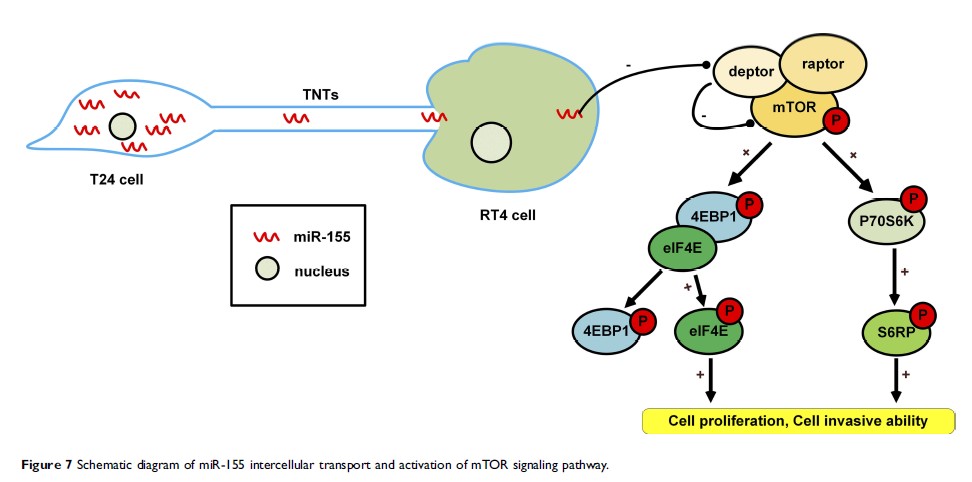
Results: MicroRNA-155 (miR-155) levels were highly expressed in T24 cells, whereas the same was not true in RT4 cells. MiR-155 was confirmed to be a crucial factor sustaining T24 bladder cancer cell proliferation, migration and cell cycle progression by CCK8, Matrigel test and cell cycle analysis, respectively. After T24 and RT4 co-culture, TNTs were assessed by SEM and LCM between T24 and RT4 cells. In addition, we observed TNTs mediated transport of miR-155 from T24 cells to RT4 cells, which thereby acquired a higher proliferative rate, an increased frequency of cells in the S phase, and increased invasive ability in Matrigel test. At the same time, Deptor, the target protein of miR-155 in RT4 cells, was downregulated, followed by mTOR/4EBP1/p70S6K- eIF4e/S6RP signaling activation.
Conclusion: MiR-155 was differentially expressed between RT4 and T24 bladder cancer cells. Intercellular transport of miR-155 via TNTs can promote bladder cancer cell reprogramming by Deptor-mTOR signal pathway activation.
Keywords: tunneling nanotubes, microRNA, bladder cancer, cell invasion, cell proliferation