119942
论文已发表
注册即可获取德孚的最新动态
IF 收录期刊
- 3.6 Breast Cancer (Dove Med Press)
- 4.3 Clin Epidemiol
- 2.6 Cancer Manag Res
- 3.2 Infect Drug Resist
- 4.1 Clin Interv Aging
- 6.1 Drug Des Dev Ther
- 4.1 Int J Chronic Obstr
- 8.7 Int J Nanomed
- 2.5 Int J Women's Health
- 3.2 Neuropsych Dis Treat
- 2.4 OncoTargets Ther
- 2.6 Patient Prefer Adher
- 2.6 Ther Clin Risk Manag
- 3.1 J Pain Res
- 3.5 Diabet Metab Synd Ob
- 4.5 Psychol Res Behav Ma
- 3.4 Nat Sci Sleep
- 2.4 Pharmgenomics Pers Med
- 2.6 Risk Manag Healthc Policy
- 4.6 J Inflamm Res
- 2.3 Int J Gen Med
- 3.9 J Hepatocell Carcinoma
- 3.3 J Asthma Allergy
- 2.5 Clin Cosmet Investig Dermatol
- 3.0 J Multidiscip Healthc

CXCL14 在肝细胞癌组织中受抑制的表达及其在慢性 HBV 感染晚期数量的减少
Authors Lin Y, Chen BM, Yu XL, Yi HC, Niu JJ, Li SL
Received 23 June 2019
Accepted for publication 2 December 2019
Published 12 December 2019 Volume 2019:11 Pages 10435—10443
DOI https://doi.org/10.2147/CMAR.S220528
Checked for plagiarism Yes
Review by Single-blind
Peer reviewer comments 6
Editor who approved publication: Dr Antonella D'Anneo
Introduction: CXCL14 was a significantly under-expressed mRNA in hepatocellular carcinoma tissues according to our microarray analysis, as well as head and neck squamous cell carcinoma and cervical squamous cell carcinoma. CXCL14 was considered a tumor suppressor in some studies; however, its role in HBV infection has not been identified.
Methods: CXCL14 mRNA expression was quantified from 20 male HCC patients, and the fold change in cancer tissues was calculated by comparisons with normal adjacent tissues. Overall, 212 patients with chronic HBV infection and 180 HBV-free controls were recruited to investigate the association between CXCL14 polymorphisms and HBV progression as well as liver function parameters. Serum CXCL14 levels were determined by enzyme-linked immunosorbent assay (ELISA), and comparisons were made between different HBV status and different CXCL14 genotypes.
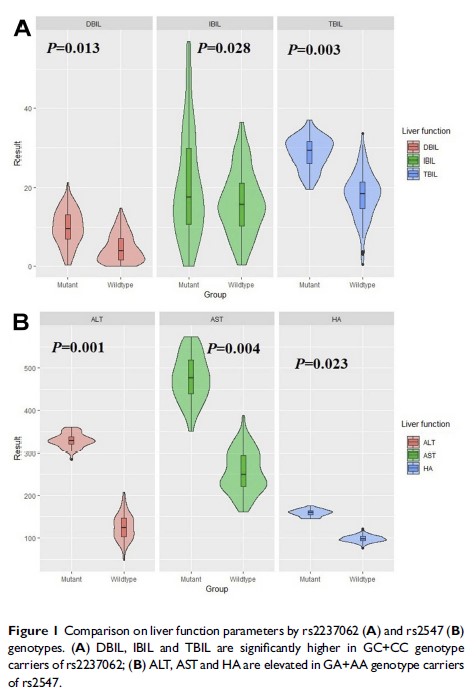
Results: The mRNA expression of CXCL14 was 0.33-fold in HCC tissues when compared with adjacent tissues. The frequencies of rs2237062 and rs2547, but not rs2237061, were significantly different between patients with mild hepatitis and moderate-to-severe hepatitis. Moreover, rs2237062 and rs2547 polymorphisms correlated with impaired liver function parameters. ELISA results suggested that HBV-free controls had the highest level of CXCL14, while mild hepatitis patients had low levels, and patients with moderate-to-severe hepatitis had the lowest level. GA+AA genotypes of rs2547 were associated with reduced levels of serum CXCL14 because it introduced a stop codon at residue 109.
Conclusion: CXCL14 was significantly suppressed in HBV-related HCC tissues, and its polymorphisms were linked with advanced stage chronic HBV infection and impaired liver function.
Keywords: CXCL14, HBV infection, disease progression, polymorphism