119942
论文已发表
注册即可获取德孚的最新动态
IF 收录期刊
- 3.6 Breast Cancer (Dove Med Press)
- 4.3 Clin Epidemiol
- 2.6 Cancer Manag Res
- 3.2 Infect Drug Resist
- 4.1 Clin Interv Aging
- 6.1 Drug Des Dev Ther
- 4.1 Int J Chronic Obstr
- 8.7 Int J Nanomed
- 2.5 Int J Women's Health
- 3.2 Neuropsych Dis Treat
- 2.4 OncoTargets Ther
- 2.6 Patient Prefer Adher
- 2.6 Ther Clin Risk Manag
- 3.1 J Pain Res
- 3.5 Diabet Metab Synd Ob
- 4.5 Psychol Res Behav Ma
- 3.4 Nat Sci Sleep
- 2.4 Pharmgenomics Pers Med
- 2.6 Risk Manag Healthc Policy
- 4.6 J Inflamm Res
- 2.3 Int J Gen Med
- 3.9 J Hepatocell Carcinoma
- 3.3 J Asthma Allergy
- 2.5 Clin Cosmet Investig Dermatol
- 3.0 J Multidiscip Healthc

音乐可以减轻疼痛的不适感:一项脑电图研究的证据
Authors Lu X, Thompson WF, Zhang L, Hu L
Received 12 April 2019
Accepted for publication 29 November 2019
Published 13 December 2019 Volume 2019:12 Pages 3331—3342
DOI https://doi.org/10.2147/JPR.S212080
Checked for plagiarism Yes
Review by Single-blind
Peer reviewer comments 3
Editor who approved publication: Dr Michael E Schatman
Background: Music is sometimes used as an adjunct to pain management. However, there is limited understanding of by what means music modulates pain perception and how the brain responds to nociceptive inputs while listening to music, because clinical practice typically involves the coexistence of multiple therapeutic interventions. To address this challenge, laboratory studies with experimental and control conditions are needed.
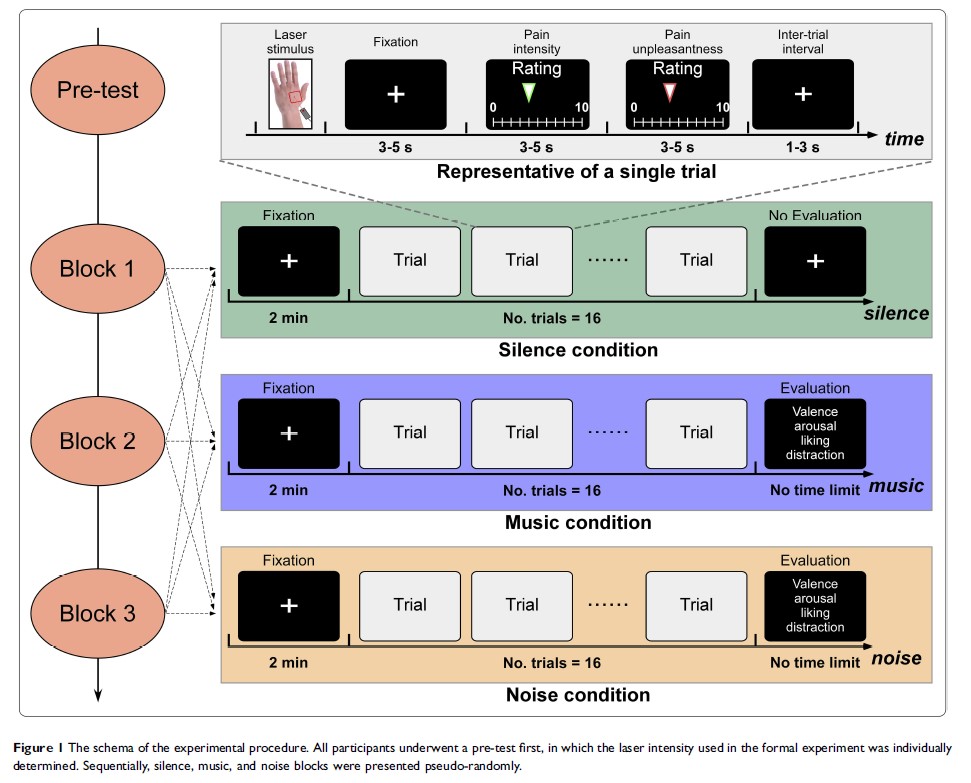
Methods: In the present investigation, we delivered nociceptive laser stimuli on 30 participants under three conditions – participants were sitting in silence, listening to their preferred music, or listening to white noise. Differences among conditions were quantified by self-reports of pain intensity and unpleasantness, and brain activity sampled by electroencephalography (EEG).
Results: Compared with the noise and silence conditions, participants in the music condition reported lower ratings on pain unpleasantness, as reflected by reduced brain oscillations immediately prior to the nociceptive laser stimulus at frequencies of 4–15 Hz in EEG. In addition, participants showed smaller P2 amplitudes in laser-evoked potentials (LEPs) when they were listening to music or white noise in comparison to sitting in silence. These findings suggest that a general modulation effect of sounds on pain, with a specific reduction of pain unpleasantness induced by the positive emotional impact.
Conclusion: Music may serve as a real-time regulator to modulate pain unpleasantness. Results are discussed in view of current understandings of music-induced analgesia.
Keywords: preferred music, pain, analgesic effect, emotional modulation, EEG, brain oscillations