119661
论文已发表
注册即可获取德孚的最新动态
IF 收录期刊
- 3.6 Breast Cancer (Dove Med Press)
- 4.3 Clin Epidemiol
- 2.6 Cancer Manag Res
- 3.2 Infect Drug Resist
- 4.1 Clin Interv Aging
- 6.1 Drug Des Dev Ther
- 4.1 Int J Chronic Obstr
- 8.7 Int J Nanomed
- 2.5 Int J Women's Health
- 3.2 Neuropsych Dis Treat
- 2.4 OncoTargets Ther
- 2.6 Patient Prefer Adher
- 2.6 Ther Clin Risk Manag
- 3.1 J Pain Res
- 3.5 Diabet Metab Synd Ob
- 4.5 Psychol Res Behav Ma
- 3.4 Nat Sci Sleep
- 2.4 Pharmgenomics Pers Med
- 2.6 Risk Manag Healthc Policy
- 4.6 J Inflamm Res
- 2.3 Int J Gen Med
- 3.9 J Hepatocell Carcinoma
- 3.3 J Asthma Allergy
- 2.5 Clin Cosmet Investig Dermatol
- 3.0 J Multidiscip Healthc

电针通过抑制 Nogo/NgR and Rho/ROCK 信号通路促进大鼠脊髓损伤后轴突再生
Authors Xiao WP, Ding LLQ, Min YJ, Yang HY, Yao HH, Sun J, Zhou X, Zeng XB, Yu W
Received 23 May 2019
Accepted for publication 8 October 2019
Published 13 December 2019 Volume 2019:15 Pages 3429—3442
DOI https://doi.org/10.2147/NDT.S216874
Checked for plagiarism Yes
Review by Single-blind
Peer reviewer comments 2
Editor who approved publication: Dr Yuping Ning
Purpose: To observe the changes of Nogo/NgR and Rho/ROCK signaling pathway-related gene and protein expression in rats with spinal cord injury (SCI) treated with electroacupuncture (EA) and to further investigate the possible mechanism of EA for treating SCI.
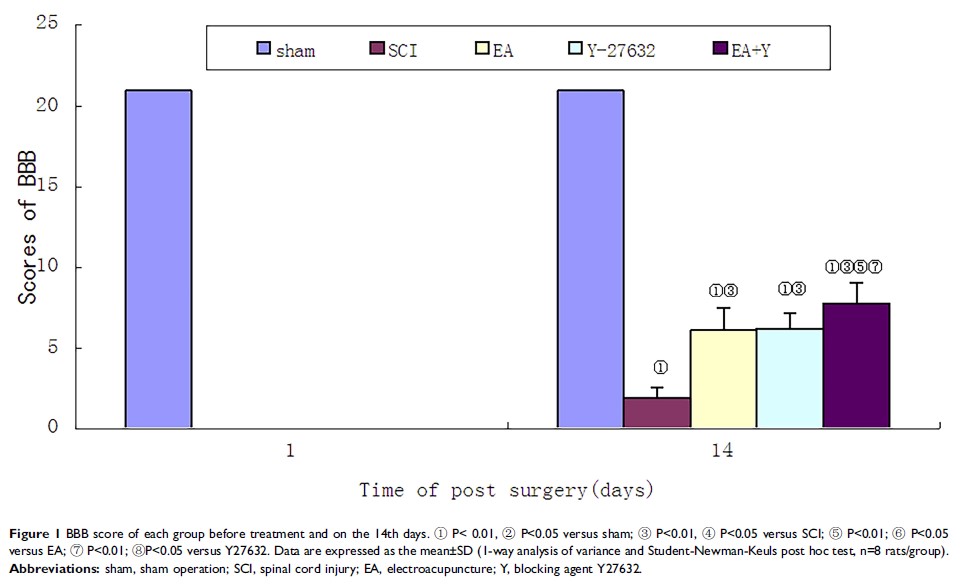
Methods: Allen’s method was used to create the SCI rat model. Sixty-four model rats were further subdivided into four subgroups, namely, the SCI model group (SCI), EA treatment group (EA), blocking agent Y27632 treatment group (Y27632) and EA+blocking agent Y27632 treatment group (EA+Y), according to the treatment received. The rats were subjected to EA and/or blocking agent Y27632 treatment. After 14 days, injured spinal cord tissue was extracted for analysis. The mRNA and protein expression levels were determined by real-time fluorescence quantitative PCR and Western blotting, respectively. Cell apoptosis changes in the spinal cord were evaluated by in situ hybridization. Hindlimb motor function in the rats was evaluated by Basso-Beattie-Bresnahan assessment methods.
Results: Except for RhoA protein expression, compared with the SCI model group, EA, blocking agent Y27632 and EA+blocking agent Y27632 treatment groups had significantly reduced mRNA and protein expression of Nogo-A, NgR, LINGO-1, RhoA and ROCK II in spinal cord tissues, increased mRNA and protein expression of MLCP, decreased p-MYPT1 protein expression and p-MYPT1/MYPT1 ratio, and caspase3 expression, and improved lower limb movement function after treatment for 14 days (P<0.01 or <0.05). The combination of EA and the blocking agent Y27632 was superior to EA or blocking agent Y27632
treatment alone (P < 0.01 or <0.05).
Conclusion: EA may have an obvious inhibitory effect on the Nogo/NgR and Rho/ROCK signaling pathway after SCI, thereby reducing the inhibition of axonal growth, which may be a key mechanism of EA treatment for SCI.
Keywords: Nogo/NgR, Rho/ROCK, MLCP, MYPT1, spinal cord injury, Y27632, electroacupuncture