117207
论文已发表
注册即可获取德孚的最新动态
IF 收录期刊
- 3.6 Breast Cancer (Dove Med Press)
- 4.3 Clin Epidemiol
- 2.6 Cancer Manag Res
- 3.2 Infect Drug Resist
- 4.1 Clin Interv Aging
- 6.1 Drug Des Dev Ther
- 4.1 Int J Chronic Obstr
- 8.7 Int J Nanomed
- 2.5 Int J Women's Health
- 3.2 Neuropsych Dis Treat
- 2.4 OncoTargets Ther
- 2.6 Patient Prefer Adher
- 2.6 Ther Clin Risk Manag
- 3.1 J Pain Res
- 3.5 Diabet Metab Synd Ob
- 4.5 Psychol Res Behav Ma
- 3.4 Nat Sci Sleep
- 2.4 Pharmgenomics Pers Med
- 2.6 Risk Manag Healthc Policy
- 4.6 J Inflamm Res
- 2.3 Int J Gen Med
- 3.9 J Hepatocell Carcinoma
- 3.3 J Asthma Allergy
- 2.5 Clin Cosmet Investig Dermatol
- 3.0 J Multidiscip Healthc

三种皮肤护理方案对婴儿皮肤状况影响的随机试验临床评估
Authors Duan Y, Ma L, Galzote C, Kong FQ, Shen CP
Received 20 February 2019
Accepted for publication 10 October 2019
Published 16 December 2019 Volume 2019:12 Pages 895—909
DOI https://doi.org/10.2147/CCID.S204216
Checked for plagiarism Yes
Review by Single-blind
Peer reviewer comments 3
Editor who approved publication: Dr Jeffrey Weinberg
Introduction: Few data are available on the comparison between the effects on infant skin of skin care products and those of water alone.
Patients and methods: In this single-center, evaluator-blind, parallel-group pilot study, healthy infants were randomized to near-daily washing for 12 weeks (starting in the summer and finishing in the winter months) with a mild liquid baby wash followed by use of baby lotion (wash+lotion), water followed by baby lotion (water+lotion), or water alone. Clinical and instrumental assessments of skin moisturization and barrier function were made.
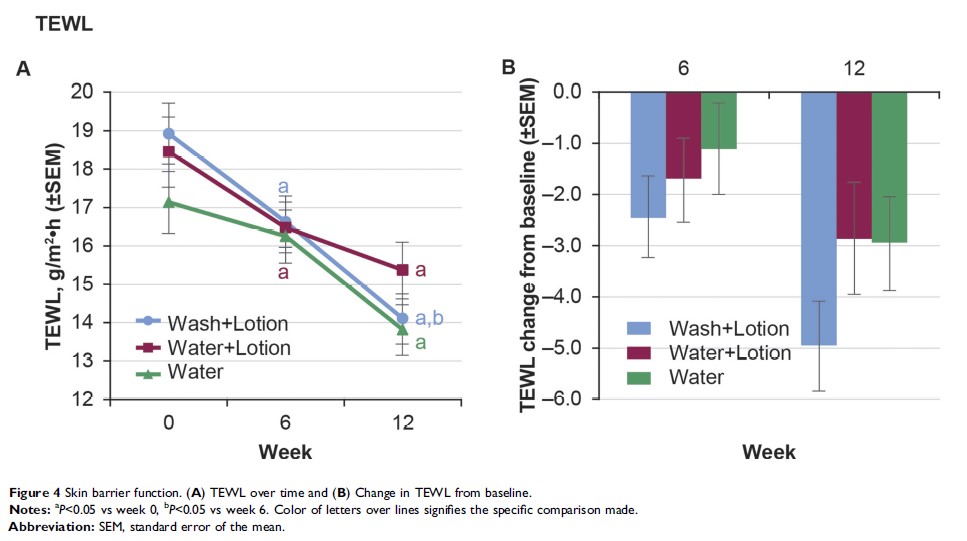
Results: As expected the skin condition in all groups was affected by the change of the season. The skin of infants in all groups was mildly deteriorated (clinical grading) and with reduced moisture levels and increased barrier function. Instrumental measurements indicated that skin moisture and barrier function were better maintained in the wash+lotion and water+lotion groups than in the water-only group at week 12. Clinical assessment scores increased slightly over 12 weeks in all groups (P <0.05). At week 12, the wash+lotion group (n = 44) had significantly less change from baseline in overall skin condition and softness (lower scores) than did the water+lotion (n = 43) or water-only (n = 43) groups. The wash+lotion regimen maintained stable erythema and rash scores with lower mean values over time than in the other groups.
Conclusion: A regimen of a liquid baby wash and a baby skin lotion for 12 weeks resulted in less detrimental changes in instrumental and clinical measures of skin than using water and lotion or water alone.
Keywords: skin abnormalities, erythema, exanthema, emollients, infant