119661
论文已发表
注册即可获取德孚的最新动态
IF 收录期刊
- 3.6 Breast Cancer (Dove Med Press)
- 4.3 Clin Epidemiol
- 2.6 Cancer Manag Res
- 3.2 Infect Drug Resist
- 4.1 Clin Interv Aging
- 6.1 Drug Des Dev Ther
- 4.1 Int J Chronic Obstr
- 8.7 Int J Nanomed
- 2.5 Int J Women's Health
- 3.2 Neuropsych Dis Treat
- 2.4 OncoTargets Ther
- 2.6 Patient Prefer Adher
- 2.6 Ther Clin Risk Manag
- 3.1 J Pain Res
- 3.5 Diabet Metab Synd Ob
- 4.5 Psychol Res Behav Ma
- 3.4 Nat Sci Sleep
- 2.4 Pharmgenomics Pers Med
- 2.6 Risk Manag Healthc Policy
- 4.6 J Inflamm Res
- 2.3 Int J Gen Med
- 3.9 J Hepatocell Carcinoma
- 3.3 J Asthma Allergy
- 2.5 Clin Cosmet Investig Dermatol
- 3.0 J Multidiscip Healthc

大小、剂量和给药途径对 BALB/c 小鼠玉米醇溶蛋白纳米颗粒免疫原性的影响
Authors Li F, Chen Y, Liu S, Pan X, Liu Y, Zhao H, Yin X, Yu C, Kong W, Zhang Y
Received 8 August 2019
Accepted for publication 13 November 2019
Published 17 December 2019 Volume 2019:14 Pages 9917—9928
DOI https://doi.org/10.2147/IJN.S226466
Checked for plagiarism Yes
Review by Single-blind
Peer reviewer comments 3
Editor who approved publication: Dr Linlin Sun
Background: Zein-based carriers are a promising delivery system for biomedical applications. However, few studies involve systematic investigation on their in vivo biocompatibility and immunogenicity.
Purpose: The objective of this study was to identify the immunogenicity, type of immune response, biocompatibility and systemic recall immune response of zein nanoparticles administrated via different routes in mice.
Animals and methods: Female Balb/c mice were selected as the animal model in this paper. The effect of particle size, dose and inoculation routes on immunogenicity were systematically explored. The mice were challenged at week 50 via intramuscular and subcutaneous routes to investigate the systemic recall immune responses of zein nanoparticles. Hematoxylin and eosin staining was performed to investigate the biocompatibility of zein nanoparticles at injection sites.
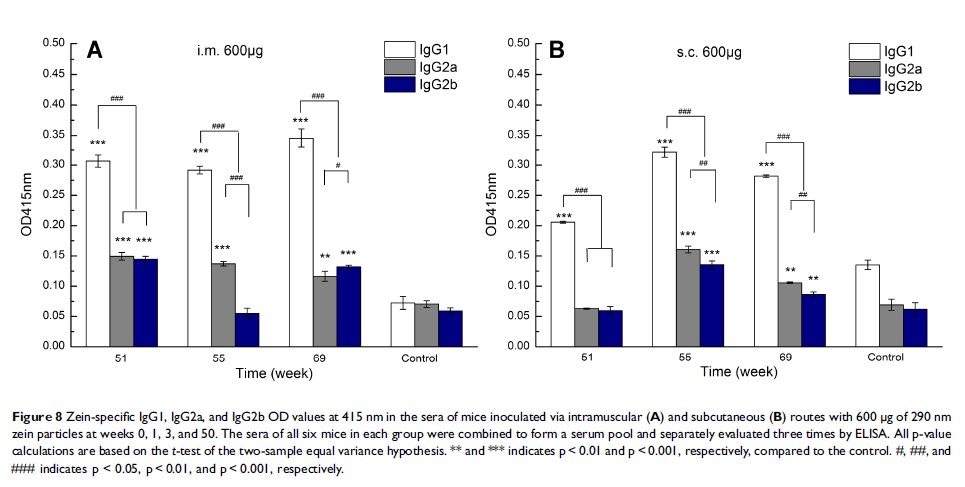
Results: The administration of zein particles by parenteral routes led to a long-term systemic immune response. Particle size did not affect zein-specific IgG antibody titers. IgG antibody titers and inflammatory cell infiltration at the injection sites resulting from intramuscular zein particle injection were significantly higher than those from subcutaneous injection of the same dose. For intramuscular inoculation, dose-dependent IgG antibody titers were observed after the third inoculation, while no significant difference was found via the subcutaneous route. For both routes, IgG titer showed a time-dependent decrease at all dose levels from week 5 onward, and finally plateaued at week 28. The IgG subtype assay showed a predominant Th2-type immune response for both administration routes. Challenge with zein nanoparticles at week 50 led to a significant increase in specific IgG titer at all dose levels, indicating systemic recall immune responses. Interestingly, IgG antibody levels in the subcutaneous groups showed a delayed decrease compared to those of the intramuscular injection groups at all dose levels.
Conclusion: This study indicated that immunogenicity may be one of the key challenges of using zein nanoparticles as carriers via parenteral administration. Further investigation is needed to illustrate zein immunogenicity in other forms, and the possible effect of systemic recall immune response on in vivo pharmacokinetic characteristics.
Keywords: zein, protein carrier, drug delivery, immune response, intramuscular injection, subcutaneous injection, parenteral administration