119661
论文已发表
注册即可获取德孚的最新动态
IF 收录期刊
- 3.6 Breast Cancer (Dove Med Press)
- 4.3 Clin Epidemiol
- 2.6 Cancer Manag Res
- 3.2 Infect Drug Resist
- 4.1 Clin Interv Aging
- 6.1 Drug Des Dev Ther
- 4.1 Int J Chronic Obstr
- 8.7 Int J Nanomed
- 2.5 Int J Women's Health
- 3.2 Neuropsych Dis Treat
- 2.4 OncoTargets Ther
- 2.6 Patient Prefer Adher
- 2.6 Ther Clin Risk Manag
- 3.1 J Pain Res
- 3.5 Diabet Metab Synd Ob
- 4.5 Psychol Res Behav Ma
- 3.4 Nat Sci Sleep
- 2.4 Pharmgenomics Pers Med
- 2.6 Risk Manag Healthc Policy
- 4.6 J Inflamm Res
- 2.3 Int J Gen Med
- 3.9 J Hepatocell Carcinoma
- 3.3 J Asthma Allergy
- 2.5 Clin Cosmet Investig Dermatol
- 3.0 J Multidiscip Healthc

miR-503 通过靶向 LRIG2 作用于 VEGFA,从而抑制胶质瘤的增殖、迁移和血管生成
Authors Sun SL, Shu YG, Tao MY
Received 10 July 2019
Accepted for publication 4 November 2019
Published 19 December 2019 Volume 2019:11 Pages 10599—10608
DOI https://doi.org/10.2147/CMAR.S222681
Checked for plagiarism Yes
Review by Single-blind
Peer reviewer comments 2
Editor who approved publication: Dr Alexandra R. Fernandes
Background: Glioma is a common malignant tumor of the human central nervous system, and the pathological characteristics include invasive growth, angiogenesis, and so on. Ectopic expression of miR-503 works as a critical factor in cancer cell proliferation, migration, and capillary-like tube formation. The potential mechanisms of miR-503 in angiogenesis of glioma cells are still not reported.
Methods: The expression levels of miR-503, LRIG2, and VEGFA mRNA and protein were performed by quantitative reverse transcription-PCR or Western blot assay. Dual-Luciferase reporter gene assay was used to determine the interaction between miR-503 and LRIG2. The concentration of VEGFA was measured using the ELISA method. The cell proliferation, migration, and angiogenesis of cocultured HCMEC/D3 cells were analyzed by MTT assay, transwell detection, and tube formation assay, respectively.
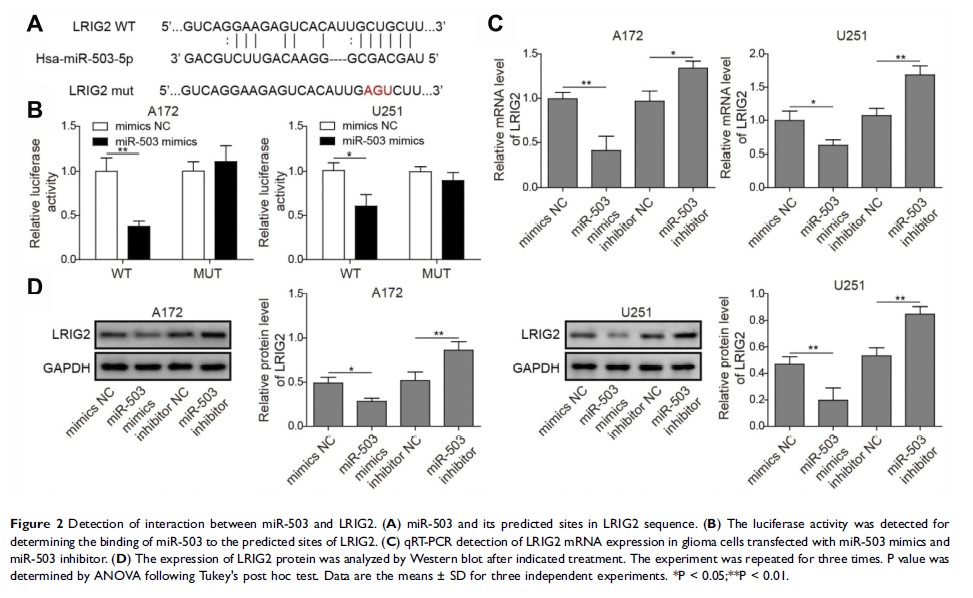
Results: The expression levels of LRIG2 and VEGFA were reduced in glioma cells with miR-503 overexpression and enhanced with miR-503 inhibition. Moreover, cell proliferation, migration, and angiogenesis of cocultured HCMEC/D3 cells were alleviated with miR-503 mimics transfection. VEGFA and miR-503 inhibitor promoted cell proliferation, cell migration, and angiogenesis. Luciferase reporter gene assay revealed that miR-503 could directly target LRIG2. Furthermore, knockdown of LRIG2 or addition of VEGF inhibitor bevacizumab could abrogate the effect of miR-503 inhibitor on VEGFA expression, as well as the promotion of cell proliferation, migration, and angiogenesis.
Conclusion: MiR-503 mediated LRIG2 suppression and regulated the expression of VEGFA, thereby reducing cell proliferation, migration, and angiogenesis of glioma cells. These results provide new insight into the action mechanism of miR-503-modulated signaling pathway in angiogenesis of glioma cells.
Keywords: glioma, miR-503, LRIG2, VEGFA, angiogenesis