119661
论文已发表
注册即可获取德孚的最新动态
IF 收录期刊
- 3.6 Breast Cancer (Dove Med Press)
- 4.3 Clin Epidemiol
- 2.6 Cancer Manag Res
- 3.2 Infect Drug Resist
- 4.1 Clin Interv Aging
- 6.1 Drug Des Dev Ther
- 4.1 Int J Chronic Obstr
- 8.7 Int J Nanomed
- 2.5 Int J Women's Health
- 3.2 Neuropsych Dis Treat
- 2.4 OncoTargets Ther
- 2.6 Patient Prefer Adher
- 2.6 Ther Clin Risk Manag
- 3.1 J Pain Res
- 3.5 Diabet Metab Synd Ob
- 4.5 Psychol Res Behav Ma
- 3.4 Nat Sci Sleep
- 2.4 Pharmgenomics Pers Med
- 2.6 Risk Manag Healthc Policy
- 4.6 J Inflamm Res
- 2.3 Int J Gen Med
- 3.9 J Hepatocell Carcinoma
- 3.3 J Asthma Allergy
- 2.5 Clin Cosmet Investig Dermatol
- 3.0 J Multidiscip Healthc

AR-42:一种 Pan-HDAC 抑制剂,在食管鳞状细胞癌中发挥抗肿瘤和抑制肿瘤血管生成的活性
Authors Zhu Y, Yuan T, Zhang Y, Shi J, Bai L, Duan X, Tong R, Zhong L
Received 10 April 2019
Accepted for publication 1 December 2019
Published 19 December 2019 Volume 2019:13 Pages 4321—4330
DOI https://doi.org/10.2147/DDDT.S211665
Checked for plagiarism Yes
Review by Single-blind
Peer reviewer comments 2
Editor who approved publication: Prof. Dr. Cristiana Tanase
Purpose: Esophageal squamous cell carcinoma (ESCC) is a refractory malignancy with high morbidity and mortality. Thus, there is an urgent need to find effective targets and agents for ESCC treatment. The purpose of this study was to assess the anti-ESCC effects of a pan-histone deacetylase (HDAC) inhibitor AR-42 and its mechanisms of action.
Methods: Immunohistochemical staining was performed to detect HDAC1 expression in ESCC and adjacent tissue samples. MTT assay, Edu cell proliferation test, flow cytometry, and subcutaneous xenograft were used to assess the anti-ESCC effects of AR-42; furthermore, the antiangiogenic activity of AR-42 was evaluated using endothelial cell migration, invasion, and tube formation assays as well as zebrafish angiogenesis assay. Western blot analysis was performed to explore the underlying mechanism of the anti-ESCC activity of AR-42.
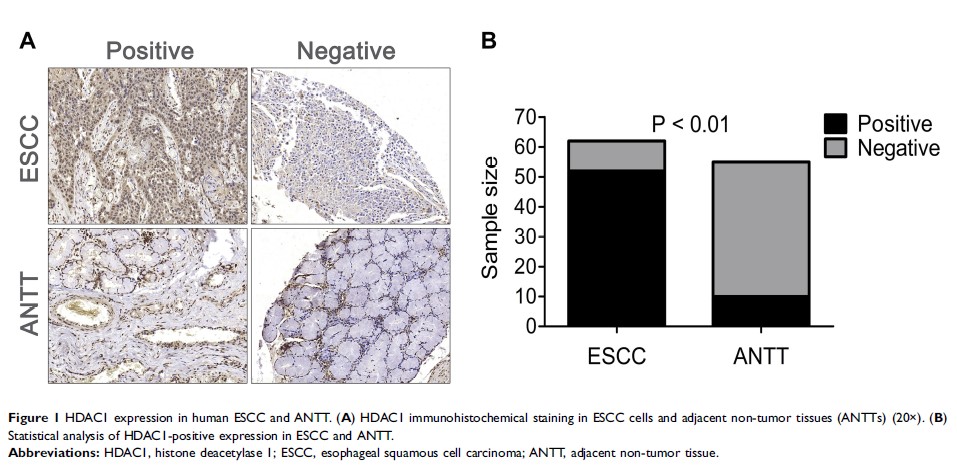
Results: HDAC1-positive expression was much higher in ESCC cells than in paracancerous tissues, and the elevated HDAC1 expression was a strong indicator of lymph node metastasis and a more advanced TNM stage of ESCC. Moreover, AR-42 potently suppressed ESCC cell growth through cellular proliferation inhibition and apoptosis induction. Moreover, AR-42 displayed a moderate antiangiogenic activity, and it could significantly inhibit the migration, invasion and tubulogenesis of human umbilical vein endothelial cells as well as intersegmental vessel formation in zebrafish at micromolar concentrations. More importantly, the inhibitory activity of AR-42 on ESCC cells and angiogenesis could also be observed in the TE-1 xenograft model. Further studies showed that AR-42 exerts its anti-ESCC effects mainly by upregulating the expression of p21 and blocking the transduction of multiple signaling cascades related to tumor growth, especially Stat3-mediated signaling.
Conclusion: Overall, AR-42 has significant potency for inhibiting ESCC cell growth and shows moderate effect in suppressing angiogenesis, displaying strong anti-ESCC effects in vitro and in vivo. Thus, AR-42 deserves further evaluation as a potential candidate for ESCC therapy.
Keywords: esophageal squamous cell cancer, AR-42, histone deacetylase, angiogenesis