119661
论文已发表
注册即可获取德孚的最新动态
IF 收录期刊
- 3.6 Breast Cancer (Dove Med Press)
- 4.3 Clin Epidemiol
- 2.6 Cancer Manag Res
- 3.2 Infect Drug Resist
- 4.1 Clin Interv Aging
- 6.1 Drug Des Dev Ther
- 4.1 Int J Chronic Obstr
- 8.7 Int J Nanomed
- 2.5 Int J Women's Health
- 3.2 Neuropsych Dis Treat
- 2.4 OncoTargets Ther
- 2.6 Patient Prefer Adher
- 2.6 Ther Clin Risk Manag
- 3.1 J Pain Res
- 3.5 Diabet Metab Synd Ob
- 4.5 Psychol Res Behav Ma
- 3.4 Nat Sci Sleep
- 2.4 Pharmgenomics Pers Med
- 2.6 Risk Manag Healthc Policy
- 4.6 J Inflamm Res
- 2.3 Int J Gen Med
- 3.9 J Hepatocell Carcinoma
- 3.3 J Asthma Allergy
- 2.5 Clin Cosmet Investig Dermatol
- 3.0 J Multidiscip Healthc

在不同病房的老年住院患者中确定虚弱及危险因素:中国的一个横断面研究
Authors Liang YD, Zhang YN, Li YM, Chen YH, Xu JY, Liu M, Li J, Ma Z, Qiao LL, Wang Z, Yang JF, Wang H
Received 29 July 2019
Accepted for publication 1 December 2019
Published 19 December 2019 Volume 2019:14 Pages 2249—2259
DOI https://doi.org/10.2147/CIA.S225149
Checked for plagiarism Yes
Review by Single-blind
Peer reviewer comments 4
Editor who approved publication: Dr Zhi-Ying Wu
Objectives: To survey the difference of frailty prevalence in elderly inpatients amongdifferent wards; to compare the diagnostic performance of five frailty measurements (Clinical Frailty Scale [CFS], FRAIL, Fried, Edmonton, Frailty Index [FI]) in identifying frailty; and to explore the risk factors of frailty in elderly inpatients.
Participants and methods: This was a cross-sectional study including 1000 inpatients (mean age 75.2±6.7 years, 51.5% male; 542, 229, and 229 patients from cardiology, non-surgical, and surgical wards, respectively) in a tertiary hospital from September 2018 to February 2019. We applied the combined index to integrate the five frailty measurements mentioned above as the gold standard of frailty diagnosis. Multivariate logistic regression models were used to determine the independent risk factors of frailty.
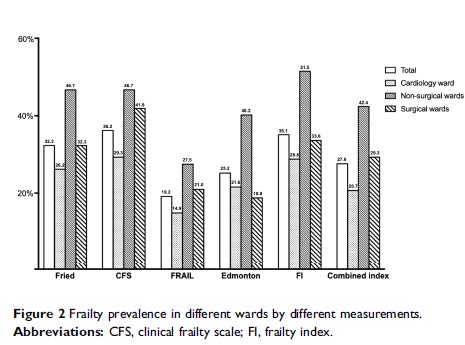
Results: Frailty prevalence was 32.3% (Fried), 36.2% (CFS), 19.2% (FRAIL), 25.2% (Edmonton), 35.1% (FI) in all patients. The frailty was more common in non-surgical wards, regardless of the frailty assessment tools used (non-surgical wards: 27.5% to 51.5%; cardiology ward: 14.9% to 29.3%; surgical wards: 18.8% to 41.9%). CFS≥5 showed a sensitivity of 94.1% and a specificity of 85.2% for all patients. FI≥0.25 showed a sensitivity of 94.8% and a specificity of 87.0% for all patients. Age [odds ratio (OR) = 1.089, P<0.001], education level (OR = 0.782, P=0.001), heart rate (OR = 1.025, P<0.001), albumin (OR = 0.911, P=0.002), log D-dimer (OR = 2.940, P<0.001), ≥5 comorbidities (OR = 2.164, P=0.002), and ≥5 medications (OR = 2.819, P<0.001) were independently associated with frailty in all participants.
Conclusion: Frailty is common among elderly inpatients, especially in non-surgical wards. CFS is a preferred screening tool and FI may be an optimal assessment tool. Old age, low educational level, fast heart rate, low albumin, high D-dimer, ≥5 comorbidities, and polypharmacy are independent risk factors of frailty in elderly hospitalized patients.
Keywords: frailty, elderly hospitalized patients, wards, risk factor, China