119661
论文已发表
注册即可获取德孚的最新动态
IF 收录期刊
- 3.6 Breast Cancer (Dove Med Press)
- 4.3 Clin Epidemiol
- 2.6 Cancer Manag Res
- 3.2 Infect Drug Resist
- 4.1 Clin Interv Aging
- 6.1 Drug Des Dev Ther
- 4.1 Int J Chronic Obstr
- 8.7 Int J Nanomed
- 2.5 Int J Women's Health
- 3.2 Neuropsych Dis Treat
- 2.4 OncoTargets Ther
- 2.6 Patient Prefer Adher
- 2.6 Ther Clin Risk Manag
- 3.1 J Pain Res
- 3.5 Diabet Metab Synd Ob
- 4.5 Psychol Res Behav Ma
- 3.4 Nat Sci Sleep
- 2.4 Pharmgenomics Pers Med
- 2.6 Risk Manag Healthc Policy
- 4.6 J Inflamm Res
- 2.3 Int J Gen Med
- 3.9 J Hepatocell Carcinoma
- 3.3 J Asthma Allergy
- 2.5 Clin Cosmet Investig Dermatol
- 3.0 J Multidiscip Healthc

中国百岁老人和近百岁老人高尿酸血症的危险因素
Authors Han QX, Zhang D, Zhao YL, Liu L, Li J, Zhang F, Luan FX, Liu DW, Liu ZS, Cai GY, Chen XM, Zhu HY
Received 13 July 2019
Accepted for publication 21 October 2019
Published 19 December 2019 Volume 2019:14 Pages 2239—2247
DOI https://doi.org/10.2147/CIA.S223048
Checked for plagiarism Yes
Review by Single-blind
Peer reviewer comments 2
Editor who approved publication: Dr Zhi-Ying Wu
Purpose: Hyperuricemia is an important potential pathogenic factor for hypertension, cardiovascular disease and stroke. The current study aimed to investigate the prevalence of hyperuricemia and its relationship to lifestyle characteristics and dietary habits in centenarians and near-centenarians.
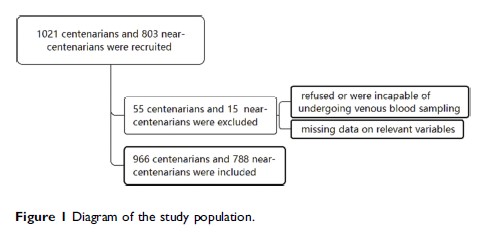
Patients and methods: In total, 966 centenarians and 788 near-centenarians were included. Community-based surveys were conducted to collect information about lifestyle. Blood examinations were performed using enzymatic assays. T-tests and χ2 tests were used to investigate significant indicators of hyperuricemia, and multivariate logistic regression was used to analyze the related risk factors. A comprehensive analysis of nineteen modifiable factors, including lifestyle characteristics, dietary habits, general characteristics and blood test indexes, was conducted.
Results: The prevalence of hyperuricemia was 29.02%. The percentage of men, waist circumference (WC), waist-hip ratio, estimated glomerular filtration rate (eGFR), levels of total protein (TP), alanine aminotransferase, aspartate aminotransferase, triglycerides, high-density lipoprotein cholesterol, serum homocysteine, serum uric acid, serum urea and serum creatinine, passive smoking, alcohol consumption, snoring, preference for fried flavors, and meat, seafood and vegetable consumption were significantly different between the hyperuricemia group and the normouricemia group (p<0.05). Multivariate logistic regression analysis showed that WC (OR=1.020), eGFR (OR=0.960), TP level (OR=1.038), serum urea level (OR=1.154), passive smoking (OR=2.589), snoring (OR=2.003), meat consumption (OR=2.506), seafood consumption (OR=1.422) and vegetable consumption (OR=0.521) were significantly associated with the risk of hyperuricemia (p<0.05).
Conclusion: Low eGFR and vegetable consumption, high WC, TP, and serum urea levels, passive smoking, snoring, and high meat and seafood consumption were independent risk factors for hyperuricemia. It is recommended that people at high risk for hyperuricemia should actively limit their intake of fried food, alcohol and purine-rich food, increase their intake of fresh vegetables, actively treat sleep apnea syndrome, avoid passive smoking, maintain a healthy WC and seek to improve their kidney and liver function.
Keywords: centenarians, hyperuricemia, lifestyle, dietary, risk factors