119661
论文已发表
注册即可获取德孚的最新动态
IF 收录期刊
- 3.6 Breast Cancer (Dove Med Press)
- 4.3 Clin Epidemiol
- 2.6 Cancer Manag Res
- 3.2 Infect Drug Resist
- 4.1 Clin Interv Aging
- 6.1 Drug Des Dev Ther
- 4.1 Int J Chronic Obstr
- 8.7 Int J Nanomed
- 2.5 Int J Women's Health
- 3.2 Neuropsych Dis Treat
- 2.4 OncoTargets Ther
- 2.6 Patient Prefer Adher
- 2.6 Ther Clin Risk Manag
- 3.1 J Pain Res
- 3.5 Diabet Metab Synd Ob
- 4.5 Psychol Res Behav Ma
- 3.4 Nat Sci Sleep
- 2.4 Pharmgenomics Pers Med
- 2.6 Risk Manag Healthc Policy
- 4.6 J Inflamm Res
- 2.3 Int J Gen Med
- 3.9 J Hepatocell Carcinoma
- 3.3 J Asthma Allergy
- 2.5 Clin Cosmet Investig Dermatol
- 3.0 J Multidiscip Healthc

劈开腓肠肌外侧联合入路治疗后外侧胫骨平台骨折
Authors Chen C, Huang L, Zheng H, Liu L, Chen Y, Xie X, Wang Y
Received 21 June 2019
Accepted for publication 2 December 2019
Published 19 December 2019 Volume 2019:15 Pages 1461—1467
DOI https://doi.org/10.2147/TCRM.S220307
Checked for plagiarism Yes
Review by Single-blind
Peer reviewer comments 2
Editor who approved publication: Professor Deyun Wang
Background: Several approaches of fracture reduction and fixation are employed in complex tibial plateau fractures. However, there is a lack of consensus regarding reduction and fixation for fractures to the posterolateral part of the tibial plateau.
Hypothesis: The combined direct posterior split-gastrocnemius approach may be a choice of the posterior part involved comminuted tibial plateau fractures.
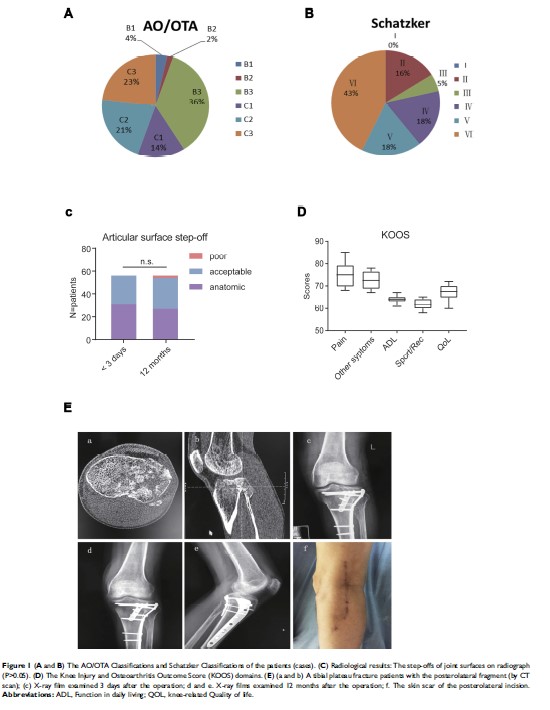
Patients and methods: We review cases of 216 patients with tibial plateau fracture and subsequent operation from 2012/1/1 to 2017/1/1. Fifty-six cases involved posterolateral plateau damage. For these 56 patients, we use anteromedial and direct posterior split-gastrocnemius approaches or anterolateral and direct posterior split-gastrocnemius approaches to fix the posterolateral and medial or lateral segments.
Results: From the radiography films, all patients (56/56) achieved a good reduction of the articular surface after surgery (31 patients were anatomic reduction, 25 patients were acceptable reduction). After 12 months follow up, only 2 patients showed poor reduction and no significant difference between <3 days after surgery and 12 months follow up. All patients acquired good knee functions at 12 months’ time-point of the fracture surgery. These patients have less pain and other related symptoms in daily living according to the Knee Injury and Osteoarthritis Scores.
Conclusion: The direct posterior split-gastrocnemius approach provides efficient and less invasive access to the posterolateral tibial plateau, which is suitable for direct reduction and rigid fixation to the fragments of posterolateral tibial fractures. It is a valuable choice when mapping a surgical approach to tibial plateau fracture reduction involving the posterior tibial plateau and its implementation may offer better post-operative functionality relative to alternative approaches.
Keywords: tibial plateau, posterior split-gastrocnemius approach, posterolateral, outcomes