119661
论文已发表
注册即可获取德孚的最新动态
IF 收录期刊
- 3.6 Breast Cancer (Dove Med Press)
- 4.3 Clin Epidemiol
- 2.6 Cancer Manag Res
- 3.2 Infect Drug Resist
- 4.1 Clin Interv Aging
- 6.1 Drug Des Dev Ther
- 4.1 Int J Chronic Obstr
- 8.7 Int J Nanomed
- 2.5 Int J Women's Health
- 3.2 Neuropsych Dis Treat
- 2.4 OncoTargets Ther
- 2.6 Patient Prefer Adher
- 2.6 Ther Clin Risk Manag
- 3.1 J Pain Res
- 3.5 Diabet Metab Synd Ob
- 4.5 Psychol Res Behav Ma
- 3.4 Nat Sci Sleep
- 2.4 Pharmgenomics Pers Med
- 2.6 Risk Manag Healthc Policy
- 4.6 J Inflamm Res
- 2.3 Int J Gen Med
- 3.9 J Hepatocell Carcinoma
- 3.3 J Asthma Allergy
- 2.5 Clin Cosmet Investig Dermatol
- 3.0 J Multidiscip Healthc

黄芩苷通过抑制鸡的 TLR2-NF-κB 信号通路和 DF-1 细胞来减轻鸡毒支原体诱导的炎症
Authors Wu Z, Chen C, Miao Y, Liu Y, Zhang Q, Li R, Ding L, Ishfaq M, Li J
Received 20 September 2019
Accepted for publication 10 December 2019
Published 20 December 2019 Volume 2019:12 Pages 3911—3923
DOI https://doi.org/10.2147/IDR.S231908
Checked for plagiarism Yes
Review by Single-blind
Peer reviewer comments 2
Editor who approved publication: Professor Suresh Antony
Background: Previous reports demonstrated that baicalin possesses potential anti-inflammatory properties. The present study was conducted to determine the effects of baicalin against inflammatory responses in chicken and DF-1 cells infected with Mycoplasma gallisepticum (MG).
Methods: An MG infection model was developed in chickens to study the anti-inflammatory mechanism of baicalin. Baicalin was mixed in water at a dose of 450 mg/kg per day, and the treatment is continued for 7 consecutive days. Samples were taken at 1, 4, and 7 days post treatment.
Results: By using transmission electron microscopy, ultrastructure of lung and tracheal cells has been examined. It can be seen that the cilia cells in the MG -infected group have pyknosis, degeneration, and necrosis. In the lung tissues, alveolar type-I epithelial cells were severely damaged. In the baicalin-treated group, cilia were swollen, mushroom-shaped edema bubbles formed on the apex, and fused together. Alveolar type I epithelial cells injury was significantly reduced. Compared to MG -infection group, the levels of proinflammatory cytokines IL-1β and TNF-α were significantly decreased (P < 0.01). The corresponding proteins TLR2 and P-p65 decreased in the baicalin-treated group after 1 (p > 0.05), 4 (p < 0.05), and 7 days (p < 0.05), respectively.
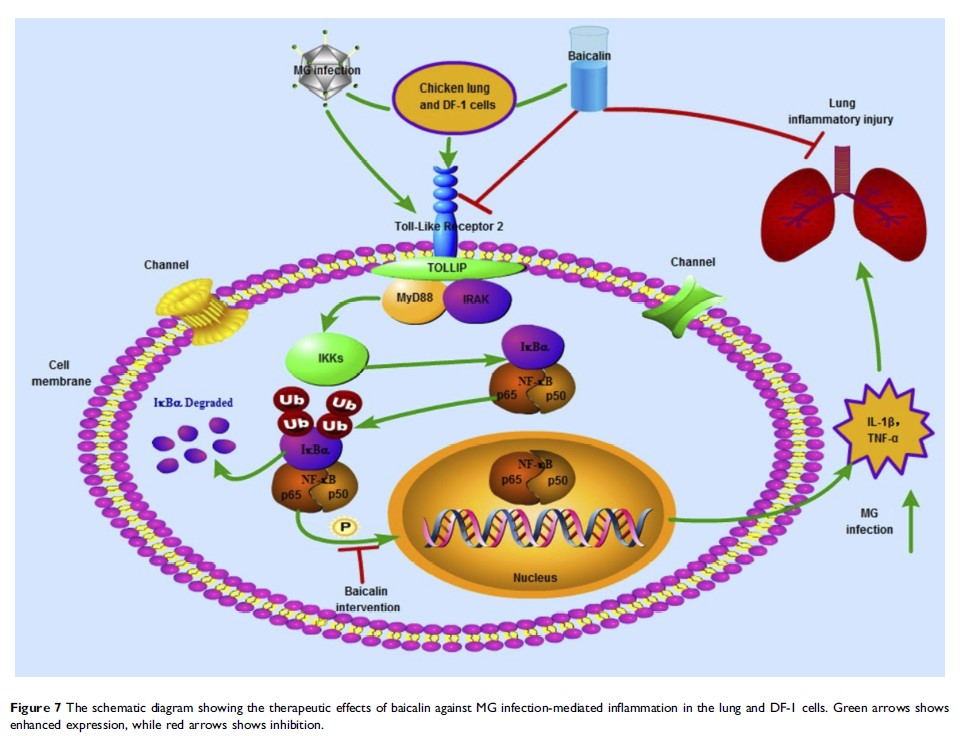
Conclusion: The results showed that baicalin can interfere with inflammatory injury by suppressing the release of inflammatory cytokines IL-1β and TNF-α during MG infection both in vivo and in vitro. Meanwhile, baicalin suppressed TLR2-NFκB signaling pathway by inhibiting the phosphorylation of p65 and IκB, thereby affecting the expression of inflammatory factors. The results suggested that baicalin acts as a potential anti-inflammatory agent against MG infection in chicken and DF-1 cells.
Keywords: Mycoplasma gallisepticum , baicalin, inflammation, TLR2, p65