117333
论文已发表
注册即可获取德孚的最新动态
IF 收录期刊
- 3.6 Breast Cancer (Dove Med Press)
- 4.3 Clin Epidemiol
- 2.6 Cancer Manag Res
- 3.2 Infect Drug Resist
- 4.1 Clin Interv Aging
- 6.1 Drug Des Dev Ther
- 4.1 Int J Chronic Obstr
- 8.7 Int J Nanomed
- 2.5 Int J Women's Health
- 3.2 Neuropsych Dis Treat
- 2.4 OncoTargets Ther
- 2.6 Patient Prefer Adher
- 2.6 Ther Clin Risk Manag
- 3.1 J Pain Res
- 3.5 Diabet Metab Synd Ob
- 4.5 Psychol Res Behav Ma
- 3.4 Nat Sci Sleep
- 2.4 Pharmgenomics Pers Med
- 2.6 Risk Manag Healthc Policy
- 4.6 J Inflamm Res
- 2.3 Int J Gen Med
- 3.9 J Hepatocell Carcinoma
- 3.3 J Asthma Allergy
- 2.5 Clin Cosmet Investig Dermatol
- 3.0 J Multidiscip Healthc

MiR-195-5p 通过靶向 CEP55 抑制增殖并诱导非小细胞肺癌细胞凋亡
Authors Luo J, Pan J, Jin Y, Li M, Chen M
Received 12 August 2019
Accepted for publication 5 December 2019
Published 24 December 2019 Volume 2019:12 Pages 11465—11474
DOI https://doi.org/10.2147/OTT.S226921
Checked for plagiarism Yes
Review by Single-blind
Peer reviewer comments 3
Editor who approved publication: Prof. Dr. Takuya Aoki
Objective: This study aims to explore whether miR-195-5p can inhibit proliferation and induce apoptosis of non-small cell lung cancer (NSCLC) cells by targeting CEP55.
Methods: qRT-PCR was used to measure the expression of miR-195-5p in NSCLC cells. MTT assay, colony formation assay, and flow cytometry were used to detect the role of miR-195-5p in NSCLC cells. Western blot was used to measure the protein expression of CEP55, Bax and Bcl-2 in cells. Dual-Luciferase assay was performed to verify the relationship between miR-195-5p and CEP55.
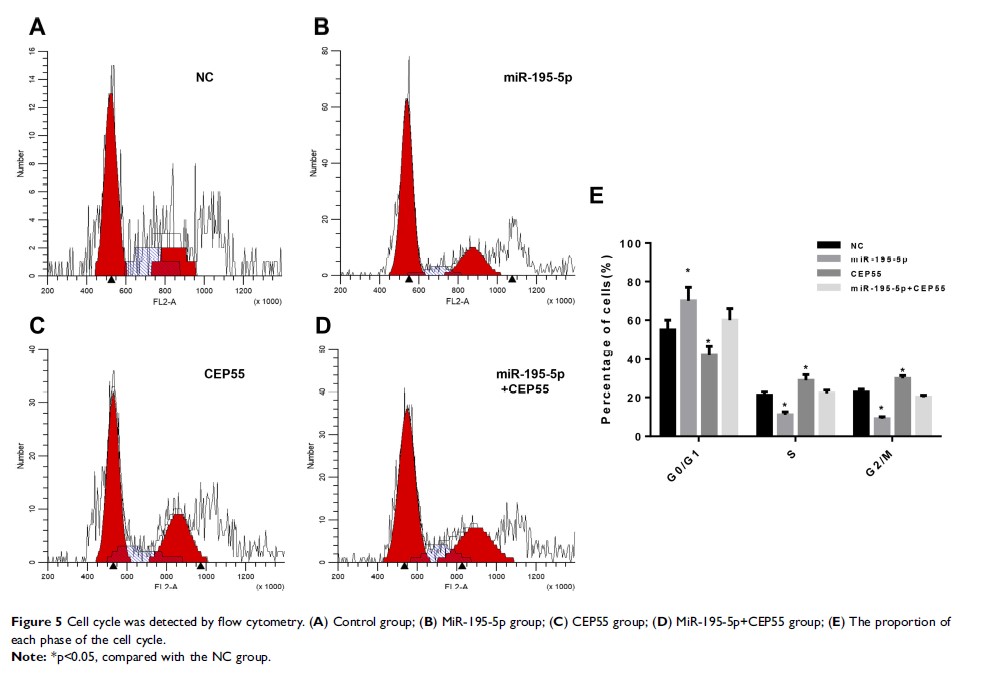
Results: The expression of miR-195-5p was higher in human normal lung cell lines than in NSCLC cells. MiR-195-5p overexpression inhibited cell proliferation, which could block the cell cycle of A549 cell line in the G0/G1 phase. Moreover, overexpression of miR-195-5p increased cell apoptotic rate of A549 cell lines, with the expression of pro-apoptotic protein Bax up-regulated and that of the anti-apoptotic protein Bcl-2 down-regulated. The Dual-Luciferase assay showed that miR-195-5p could specifically target CEP55. Furthermore, CEP55 was down-regulated in NSCLC cells. Overexpression of CEP55 enhanced the proliferation and colony formation ability of A549 cell line. Overexpression of CEP55 can reverse the inhibitory effect of miR-195-5p.
Conclusion: MiR-195-5p inhibits proliferation and induces apoptosis of NSCLC cells by negatively regulating CEP55.
Keywords: non-small cell lung cancer, NSCLC, miR-195-5p, CEP55, cell proliferation, cell apoptosis