119661
论文已发表
注册即可获取德孚的最新动态
IF 收录期刊
- 3.6 Breast Cancer (Dove Med Press)
- 4.3 Clin Epidemiol
- 2.6 Cancer Manag Res
- 3.2 Infect Drug Resist
- 4.1 Clin Interv Aging
- 6.1 Drug Des Dev Ther
- 4.1 Int J Chronic Obstr
- 8.7 Int J Nanomed
- 2.5 Int J Women's Health
- 3.2 Neuropsych Dis Treat
- 2.4 OncoTargets Ther
- 2.6 Patient Prefer Adher
- 2.6 Ther Clin Risk Manag
- 3.1 J Pain Res
- 3.5 Diabet Metab Synd Ob
- 4.5 Psychol Res Behav Ma
- 3.4 Nat Sci Sleep
- 2.4 Pharmgenomics Pers Med
- 2.6 Risk Manag Healthc Policy
- 4.6 J Inflamm Res
- 2.3 Int J Gen Med
- 3.9 J Hepatocell Carcinoma
- 3.3 J Asthma Allergy
- 2.5 Clin Cosmet Investig Dermatol
- 3.0 J Multidiscip Healthc

经新辅助放化疗获得临床完全缓解后直肠癌复发的病例
Authors Zhang PB, Huang ZL, Li JB, Huang XY
Received 1 August 2019
Accepted for publication 12 December 2019
Published 27 December 2019 Volume 2019:11 Pages 10801—10806
DOI https://doi.org/10.2147/CMAR.S225628
Checked for plagiarism Yes
Review by Single-blind
Peer reviewer comments 2
Editor who approved publication: Dr Antonella D'Anneo
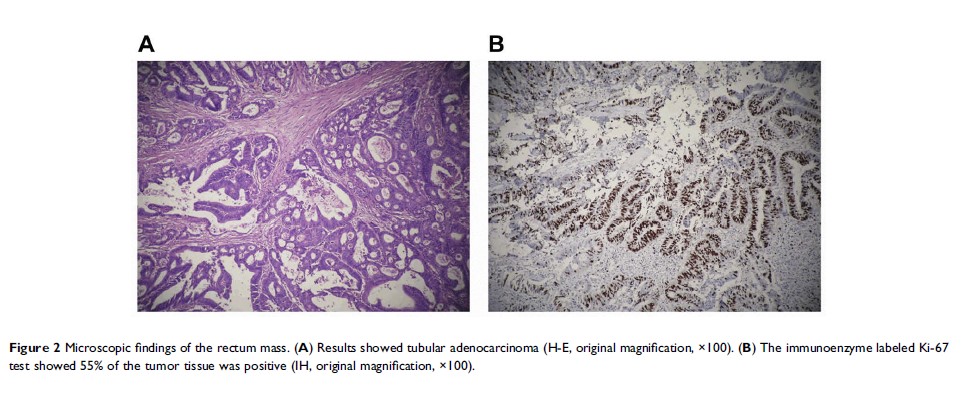
Abstract: Despite advancements in diagnosis and therapy, relapse of rectal cancer after clinical complete remission (cCR) remains a frequent event. The key factors influencing the treatment strategy for the management of patients achieving cCR following neoadjuvant chemoradiotherapy (Neo-CRT) remain to be identified. We present the case of a 64-year-old man with rectal cancer. The patient was initially admitted to the hospital in September 2011 with a 3-month history of change in his stools. Following his re-hospitalization in November 2011, a biopsy specimen of the neoplasm suggested the presence of rectal adenocarcinoma; laboratory investigations also revealed elevated levels of carcinoembryonic antigens (CEA; carbohydrate antigen 199) in the serum. Subsequently, the patient received Neo-CRT, as well as symptomatic and supportive treatment. The level of serum CEA returned to normal, without signs of swollen lymph nodes in the pelvic cavity. The patient was diagnosed with rectal cancer based on the elevated level of serum CEA, colonoscopy, and contrast-enhanced magnetic resonance imaging. He relapsed 4 months after cCR following Neo-CRT and underwent laparoscopic Miles’ surgery in April 2013. The relapse may have been mainly attributed to residual tumor cells. This case report and literature review may contribute to the clinical recognition of treatment for patients with rectal cancer achieving cCR following Neo-CRT.
Keywords: rectal cancer, neoadjuvant chemoradiotherapy, Neo-CRT, clinical complete remission, cCR