119661
论文已发表
注册即可获取德孚的最新动态
IF 收录期刊
- 3.6 Breast Cancer (Dove Med Press)
- 4.3 Clin Epidemiol
- 2.6 Cancer Manag Res
- 3.2 Infect Drug Resist
- 4.1 Clin Interv Aging
- 6.1 Drug Des Dev Ther
- 4.1 Int J Chronic Obstr
- 8.7 Int J Nanomed
- 2.5 Int J Women's Health
- 3.2 Neuropsych Dis Treat
- 2.4 OncoTargets Ther
- 2.6 Patient Prefer Adher
- 2.6 Ther Clin Risk Manag
- 3.1 J Pain Res
- 3.5 Diabet Metab Synd Ob
- 4.5 Psychol Res Behav Ma
- 3.4 Nat Sci Sleep
- 2.4 Pharmgenomics Pers Med
- 2.6 Risk Manag Healthc Policy
- 4.6 J Inflamm Res
- 2.3 Int J Gen Med
- 3.9 J Hepatocell Carcinoma
- 3.3 J Asthma Allergy
- 2.5 Clin Cosmet Investig Dermatol
- 3.0 J Multidiscip Healthc

白藜芦醇抑制 HBL-52 脑膜瘤细胞增殖
Authors Hu S, Wei W, Yuan J, Cheng J
Received 24 August 2019
Accepted for publication 7 November 2019
Published 30 December 2019 Volume 2019:12 Pages 11579—11586
DOI https://doi.org/10.2147/OTT.S228513
Checked for plagiarism Yes
Review by Single-blind
Peer reviewer comments 2
Editor who approved publication: Prof. Dr. Nicola Silvestris
Objective: To investigate the effects of resveratrol on apoptosis and proliferation in meningioma cells and characterize the underlying molecular mechanism.
Methods: HBL-52 meningioma cells were treated with resveratrol at doses of 10, 50, 100, 200, and 400 μM for 24, 36, and 48 hrs. Inhibition of proliferation was measured by CCK8 assay, and apoptosis was determined by annexin V staining and flow cytometry. Expression of apoptosis-associated proteins (cleaved-caspase-3, pro-caspase-3) and Bcl-2 were measured by Western blot. Levels of miR-34a-3p and Bcl-2 mRNA were analyzed by reverse transcriptase PCR. A dual luciferase assay was used to determine whether miR-34a-3p binds to the 3ʹUTR of Bcl-2.
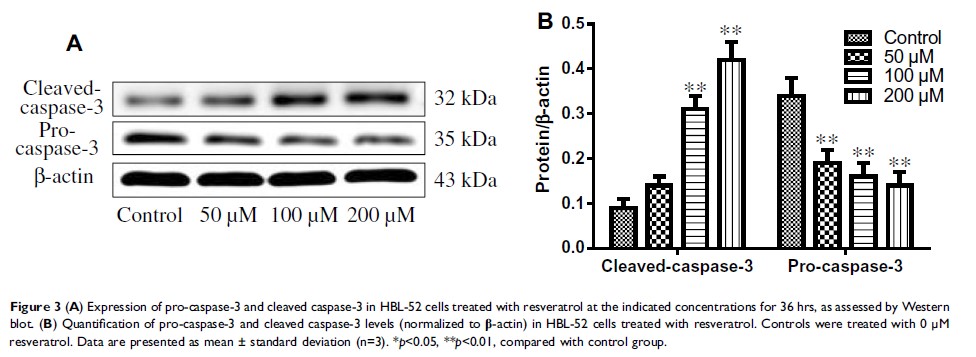
Results: Resveratrol reduces proliferation and increases apoptosis in HBL-52 cells. These effects increase with increasing resveratrol concentration and exposure time. Resveratrol increases levels of cleaved-caspase 3 protein as well as decreases levels of pro-caspase 3 protein and Bcl-2 mRNA. The 3ʹUTR of Bcl-2 contains putative binding sites for miR-34a-3p, and these binding sites can regulate the expression of a luciferase reporter. Overexpression of miR-34a-3p reduces Bcl-2 protein levels in HBL-52 cells.
Conclusion: Resveratrol suppresses proliferation and induces apoptosis in meningioma cells by upregulating miR-34a-3p, which in turn downregulates Bcl-2. Resveratrol may be a useful drug for treating meningiomas.
Keywords: resveratrol, meningioma, miR-34a-3p, apoptosis