119661
论文已发表
注册即可获取德孚的最新动态
IF 收录期刊
- 3.6 Breast Cancer (Dove Med Press)
- 4.3 Clin Epidemiol
- 2.6 Cancer Manag Res
- 3.2 Infect Drug Resist
- 4.1 Clin Interv Aging
- 6.1 Drug Des Dev Ther
- 4.1 Int J Chronic Obstr
- 8.7 Int J Nanomed
- 2.5 Int J Women's Health
- 3.2 Neuropsych Dis Treat
- 2.4 OncoTargets Ther
- 2.6 Patient Prefer Adher
- 2.6 Ther Clin Risk Manag
- 3.1 J Pain Res
- 3.5 Diabet Metab Synd Ob
- 4.5 Psychol Res Behav Ma
- 3.4 Nat Sci Sleep
- 2.4 Pharmgenomics Pers Med
- 2.6 Risk Manag Healthc Policy
- 4.6 J Inflamm Res
- 2.3 Int J Gen Med
- 3.9 J Hepatocell Carcinoma
- 3.3 J Asthma Allergy
- 2.5 Clin Cosmet Investig Dermatol
- 3.0 J Multidiscip Healthc

基于生物信息学方法确定轻链淀粉样变的候选基因和治疗剂
Authors Bai W, Wang H, Bai H
Received 24 August 2019
Accepted for publication 3 December 2019
Published 3 January 2020 Volume 2019:12 Pages 387—396
DOI https://doi.org/10.2147/PGPM.S228574
Checked for plagiarism Yes
Review by Single-blind
Peer reviewer comments 2
Editor who approved publication: Dr Martin H. Bluth
Objective: Systemic amyloid light chain (AL) amyloidosis is a rare plasma cell disease. However, the regulatory mechanisms of AL amyloidosis have not been thoroughly uncovered, identification of candidate genes and therapeutic agents for this disease is crucial to provide novel insights into exploring the regulatory mechanisms underlying AL amyloidosis.
Methods: The gene expression profile of GSE73040, including 9 specimens from AL amyloidosis patients and 5 specimens from normal control, was downloaded from GEO datasets. Differentially expressed genes (DEGs) were sorted with regard to AL amyloidosis versus normal control group using Limma package. The gene enrichment analyses including GO and KEGG pathway were performed using DAVID website subsequently. Furthermore, the protein–protein interaction (PPI) network for DEGs was constructed by Cytoscape software and STRING database. DEGs were mapped to the connectivity map datasets to identify potential molecular agents of AL amyloidosis.
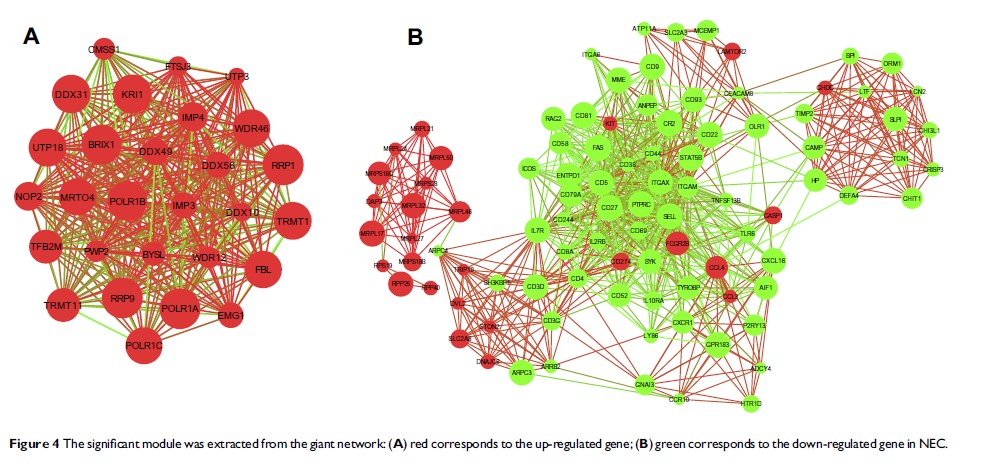
Results: A total of 1464 DEGs (727 up-regulated, 737 down-regulated) were identified in AL amyloidosis samples versus control samples, these dysregulated genes were associated with the dysfunction of ribosome biogenesis and immune response. PPI network and module analysis uncovered that several crucial genes were defined as candidate genes, including ITGAM, ITGB2, ITGAX, IMP3 and FBL . More importantly, we identified the small molecular agents (AT-9283, Ritonavir and PKC beta-inhibitor) as the potential drugs for AL amyloidosis.
Conclusion: Using bioinformatics approach, we have identified candidate genes and pathways in AL amyloidosis, which can extend our understanding of the cause and molecular mechanisms, and these crucial genes and pathways could act as biomarkers and therapeutic targets for AL amyloidosis.
Keywords: light chain amyloidosis, bioinformatics approach, differentially expressed genes, candidate genes, therapeutic agent