119661
论文已发表
注册即可获取德孚的最新动态
IF 收录期刊
- 3.6 Breast Cancer (Dove Med Press)
- 4.3 Clin Epidemiol
- 2.6 Cancer Manag Res
- 3.2 Infect Drug Resist
- 4.1 Clin Interv Aging
- 6.1 Drug Des Dev Ther
- 4.1 Int J Chronic Obstr
- 8.7 Int J Nanomed
- 2.5 Int J Women's Health
- 3.2 Neuropsych Dis Treat
- 2.4 OncoTargets Ther
- 2.6 Patient Prefer Adher
- 2.6 Ther Clin Risk Manag
- 3.1 J Pain Res
- 3.5 Diabet Metab Synd Ob
- 4.5 Psychol Res Behav Ma
- 3.4 Nat Sci Sleep
- 2.4 Pharmgenomics Pers Med
- 2.6 Risk Manag Healthc Policy
- 4.6 J Inflamm Res
- 2.3 Int J Gen Med
- 3.9 J Hepatocell Carcinoma
- 3.3 J Asthma Allergy
- 2.5 Clin Cosmet Investig Dermatol
- 3.0 J Multidiscip Healthc

右美托咪定可促进新生大鼠的海马神经发生并改善空间学习与记忆
Authors Zhang Y, Gao Q, Wu Z, Xue H, Liu B, Zhao P
Received 22 August 2019
Accepted for publication 2 December 2019
Published 3 January 2020 Volume 2019:13 Pages 4439—4449
DOI https://doi.org/10.2147/DDDT.S228220
Checked for plagiarism Yes
Review by Single-blind
Peer reviewer comments 3
Editor who approved publication: Dr Qiongyu Guo
Background: Dexmedetomidine (Dex) is a highly selective α2-adrenoceptor agonist used as an off-label medication for pediatric sedation and analgesia. Recently, Dex was reported to exhibit neuroprotective efficacy in several brain injury models. Here we investigate whether neonatal Dex administration promotes hippocampal neurogenesis and enhances hippocampus-dependent spatial learning and memory under physiological conditions.
Methods: Postnatal day 7 (P7) pups were administered saline (vehicle control) or Dex (10, 20, or 40 μg/kg) by intraperitoneal injection. Neurogenesis and astrogenesis were examined in brain slices by BrdU immunostaining on P8 and changes in the expression levels of GDNF, NCAM, CREB, PSD95, and GAP43 were assessed by Western blotting on P35, respectively. Open field and Morris water maze (MWM) tests were conducted from P28 to P36 in order to assess effects on general motor activity and spatial learning, respectively.
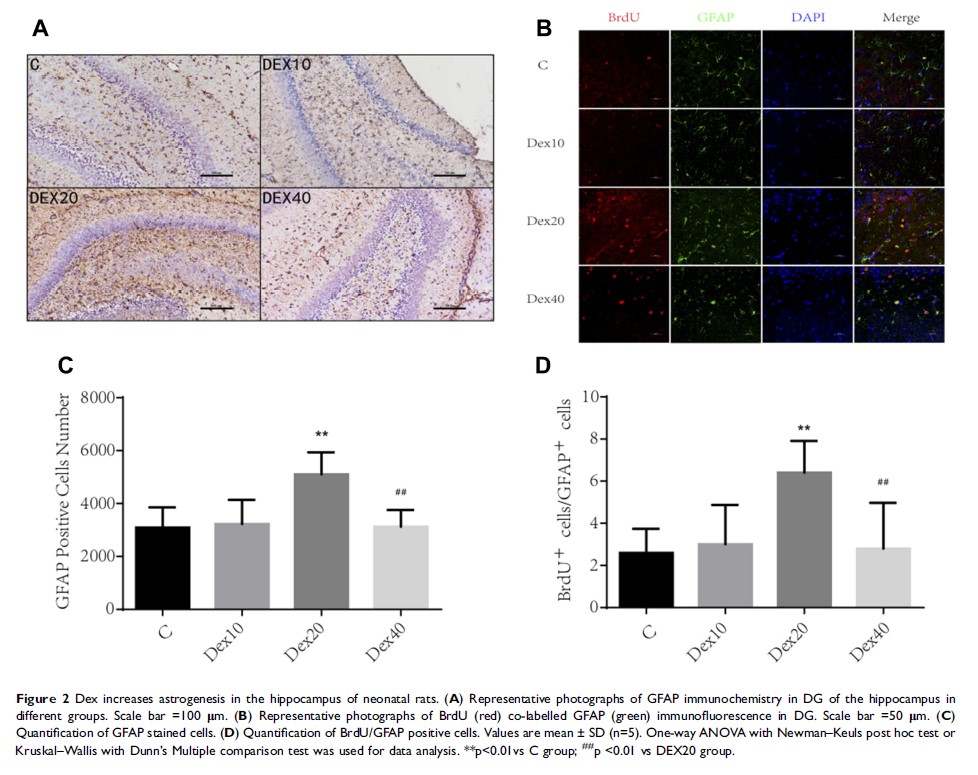
Results: Dexmedetomidine at 20 μg/kg significantly enhanced neurogenesis and astrogenesis in hippocampus and upregulated GDNF, NCAM, CREB, PSD95, and GAP43 compared to vehicle and other Dex doses. Moreover, 20 μg/kg Dex-injected rats showed no changes in motor or anxiety-like behavior but performed better in the MWM test compared to all other groups.
Conclusion: Neonatal injection of Dex (20 μg/kg) enhances spatial learning and memory in rat pups, potentially by promoting hippocampal neurogenesis and synaptic plasticity via activation of GDNF/NCAM/CREB signaling.
Keywords: dexmedetomidine, neurogenesis, GDNF, spatial learning and memory, neonate