119661
论文已发表
注册即可获取德孚的最新动态
IF 收录期刊
- 3.6 Breast Cancer (Dove Med Press)
- 4.3 Clin Epidemiol
- 2.6 Cancer Manag Res
- 3.2 Infect Drug Resist
- 4.1 Clin Interv Aging
- 6.1 Drug Des Dev Ther
- 4.1 Int J Chronic Obstr
- 8.7 Int J Nanomed
- 2.5 Int J Women's Health
- 3.2 Neuropsych Dis Treat
- 2.4 OncoTargets Ther
- 2.6 Patient Prefer Adher
- 2.6 Ther Clin Risk Manag
- 3.1 J Pain Res
- 3.5 Diabet Metab Synd Ob
- 4.5 Psychol Res Behav Ma
- 3.4 Nat Sci Sleep
- 2.4 Pharmgenomics Pers Med
- 2.6 Risk Manag Healthc Policy
- 4.6 J Inflamm Res
- 2.3 Int J Gen Med
- 3.9 J Hepatocell Carcinoma
- 3.3 J Asthma Allergy
- 2.5 Clin Cosmet Investig Dermatol
- 3.0 J Multidiscip Healthc

厌食症、高血压、气胸和甲状腺功能低下:阿帕替尼治疗骨肉瘤晚期的临床疗效改善的潜在征象
Authors Xie L, Xu J, Sun X, Tang X, Yan T, Yang R, Guo W
Received 28 September 2019
Accepted for publication 12 December 2019
Published 7 January 2020 Volume 2020:12 Pages 91—102
DOI https://doi.org/10.2147/CMAR.S232823
Checked for plagiarism Yes
Review by Single-blind
Peer reviewer comments 2
Editor who approved publication: Dr Antonella D'Anneo
Aim: Apatinib, a specific tyrosine kinase inhibitor (TKI) that targets mainly vascular endothelial growth factor receptor-2 (VEGFR-2) as well as Ret, c-Kit and c-Src, has been assessed in patients with advanced osteosarcoma (phase II), the primary report of which has been published in PMID 30559126. This sub-study explored the potential signs of Adverse Events (AEs) for apatinib-treated osteosarcoma.
Methods: Participants with advanced osteosarcoma progressing upon chemotherapy received apatinib until disease progression or unacceptable toxicity. Toxicities, progression-free survival (PFS), and clinical benefit rate (CBR) following treatment were evaluated.
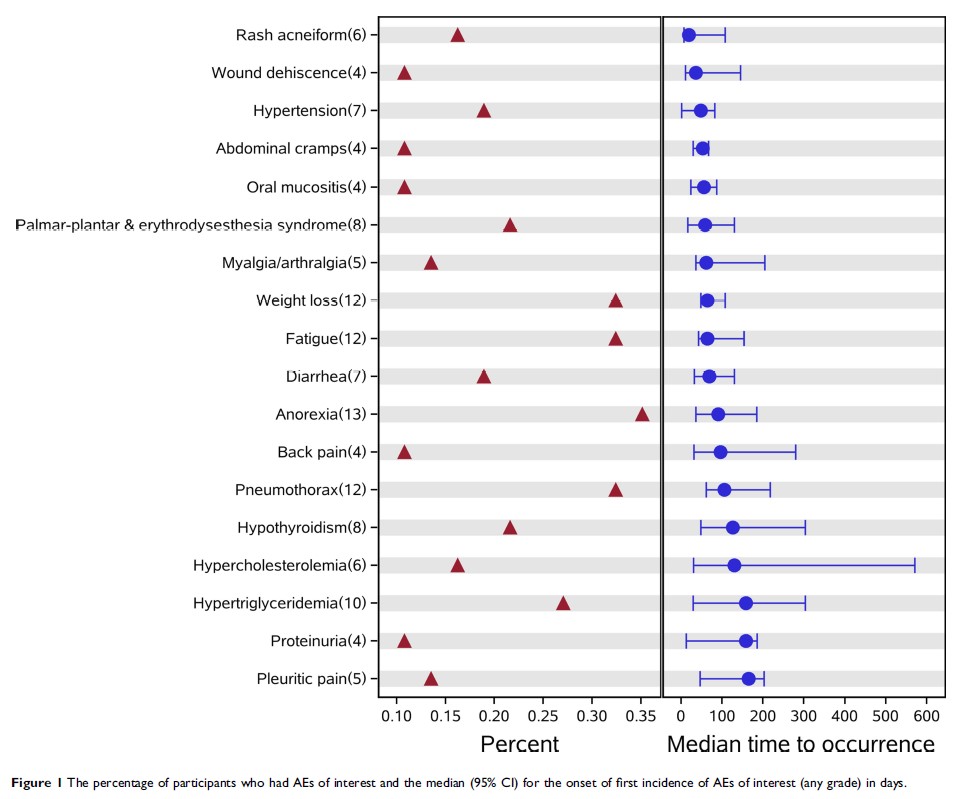
Results: Of the 41 patients recruited to the study, 37 received treatment and constituted the safety population. At data cut-off (December 30, 2017), median follow-up for safety was 7.37 (IQR, 6.33–11.07) months. The most common grade 3–4 AEs were pneumothorax (16.22%), wound dehiscence (10.81%), proteinuria (8.11%), diarrhea (8.11%), and skin reaction (8.11%). Only hypertension was an independent predictive factor for both PFS (hazard ratio [HR], 0.44; P = 0.07) and CBR (P = 0.07). Anorexia was also significantly related to a longer PFS in a Cox regression model (HR, 0.35; P =0.01). For CBR, pneumothorax and hypothyroidism showed more clinical benefit (P = 0.07 and 0.00, respectively).
Conclusion: The results of this study suggest that anorexia, hypertension, pneumothorax, and hypothyroidism might be markers for a favorable clinical outcome following apatinib-treated refractory osteosarcoma.
Keywords: apatinib, osteosarcoma, prognosis