117333
论文已发表
注册即可获取德孚的最新动态
IF 收录期刊
- 3.6 Breast Cancer (Dove Med Press)
- 4.3 Clin Epidemiol
- 2.6 Cancer Manag Res
- 3.2 Infect Drug Resist
- 4.1 Clin Interv Aging
- 6.1 Drug Des Dev Ther
- 4.1 Int J Chronic Obstr
- 8.7 Int J Nanomed
- 2.5 Int J Women's Health
- 3.2 Neuropsych Dis Treat
- 2.4 OncoTargets Ther
- 2.6 Patient Prefer Adher
- 2.6 Ther Clin Risk Manag
- 3.1 J Pain Res
- 3.5 Diabet Metab Synd Ob
- 4.5 Psychol Res Behav Ma
- 3.4 Nat Sci Sleep
- 2.4 Pharmgenomics Pers Med
- 2.6 Risk Manag Healthc Policy
- 4.6 J Inflamm Res
- 2.3 Int J Gen Med
- 3.9 J Hepatocell Carcinoma
- 3.3 J Asthma Allergy
- 2.5 Clin Cosmet Investig Dermatol
- 3.0 J Multidiscip Healthc

基于分子病理学抗生素耐药性的疗法根治幽门螺杆菌感染
Authors Gao C, Du SY, Fang L, Fan YH, Song AP, Chen H
Received 23 September 2019
Accepted for publication 17 December 2019
Published 7 January 2020 Volume 2020:13 Pages 69—79
DOI https://doi.org/10.2147/IDR.S232169
Checked for plagiarism Yes
Review by Single-blind
Peer reviewer comments 2
Editor who approved publication: Dr Sahil Khanna
Background: Unfortunately, the eradication rate of Helicobacter pylori (H. pylori ) treatment is markedly decreasing in recent years and the major reason is antibiotic resistance. Our study was designed to determine the effect and safety of H. pylori eradication treatment based on the molecular pathologic antibiotic resistance.
Methods: 261 patients were analyzed retrospectively, including 111 patients who were treated for the first time (one group as First-treated) and 150 patients who failed at least once in bismuth quadruple therapy (another group as Re-treatment). Antibiotic resistance was examined by Real-time PCR detection and conventional PCR and sequencing method. The eradication rate (ER) was compared per intention to treat (ITT) and per protocol (PP) between the two groups.
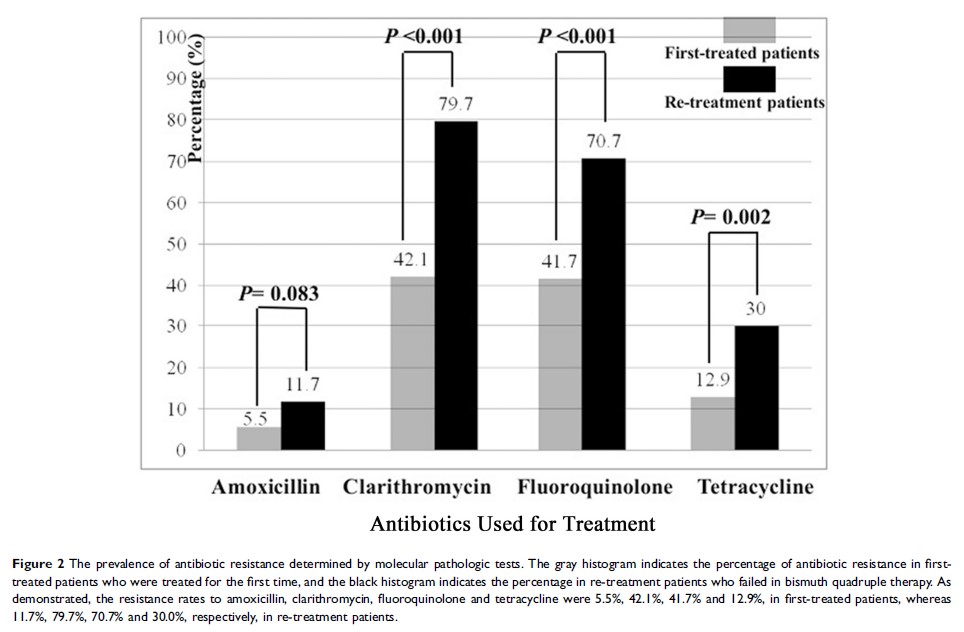
Results: The resistance rates to amoxicillin, clarithromycin, fluoroquinolone and tetracycline were 5.5%, 42.1%, 41.7% and 12.9% in the 111 first-treated patients, and 11.7%, 79.7%, 70.7% and 30.0% in the 150 re-treatment patients. The ERs in the ITT and PP analyses were 92.79% (95% CI, 87.98– 97.60%, n=111) and 98.10% (95% CI, 95.48– 100%, n=105), respectively, in the first-treated patients and 90.67% (95% CI, 86.01– 95.32%, n=150) and 95.10% (95% CI, 91.57– 98.64%, n=143), respectively, in the re-treatment patients. No significant differences were shown in the ERs between two group patients, and no serious adverse events were found.
Conclusion: H. pylori eradication treatment based on molecular pathologic antibiotic resistance showed good effect and safety in both first and re-treated patients.
Keywords: Helicobacter pylori , antibiotic resistance, eradication, first treatment, re-treatment, molecular pathology