119661
论文已发表
注册即可获取德孚的最新动态
IF 收录期刊
- 3.6 Breast Cancer (Dove Med Press)
- 4.3 Clin Epidemiol
- 2.6 Cancer Manag Res
- 3.2 Infect Drug Resist
- 4.1 Clin Interv Aging
- 6.1 Drug Des Dev Ther
- 4.1 Int J Chronic Obstr
- 8.7 Int J Nanomed
- 2.5 Int J Women's Health
- 3.2 Neuropsych Dis Treat
- 2.4 OncoTargets Ther
- 2.6 Patient Prefer Adher
- 2.6 Ther Clin Risk Manag
- 3.1 J Pain Res
- 3.5 Diabet Metab Synd Ob
- 4.5 Psychol Res Behav Ma
- 3.4 Nat Sci Sleep
- 2.4 Pharmgenomics Pers Med
- 2.6 Risk Manag Healthc Policy
- 4.6 J Inflamm Res
- 2.3 Int J Gen Med
- 3.9 J Hepatocell Carcinoma
- 3.3 J Asthma Allergy
- 2.5 Clin Cosmet Investig Dermatol
- 3.0 J Multidiscip Healthc

上调的 CCDC34 促进肝细胞癌的增殖和转移
Authors Lin Z, Qu S, Peng W, Yang P, Zhang R, Zhang P, Guo D, Du J, Wu W, Tao K, Wang J
Received 5 November 2019
Accepted for publication 18 December 2019
Published 7 January 2020 Volume 2020:13 Pages 51—60
DOI https://doi.org/10.2147/OTT.S237399
Checked for plagiarism Yes
Review by Single-blind
Peer reviewer comments 3
Editor who approved publication: Dr Federico Perche
Background: Coiled-coil domain-containing protein 34 (CCDC34), which belongs to the CCDCs family, has been recently reported to be up-regulated in various kinds of tumors. However, its role in the development of hepatocellular carcinoma (HCC) still remains unclear.
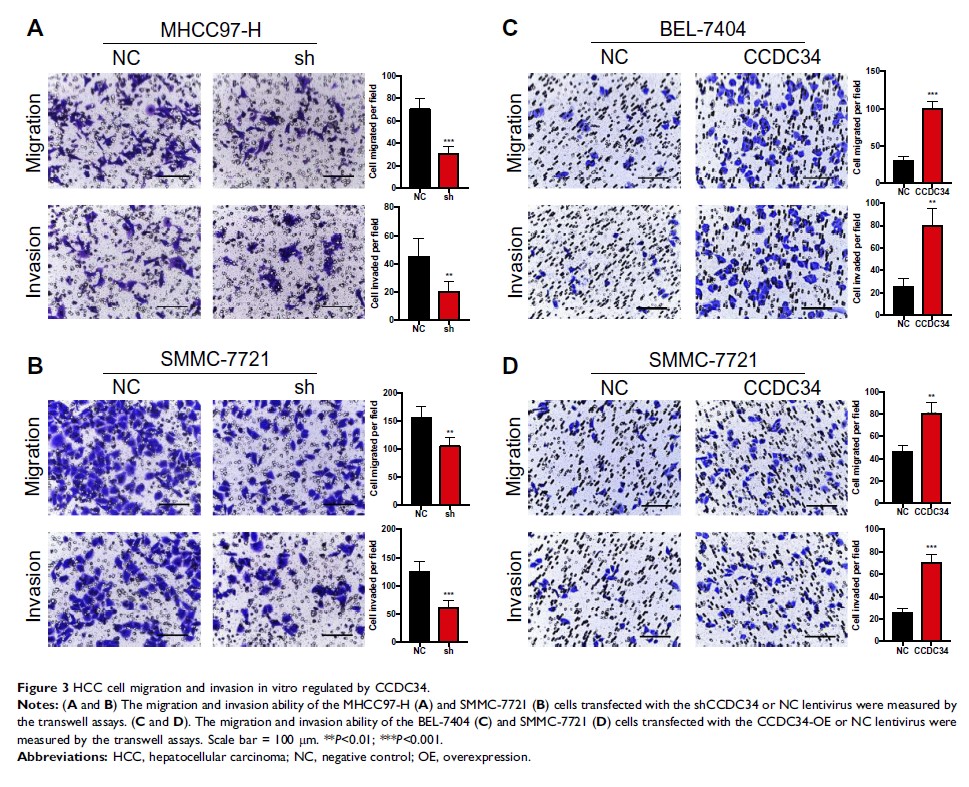
Materials and methods: In this study, real-time polymerase chain reaction (RT-PCR) and Western blot analysis were performed to measure the mRNA and protein levels of CCDC34 in clinical samples. Kaplan-Meier method was used to analyze the relationship between CCDC34 and the prognosis in HCC patients. CCK-8 and colony formation assays were conducted to investigate CCDC34’s effect on the cell proliferation, and Transwell assays were used to detect CCDC34’s effect on the cell metastasis. Moreover, subcutaneous xenograft tumor model and lung metastasis model were applied to confirm the impact of CCDC34 on the HCC development. Lastly, RNA sequencing and Western blot analysis were performed to probe the underlying mechanism of CCDC34’s effect on HCC.
Results: CCDC34 was significantly induced in HCC tissues, and the overexpression of CCDC34 predicted the poor outcomes among HCC patients. It was verified by the in vitro and in vivo experiments that CCDC34-knockdown potently inhibited the proliferation and metastasis of HCC cells. Subsequent results indicated that CCDC34 inhibition can affect the activation of protein kinase B (PKB or AKT) as well as epithelial-mesenchymal transition (EMT) process.
Conclusion: CCDC34 is significantly associated with HCC. It will become a promising prognostic biomarker and therapeutic target against HCC.
Keywords: CCDC34, HCC, proliferation, EMT, PI3K/AKT, CCND1