119661
论文已发表
注册即可获取德孚的最新动态
IF 收录期刊
- 3.6 Breast Cancer (Dove Med Press)
- 4.3 Clin Epidemiol
- 2.6 Cancer Manag Res
- 3.2 Infect Drug Resist
- 4.1 Clin Interv Aging
- 6.1 Drug Des Dev Ther
- 4.1 Int J Chronic Obstr
- 8.7 Int J Nanomed
- 2.5 Int J Women's Health
- 3.2 Neuropsych Dis Treat
- 2.4 OncoTargets Ther
- 2.6 Patient Prefer Adher
- 2.6 Ther Clin Risk Manag
- 3.1 J Pain Res
- 3.5 Diabet Metab Synd Ob
- 4.5 Psychol Res Behav Ma
- 3.4 Nat Sci Sleep
- 2.4 Pharmgenomics Pers Med
- 2.6 Risk Manag Healthc Policy
- 4.6 J Inflamm Res
- 2.3 Int J Gen Med
- 3.9 J Hepatocell Carcinoma
- 3.3 J Asthma Allergy
- 2.5 Clin Cosmet Investig Dermatol
- 3.0 J Multidiscip Healthc

癌组织和邻近非癌组织的外显子覆盖范围差异是胃癌的预后因素
Authors Pan X, Wang Y, Li C, Zhou Z, Zhong Y, Feng J, Lu J
Received 11 October 2019
Accepted for publication 2 December 2019
Published 7 January 2020 Volume 2020:13 Pages 61—70
DOI https://doi.org/10.2147/OTT.S234351
Checked for plagiarism Yes
Review by Single-blind
Peer reviewer comments 2
Editor who approved publication: Dr Leo Jen-Liang Su
Introduction: Gastric cancer is highly heterogeneous both clinically and pathologically and is one of the leading causes of cancer-related deaths worldwide. Genomic coverage variations, also known as copy number variations (CNVs), play a critical role in the carcinogenesis of gastric cancer. Many studies have demonstrated that DNA CNVs are important factors affecting the expression of protein-encoding genes in the gastric cancer genome.
Methods: Thirty gastric cancer patients from a Chinese population were enrolled. Genomic DNA was extracted from gastric cancer tissue and matched adjacent non-cancerous tissue from each patient. A panel of 1,021 genes including 3300 exons was designed and subjected to next-generation sequencing. Copy numbers of each gene and exon were calculated for each tissue. Coverage variations between gastric cancer tissue and matched adjacent non-cancerous tissue were also calculated, and we examined the correlation between overall survival of patients and coverage variation type for each exon.
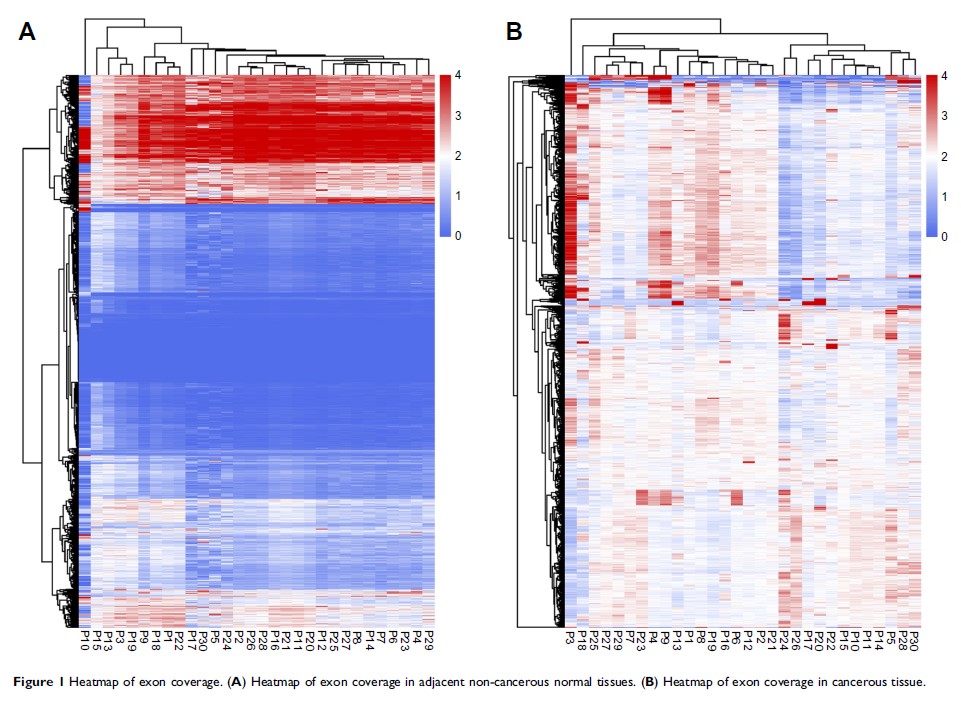
Results: DNA from cancerous tissue and corresponding adjacent non-cancerous tissue were significantly different with respect to the pattern of gene copy number. Exon copy numbers were highly consistent among non-cancerous samples and confirmed that non-cancerous tissue contain diploid genomes. In contrast, the gene coverage pattern among cancerous tissue showed significant differences and confirmed that gastric cancer is a genetically heterogeneous disease. Numerous exon coverage variations were identified in gastric cancer tissue compared with matched, adjacent non-cancerous tissue. Overall survival between patients with and without coverage variations in regions of NOTCH2 , NTRK3 , ERBB2 and RERE exons exhibited significant differences. This is consistent with previous reports and indicates that these findings may have prognostic value.
Conclusion: Our results confirm that gastric cancer is a genetically heterogeneous disease. Exon coverage variations between cancer tissue and their adjacent non-cancerous tissue were shown to be associated with prognosis in gastric cancer.
Keywords: gastric cancer, next-generation sequencing, copy number variations, overall survival