117333
论文已发表
注册即可获取德孚的最新动态
IF 收录期刊
- 3.6 Breast Cancer (Dove Med Press)
- 4.3 Clin Epidemiol
- 2.6 Cancer Manag Res
- 3.2 Infect Drug Resist
- 4.1 Clin Interv Aging
- 6.1 Drug Des Dev Ther
- 4.1 Int J Chronic Obstr
- 8.7 Int J Nanomed
- 2.5 Int J Women's Health
- 3.2 Neuropsych Dis Treat
- 2.4 OncoTargets Ther
- 2.6 Patient Prefer Adher
- 2.6 Ther Clin Risk Manag
- 3.1 J Pain Res
- 3.5 Diabet Metab Synd Ob
- 4.5 Psychol Res Behav Ma
- 3.4 Nat Sci Sleep
- 2.4 Pharmgenomics Pers Med
- 2.6 Risk Manag Healthc Policy
- 4.6 J Inflamm Res
- 2.3 Int J Gen Med
- 3.9 J Hepatocell Carcinoma
- 3.3 J Asthma Allergy
- 2.5 Clin Cosmet Investig Dermatol
- 3.0 J Multidiscip Healthc

肌肉减少症是中国代谢综合征人群颈动脉粥样硬化的独立危险因素
Authors Cao Y, Zhong M, Zhang Y, Zheng Z, Liu Y, Ni X, Han L, Song M, Zhang W, Wang Z
Received 20 October 2019
Accepted for publication 22 November 2019
Published 9 January 2020 Volume 2020:13 Pages 81—88
DOI https://doi.org/10.2147/DMSO.S235335
Checked for plagiarism Yes
Review by Single-blind
Peer reviewer comments 2
Editor who approved publication: Prof. Dr. Juei-Tang Cheng
Purpose: To investigate the impacts of skeletal muscle mass on carotid atherosclerosis in Chinese adults with metabolic syndrome (MetS).
Methods: One hundred and ninety-five subjects with MetS had the waist-to-height ratio (WHTR)≥ 0.5 for all. One hundred and eighty-four subjects without MetS were divided into 2 groups: Non-Mets obese group (WHTR ≥ 0.5, n = 118) and Non-MetS control group (WHTR < 0.5, n = 66). All the groups had no difference in age. Appendicular skeletal muscle mass was acquired and skeletal muscle mass index (SMI) was calculated. Carotid intima-media thickness (IMT) was assessed by ultrasonography. Each group was stratified according to the presence or absence of presarcopenia.
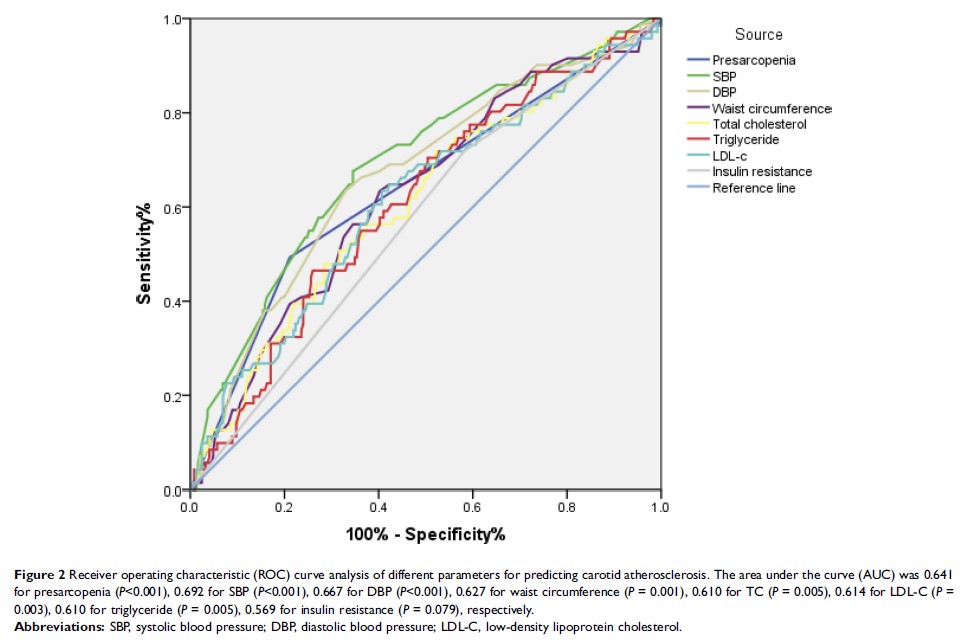
Results: While most parameters showed an increasing trend with WHTR and MetS in both genders, SMI and HDL-C showed a decreasing trend. The prevalence of carotid atherosclerosis showed the same increasing trend. Multivariate logistic regression analyses showed SBP and presarcopenia were both independent risk factors for carotid atherosclerosis in MetS (OR 1.026, P < 0.001; OR 2.788, P = 0.001, respectively). There was no significant difference in IMT among the three groups with preserved muscle mass whether the participants suffered from obesity or MetS, while there was a significant difference between the two groups with presarcopenia (in male P = 0.020, in female P = 0.009, respectively). The area under the ROC curve (AUC) was 0.641 (P < 0.001) for presarcopenia.
Conclusion: Obesity was a risk factor for sarcopenia independent of age, especially in subjects with metabolic syndrome. In individuals with MetS, our findings suggest that presarcopenia may be an independent risk factor for atherosclerosis and appendicular skeletal muscle mass had potential protective effects for carotid atherosclerosis regardless of gender.
Keywords: skeletal muscle mass, presarcopenia, metabolic syndrome, carotid atherosclerosis