117333
论文已发表
注册即可获取德孚的最新动态
IF 收录期刊
- 3.6 Breast Cancer (Dove Med Press)
- 4.3 Clin Epidemiol
- 2.6 Cancer Manag Res
- 3.2 Infect Drug Resist
- 4.1 Clin Interv Aging
- 6.1 Drug Des Dev Ther
- 4.1 Int J Chronic Obstr
- 8.7 Int J Nanomed
- 2.5 Int J Women's Health
- 3.2 Neuropsych Dis Treat
- 2.4 OncoTargets Ther
- 2.6 Patient Prefer Adher
- 2.6 Ther Clin Risk Manag
- 3.1 J Pain Res
- 3.5 Diabet Metab Synd Ob
- 4.5 Psychol Res Behav Ma
- 3.4 Nat Sci Sleep
- 2.4 Pharmgenomics Pers Med
- 2.6 Risk Manag Healthc Policy
- 4.6 J Inflamm Res
- 2.3 Int J Gen Med
- 3.9 J Hepatocell Carcinoma
- 3.3 J Asthma Allergy
- 2.5 Clin Cosmet Investig Dermatol
- 3.0 J Multidiscip Healthc

胶囊的厚度(非生物膜的形成)可导致在长期感染中更为普遍的鲍曼不动杆菌粘液表型:来自中国一家医院的临床分离株研究
Authors Hu L, Shi Y, Xu Q, Zhang L, He J, Jiang Y, Liu L, Leptihn S, Yu Y, Hua X, Zhou Z
Received 7 September 2019
Accepted for publication 17 December 2019
Published 9 January 2020 Volume 2020:13 Pages 99—109
DOI https://doi.org/10.2147/IDR.S230178
Checked for plagiarism Yes
Review by Single-blind
Peer reviewer comments 3
Editor who approved publication: Dr Sahil Khanna
Background: Acinetobacter baumannii is a nosocomial pathogen of critical importance due to the increasing numbers of antibiotic-resistant isolates. Colonies can have a smooth or matt appearance, but also exhibit slimy, mucoid growth, with the latter being increasingly isolated in patients in recent years.
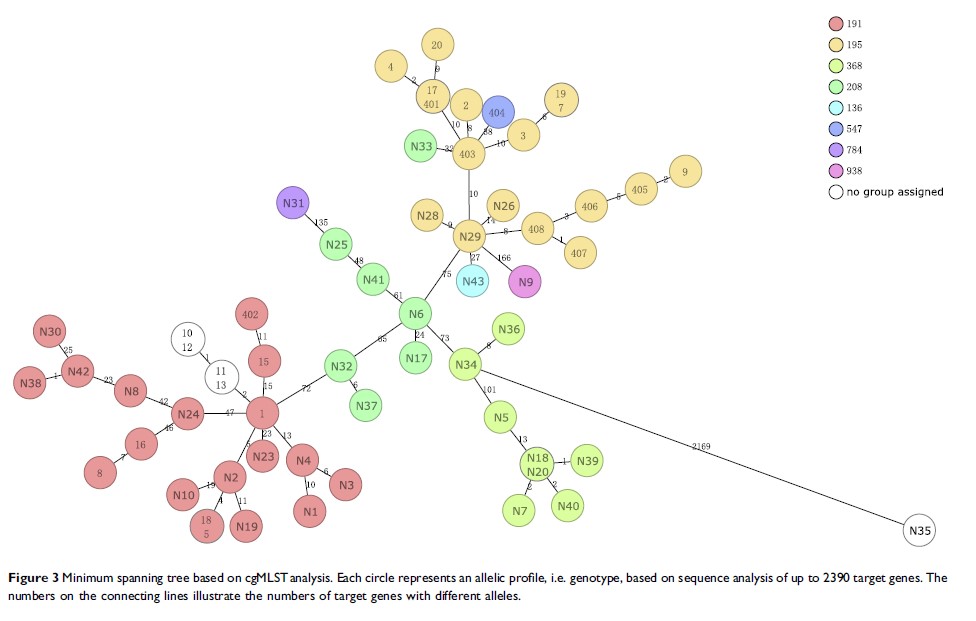
Methods: We isolated 60 A. baumannii strains from altogether 56 patients and found that all patients were infected by mucoid strains, with four patients having also matt phenotypes in addition to the mucoid ones. The morphology of the colonies and capsules was observed. The antibiotics susceptibilities were tested, and the biofilm formation ability was determined by crystal violet staining. The whole-genome sequencing (WGS) was performed on all the strains, and then the core genome multilocus sequence typing (cgMLST) and drug resistance gene analysis were performed. Finally, a part of isolates were selected to test virulence in a Galleria mellonella model.
Results: We observed much larger capsules in the mucoid strains compared to the matt isolates. But the mucoid phenotype did not correlate with the amount of biofilm produced by the strain. Almost all mucus-type A. baumannii were multi-drug resistant isolates, containing various antibiotic resistance genes. The main ST types of mucoid-type A.baumannii were ST191 and ST195, of which ST191 isolates were more virulence, while ST195 isolates were weaker.
Conclusion: The mucoid A. baumannii had resistance to most antibiotics and some strains had high virulence, which should be paid attention in clinical.
Keywords: Acinetobacter baumannii , capsule, biofilm formation, mucoid phenotype