117333
论文已发表
注册即可获取德孚的最新动态
IF 收录期刊
- 3.6 Breast Cancer (Dove Med Press)
- 4.3 Clin Epidemiol
- 2.6 Cancer Manag Res
- 3.2 Infect Drug Resist
- 4.1 Clin Interv Aging
- 6.1 Drug Des Dev Ther
- 4.1 Int J Chronic Obstr
- 8.7 Int J Nanomed
- 2.5 Int J Women's Health
- 3.2 Neuropsych Dis Treat
- 2.4 OncoTargets Ther
- 2.6 Patient Prefer Adher
- 2.6 Ther Clin Risk Manag
- 3.1 J Pain Res
- 3.5 Diabet Metab Synd Ob
- 4.5 Psychol Res Behav Ma
- 3.4 Nat Sci Sleep
- 2.4 Pharmgenomics Pers Med
- 2.6 Risk Manag Healthc Policy
- 4.6 J Inflamm Res
- 2.3 Int J Gen Med
- 3.9 J Hepatocell Carcinoma
- 3.3 J Asthma Allergy
- 2.5 Clin Cosmet Investig Dermatol
- 3.0 J Multidiscip Healthc

抑制 PCGF1 可减少与 c-Myc 信号通路失活相关的胶质母细胞瘤细胞增殖
Authors Yan R, Cui F, Dong L, Liu Y, Chen X, Fan R
Received 13 October 2019
Accepted for publication 12 December 2019
Published 9 January 2020 Volume 2020:13 Pages 253—261
DOI https://doi.org/10.2147/OTT.S234517
Checked for plagiarism Yes
Review by Single-blind
Peer reviewer comments 2
Editor who approved publication: Prof. Dr. Nicola Silvestris
Purpose: Glioblastoma (GBM) is the most common primary brain tumor with a poor therapeutic outcome. Polycomb group factor 1 (PCGF1), a member of the PcG (Polycomb group) family, is highly expressed in the developing nervous system of mice. However, the function and the mechanism of PCGF1 in GBM proliferation still remain unclear.
Methods: Knockdown of PCGF1 was performed in U87 GBM cell by shRNA strategy via lentivirus vector. MTT assay, colony formation assays, and flow cytometry were used to measure the properties of cell proliferation and cell cycle distribution, respectively. GeneChip analysis was performed to identify the downstream effector molecules. Rescue assay was constructed to verify the screening results.
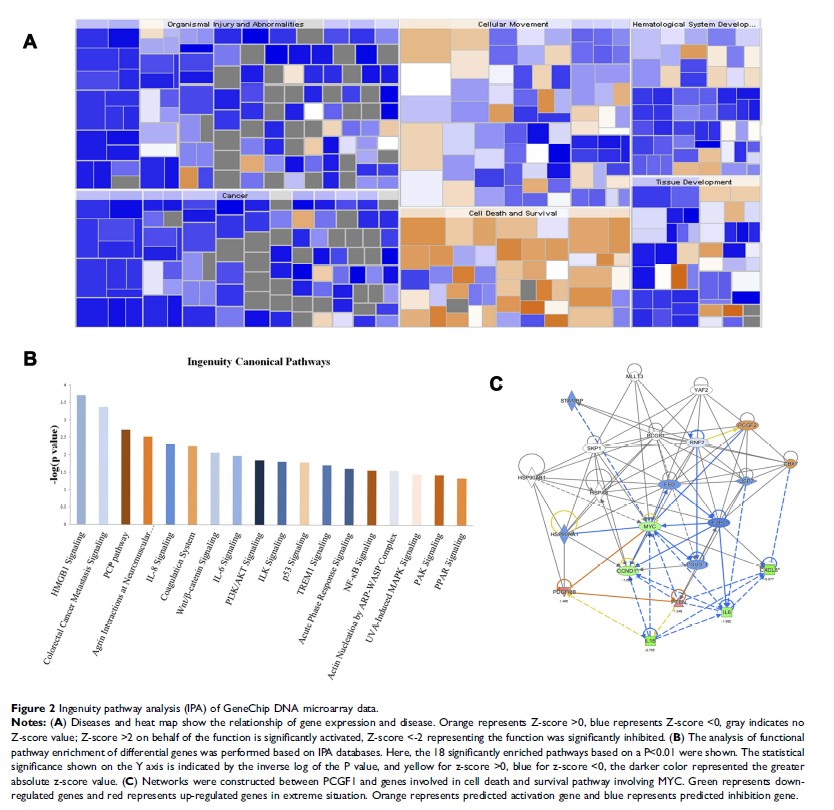
Results: We first found that knockdown of PCGF1 led to the inhibition of U87 cells proliferation and decreased colony formation ability. The data from GeneChip expression profiling and Ingenuity Pathway Analysis (IPA) indicated that many of the altered gene cells are associated with the cell proliferation control pathways. We have further confirmed the suppression of AKT/GSK3β/c-Myc/cyclinD1 expressions by Western blotting analysis. The over-expression of c-Myc could partly restore the attenuated proliferation ability caused by knockdown of PCGF1.
Conclusion: All the above evidences suggested that PCGF1 might be closely associated with tumorigenesis and progression of glioblastoma (GBM), in which process the oncoprotein c-Myc may participate. PCGF1 could thus be a potential therapeutic target for the treatment of glioblastoma (GBM).
Keywords: glioblastoma, GBM, PCGF1, cell proliferation, polycomb group