117333
论文已发表
注册即可获取德孚的最新动态
IF 收录期刊
- 3.6 Breast Cancer (Dove Med Press)
- 4.3 Clin Epidemiol
- 2.6 Cancer Manag Res
- 3.2 Infect Drug Resist
- 4.1 Clin Interv Aging
- 6.1 Drug Des Dev Ther
- 4.1 Int J Chronic Obstr
- 8.7 Int J Nanomed
- 2.5 Int J Women's Health
- 3.2 Neuropsych Dis Treat
- 2.4 OncoTargets Ther
- 2.6 Patient Prefer Adher
- 2.6 Ther Clin Risk Manag
- 3.1 J Pain Res
- 3.5 Diabet Metab Synd Ob
- 4.5 Psychol Res Behav Ma
- 3.4 Nat Sci Sleep
- 2.4 Pharmgenomics Pers Med
- 2.6 Risk Manag Healthc Policy
- 4.6 J Inflamm Res
- 2.3 Int J Gen Med
- 3.9 J Hepatocell Carcinoma
- 3.3 J Asthma Allergy
- 2.5 Clin Cosmet Investig Dermatol
- 3.0 J Multidiscip Healthc

miR-708 在宫颈癌中通过消极地靶向 Timeless 抑制细胞增殖并增加宫颈癌细胞对 cDDP 的化学敏感性
Authors Zou X, Zhu C, Zhang L, Zhang Y, Fu F, Chen Y, Zhou J
Received 13 August 2019
Accepted for publication 22 November 2019
Published 9 January 2020 Volume 2020:13 Pages 225—235
DOI https://doi.org/10.2147/OTT.S227015
Checked for plagiarism Yes
Review by Single-blind
Peer reviewer comments 3
Editor who approved publication: Dr Sanjay Singh
Purpose: Cervical cancer is the fourth most common cause of cancer-associated mortality in women worldwide. Previous studies have reported that microRNAs (miRNAs) are involved in multiple biological aspects of cancer progression by regulating gene expression. Here, we investigated the role of microRNA-708 (miR-708) in cervical cancer.
Methods: The expression levels of miR-708 in cervical cancer tissues and paired-normal cervical tissues were tested by quantitative polymerase chain reaction (qPCR). The interaction between miR-708 and Timeless was identified by bioinformatics method, dual-luciferase reporter assay, and Western blotting. The effects of over-expression of miR-708 on cell proliferation and cisplatin sensitivity were determined by Cell Counting Kit-8 (CCK-8) and colony formation assay. Cell cycle and apoptosis were analyzed by flow cytometry. DNA damage induced by over-expression of miR-708 was determined by comet assay. Expression levels of the genes involved in repair of DNA damage were analyzed by Western blotting.
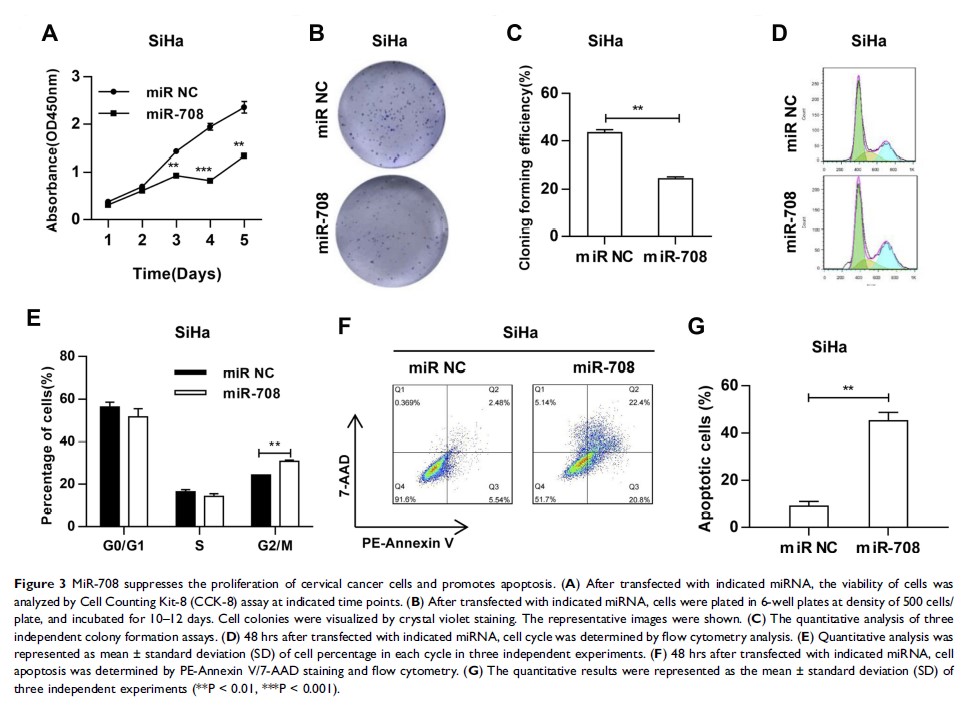
Results: MiR-708 was down-regulated in cervical cancer tissues compared with paired-normal cervical tissues. By bioinformatics method, Western blotting, and dual-luciferase reporter assay, we found that Timeless was a direct target of miR-708. Furthermore, miR-708 suppressed cellular viability, colony formation, promoted apoptosis, and induced DNA damage levels. MiR-708 also enhanced chemosensitivity of cervical cancer cells to cDDP via impairing the ATR/CHK1 signaling pathway.
Conclusion: We conclude that miR-708 suppresses cell proliferation, facilitates cisplatin efficacy, and impairs DNA repair pathway in cervical cancer cells. These results demonstrate that miR-708 might be a candidate therapeutic target for future cervical cancer therapy.
Keywords: cervical cancer, miR-708, Timeless, repair of DNA damage, chemotherapy