114900
论文已发表
注册即可获取德孚的最新动态
IF 收录期刊
- 3.4 Breast Cancer (Dove Med Press)
- 3.2 Clin Epidemiol
- 2.6 Cancer Manag Res
- 2.9 Infect Drug Resist
- 3.7 Clin Interv Aging
- 5.1 Drug Des Dev Ther
- 3.1 Int J Chronic Obstr
- 6.6 Int J Nanomed
- 2.6 Int J Women's Health
- 2.9 Neuropsych Dis Treat
- 2.8 OncoTargets Ther
- 2.0 Patient Prefer Adher
- 2.2 Ther Clin Risk Manag
- 2.5 J Pain Res
- 3.0 Diabet Metab Synd Ob
- 3.2 Psychol Res Behav Ma
- 3.4 Nat Sci Sleep
- 1.8 Pharmgenomics Pers Med
- 2.0 Risk Manag Healthc Policy
- 4.1 J Inflamm Res
- 2.0 Int J Gen Med
- 3.4 J Hepatocell Carcinoma
- 3.0 J Asthma Allergy
- 2.2 Clin Cosmet Investig Dermatol
- 2.4 J Multidiscip Healthc

机器学习预测中国患者急性前壁心肌梗死后的一年死亡率
Authors Li Y, Jiang L, He J, Jia K, Peng Y, Chen M
Received 29 October 2019
Accepted for publication 20 December 2019
Published 9 January 2020 Volume 2020:16 Pages 1—6
DOI https://doi.org/10.2147/TCRM.S236498
Checked for plagiarism Yes
Review by Single-blind
Peer reviewer comments 2
Editor who approved publication: Professor Deyun Wang
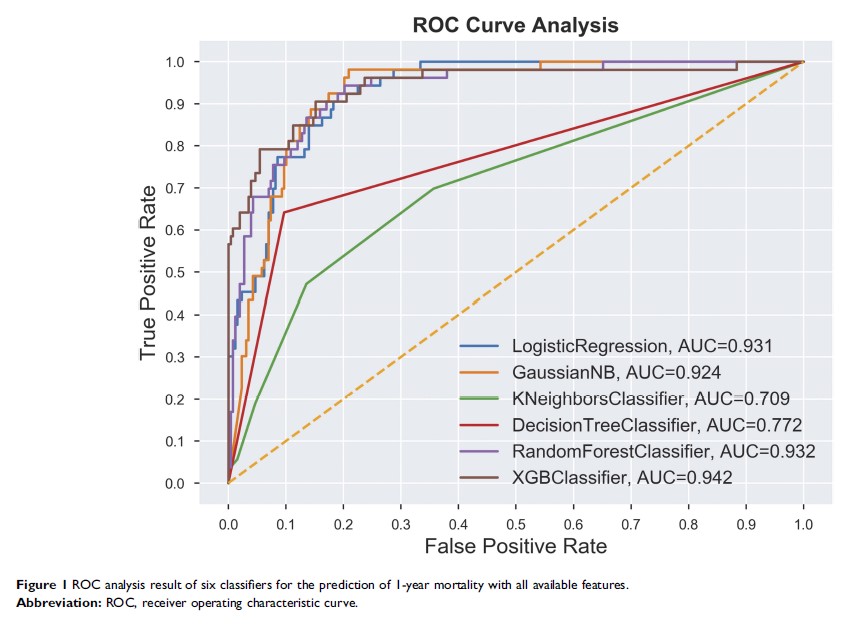
Abstract: A formal risk assessment for identifying high-risk patients is essential in clinical practice and promoted in guidelines for the management of anterior acute myocardial infarction. In this study, we sought to evaluate the performance of different machine learning models in predicting the 1-year mortality rate of anterior ST-segment elevation myocardial infarction (STEMI) patients and to compare the utility of these models to the conventional Global Registry of Acute Coronary Events (GRACE) risk scores. We enrolled all of the patients aged >18 years with discharge diagnoses of anterior STEMI in the Western China Hospital, Sichuan University, from January 2011 to January 2017. A total of 1244 patients were included in this study. The mean patient age was 63.8±12.9 years, and the proportion of males was 78.4%. The majority (75.18%) received revascularization therapy. In the prediction of the 1-year mortality rate, the areas under the curve (AUCs) of the receiver operating characteristic curves (ROCs) of the six models ranged from 0.709 to 0.942. Among all models, XGBoost achieved the highest accuracy (92%), specificity (99%) and f1 score (0.72) for predictions with the full variable model. After feature selection, XGBoost still obtained the highest accuracy (93%), specificity (99%) and f1 score (0.73). In conclusion, machine learning algorithms can accurately predict the rate of death after a 1-year follow-up of anterior STEMI, especially the XGBoost model.
Keywords: machine learning, prediction model, acute anterior myocardial infarction